




Speak with a licensed insurance agent

1-888-891-0229

What Does Aetna Cancer Policy Cover? Covered Cancers, Exclusions and Real Scenarios

Updated October 2026

Key Takeaway

The Aetna cancer policy pays one cash lump sum, from $5,000 to $75,000 in brochures we reviewed, when you are first diagnosed with a covered cancer after the 30-day waiting period. It covers invasive cancers and malignant melanoma, excludes other skin cancers and premalignant conditions, and pays again for a recurrence only with the optional recurrence benefit.

A cancer policy is only as good as what it actually pays for. Aetna’s individual cancer plan is simple on purpose: it pays one lump sum at diagnosis instead of a long list of treatment benefits. That makes the coverage question easier to answer, but the fine print still matters.

Below, we list what qualifies for the benefit, what does not, and how common situations would play out. For background on the company and ratings, start with our main guide to Aetna cancer insurance. Remember that this is a supplemental, limited-benefit policy. It pays you cash and does not replace health insurance.

Compare Aetna Cancer Insurance Plans

Speak with a licensed insurance agent

1-888-891-0229

CancerInsurance.org logo

How the Aetna Cancer Policy Pays

What does Aetna cancer policy cover compared with what it excludes

Aetna’s cancer coverage is underwritten by Continental Life Insurance Company of Brentwood, Tennessee, an Aetna company owned by CVS Health. Brochures we reviewed describe a Cancer and Heart Attack or Stroke plan and a Plus version sold in many states.

The core benefit is a lump sum equal to 100% of the amount you choose, from $5,000 to $75,000 in $5,000 steps, paid the first time a covered person is diagnosed with a covered cancer. No hospital stay is required. The money goes to you, and it is paid regardless of any other insurance you have.

Because the payment is not tied to a bill, there is no list of approved expenses. People commonly use it for a health plan deductible and coinsurance, travel and lodging near a cancer center, child care, groceries and rent, or to replace pay while they are out of work. The trade-off is that the amount is fixed. If treatment runs for many months, the policy does not send more money for each round of chemotherapy or each hospital day, the way a scheduled-benefit plan would.

Good to know: Everyone on the policy is covered for the same benefit amount. If you want a different amount for a spouse, ask the agent whether separate policies make more sense in your state.

Cancer Insurance Quotes

Call a Licensed Agent Now

Compare cancer insurance plans and cash benefits from several insurance companies in one call.

☎ 1-888-891-0229

No obligation to buy

Cancers the Aetna Policy Covers

The brochure lists these as covered when first diagnosed after the waiting period.

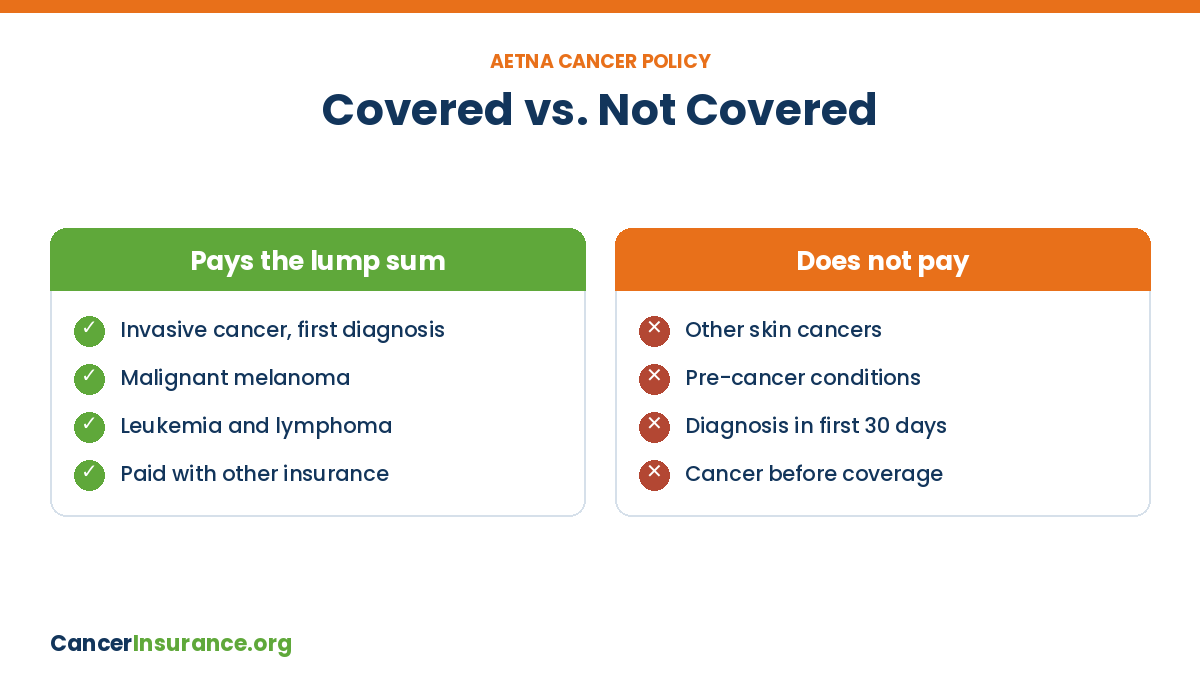
Blood cancers. Leukemia, lymphoma and Hodgkin’s disease.

Solid tumors. Carcinoma, sarcoma and other malignant tumors.

Malignant melanoma. The one skin cancer that qualifies for the lump sum.

Carcinoma in situ. Listed as covered in the brochure. Check your state’s outline for the percentage it pays.

A full rundown of benefit amounts and options is in our Aetna cancer policy benefits guide.

What the Aetna Cancer Policy Does Not Cover

The exclusions are short but important. A claim is denied in these situations.

1

Most skin cancers. Basal cell and squamous cell skin cancers and other skin cancers besides malignant melanoma do not qualify.

2

Pre-cancer. Premalignant conditions do not earn a benefit.

3

Cancer before coverage. A cancer diagnosed before your policy started is not covered.

4

The first 30 days. A diagnosis during the 30-day waiting period after the coverage start date is not covered.

5

A second initial diagnosis. The base policy pays one initial cancer benefit per covered person. Paying again requires the recurrence option.

General exclusions, such as self-inflicted injury, also apply. Agent materials we reviewed say applicants must not have had cancer in the past 10 years. If you have been diagnosed, see can I get cancer insurance after diagnosis.

Recurrence and Heart Attack or Stroke Coverage

What does Aetna cancer policy cover for recurrence by years since last diagnosis

Two add-ons widen what the Aetna policy covers. Both raise the premium, and both must be chosen when you enroll.

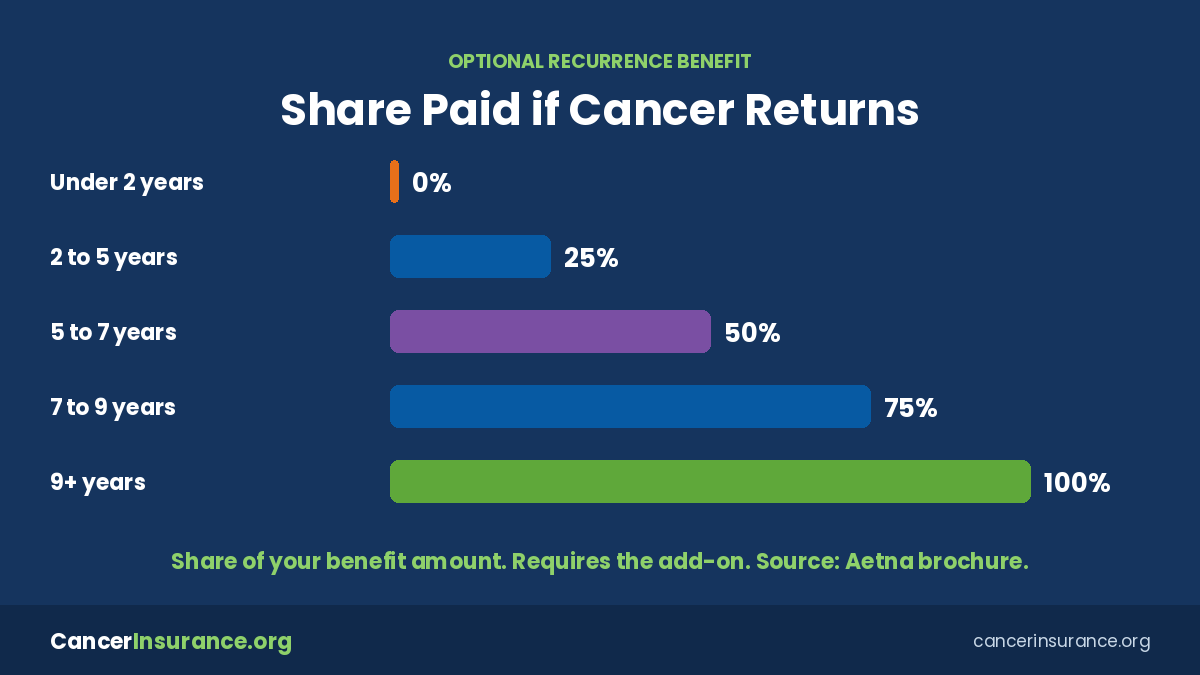
Recurrence benefit. Pays up to an additional 100% of your amount if cancer is diagnosed again. Nothing is paid within 2 years of the last diagnosis, then 25%, 50% and 75% as time passes, reaching 100% after 9 years.

Treatment-free rule. For a recurrence to pay, you must have had no treatment or medical advice for cancer for at least 2 years before the new diagnosis.

Heart attack or stroke. The Plus plan adds a lump sum for a first heart attack or stroke. It is not sold in every state.

Here is how the recurrence math works. Say you chose a $20,000 benefit with the recurrence option, were paid at diagnosis and then stayed treatment-free. If a new diagnosis comes six years later, it falls in the 5-to-7-year band and pays 50%, or $10,000. After nine or more years, it would pay the full $20,000 again. The add-on tends to be worth the most for younger buyers who plan to keep the policy for decades.

If you want a wider list of covered illnesses, compare this plan with a full critical illness policy in our guide to Aetna cancer vs. critical illness insurance.

Compare Aetna Cancer Insurance Plans

Speak with a licensed insurance agent

1-888-891-0229

CancerInsurance.org logo

Would the Aetna Policy Pay? Common Scenarios

These made-up examples assume a $20,000 benefit and the base policy, without the recurrence option.

ScenarioWould it pay?Why
Breast cancer found 6 months after coverage startsYes, $20,000First diagnosis of a covered cancer after the waiting period
Basal cell skin cancer removed at the dermatologistNoSkin cancers other than malignant melanoma are excluded
Melanoma diagnosed in year twoYes, $20,000Malignant melanoma is a covered cancer
Colon cancer found 20 days after coverage startsNoDiagnosed during the 30-day waiting period
Spouse diagnosed after you already claimedYes, $20,000Each covered person has their own initial benefit
Same person, new cancer 4 years laterNoBase policy pays one initial benefit per person

Hypothetical examples based on the Aetna brochure. The policy and your state’s outline of coverage decide every claim.

That last row is where the recurrence option changes the answer, as the next section shows.

Who Can Buy It and Policy Protections

Aetna’s wide age range fits working adults with employer or ACA Marketplace coverage, as well as people on Medicare.

Issue ages 18 to 89. Based on age at last birthday. Buying younger usually means a lower premium.

Family options. Cover yourself alone, with a spouse or partner, with children, or the whole family.

Guaranteed renewable. Coverage continues as long as you pay premiums on time.

30-day free look. Cancel within 30 days of receiving the policy for a full premium refund.

Aetna’s supplemental insurers carry an A (Excellent) AM Best rating in the 2026 reports we reviewed. The product is not sold in every state, so confirm availability with an agent. To see what the coverage costs, read our Aetna cancer insurance cost guide or our take on whether the Aetna cancer policy is worth it.

Bottom Line

The Aetna cancer policy covers the first diagnosis of invasive cancers and malignant melanoma with one lump sum of $5,000 to $75,000, paid to you after a 30-day waiting period. It excludes other skin cancers, pre-cancer and cancers found before coverage, and pays for a recurrence only with the add-on. Check your state’s outline, and keep your health insurance, since this policy supplements it.

Get Free Aetna Cancer Insurance Quotes

Speak with a licensed insurance agent

1-888-891-0229

CancerInsurance.org logo

What Does Aetna Cancer Policy Cover — Frequently Asked Questions

➤ What does the Aetna cancer policy cover?

It pays one lump sum, from $5,000 to $75,000 in brochures we reviewed, the first time a covered person is diagnosed with a covered cancer such as leukemia, lymphoma, carcinoma, sarcoma or malignant melanoma.

➤ What does the Aetna cancer policy not cover?

Skin cancers other than malignant melanoma, premalignant conditions, cancers diagnosed before coverage starts and diagnoses in the 30-day waiting period are excluded.

➤ Does the Aetna cancer policy cover carcinoma in situ?

The brochure lists carcinoma in situ as covered. The share of your benefit it pays can vary, so check your state’s outline of coverage.

➤ Does Aetna pay if my cancer comes back?

Only if you added the recurrence benefit at enrollment. It pays a rising share of your amount, starting at 25% after 2 years and reaching 100% after 9 years, if you had no cancer treatment or advice for 2 years.

➤ Does each family member get a benefit?

Yes. On a family policy, each covered person can receive their own initial cancer benefit at the same benefit amount.

➤ Does the Aetna policy pay for chemotherapy or hospital days?

No. It pays one lump sum at diagnosis rather than per-treatment benefits. You can use that cash for chemotherapy costs, hospital bills or anything else.

➤ Who can buy Aetna cancer insurance?

Adults ages 18 to 89 can apply, alone or with a spouse or partner, children or the whole family. Availability varies by state.

➤ Does the Aetna cancer policy replace health insurance?

No. It is a limited-benefit supplemental policy. You still need employer, Marketplace, Medicare or other major medical coverage for your treatment.

Cancer Insurance Quotes

Call a Licensed Agent Now

Compare cancer insurance plans and cash benefits from several insurance companies in one call.

☎ 1-888-891-0229

No obligation to buy

Ready to Compare? Get Free Cancer Insurance Quotes

Speak with a licensed insurance agent

1-888-891-0229

CancerInsurance.org logo

ZRN Health & Financial Services, LLC, a Texas limited liability company