




Speak with a licensed insurance agent

1-888-891-0229

Cancer Insurance Return of Premium: How the Refund Really Works

Updated November 2026

Key Takeaway

Cancer insurance return of premium is an optional rider, or in some policies a built-in feature, that refunds the premiums you paid after you keep the coverage for a set period, usually minus any claims the insurer already paid. It costs extra, and if you drop the policy or it lapses before the rider matures, the refund can shrink or disappear.

2027 by the Numbers

20 years

in force for Aflac’s full ROP refund (Aflac rider summary)

Year 5

when Aflac’s ROP cash value starts to build

Age 75

Washington National pays the return at the rider anniversary nearest 75 if sooner

100%

of premiums minus claims, Washington National critical illness ROP rider

Most people who buy a cancer policy never file a claim on it, and that is exactly the worry a return of premium rider is built to answer. Pay a higher premium now, keep the policy long enough, and the insurer sends back much of what you paid. The catch sits in the rider’s math and its exit rules.

This page goes deep on that one feature. If you want a tour of every add-on a cancer policy can carry, start with our guide to cancer insurance policy riders. Here we cover how the refund is figured, what carriers’ own filed documents say, and who tends to get real value from it.

Compare Cancer Policies With ROP

Speak with a licensed insurance agent

1-888-891-0229

CancerInsurance.org logo

What a Return of Premium Rider Promises

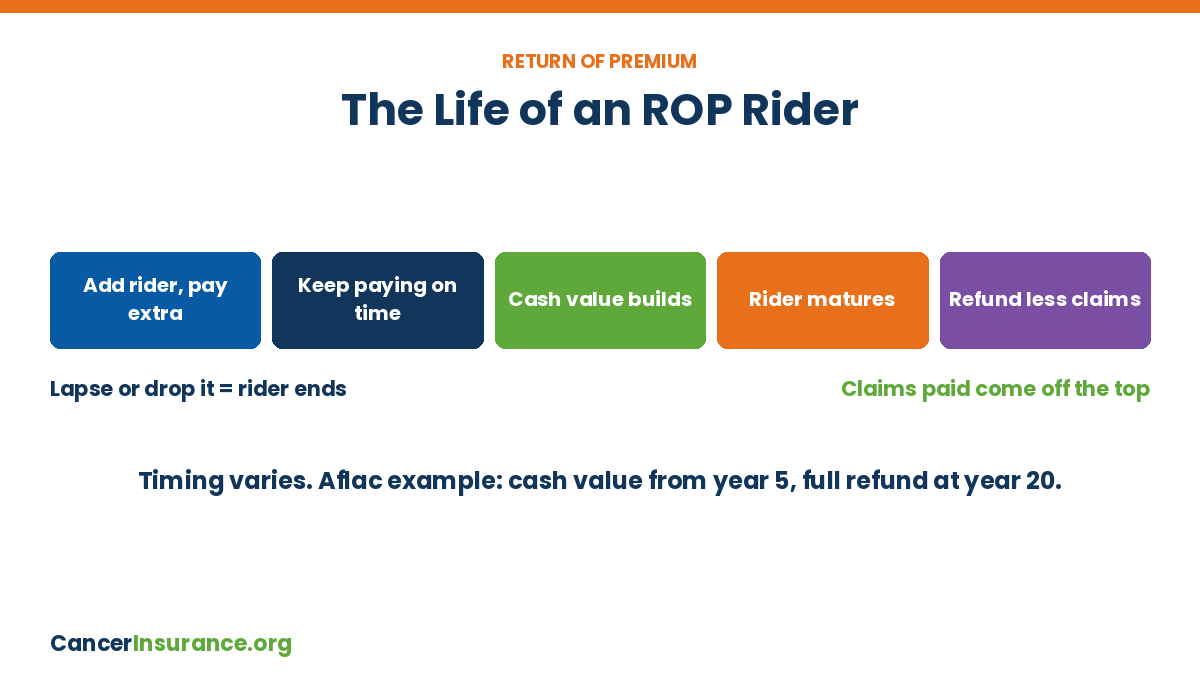
Cancer insurance return of premium rider life cycle from purchase to refund less claims

A return of premium (ROP) rider turns part of your cancer premium into a kind of forced savings. In exchange for an added charge, the insurer agrees to pay back premiums at a future date if the policy and rider stay in force that whole time. Washington National describes its version, called Premium-Return, as an optional rider with an additional charge. In Missouri the same idea is labeled a cash return.

Rider style. You choose to add it and pay more for it. Aflac and Washington National both file ROP as an optional rider.

Built-in style. The refund is part of the base policy. Mutual of Omaha lists a return of premium benefit on death inside the base benefit of its Critical Advantage critical illness policy.

Living refund vs. death refund. Some versions pay you at a set anniversary. Others pay only if you die, so the refund goes to your beneficiary.

None of this changes what the policy is. Cancer insurance is a supplemental, limited-benefit policy that pays cash on top of your health plan. It does not replace health insurance, and an ROP rider does not make it a savings account or an investment.

Cancer Insurance Quotes

Call a Licensed Agent Now

Compare cancer insurance plans and cash benefits from several insurance companies in one call.

☎ 1-888-891-0229

No obligation to buy

How the Refund Is Calculated

Every ROP rider we reviewed follows the same basic formula, even though the timing and percentages differ. Work through it in this order before you agree to the extra cost.

1

Add up what counts as premium. Aflac’s rider summary bases the value on annualized premium for the policy, the rider and other attached benefit riders. If the rider is added after the policy starts, only premium paid after the rider’s effective date counts.

2

Apply the return percentage. Short of the full period, a rider may pay only a share of premiums. Aflac says its percentages are available on request rather than printed on the summary page.

3

Subtract claims already paid. Aflac states that all ROP benefits and cash values are paid less any claims paid. Washington National says its return is paid regardless of claims or minus claims, depending on the product.

4

Check the payout date. Washington National pays at the end of the set period, or at the rider anniversary closest to age 75 if that comes first.

Here is the math in plain terms, using made-up round numbers only to show the formula. If you paid $9,000 in total premiums over the full period and the policy paid $4,000 in cancer claims, a less-claims rider would return $5,000. If claims had reached $9,000 or more, the refund would be zero. Aflac’s rider even ends on its own once paid claims equal or exceed the cash value due at the 20th anniversary.

Return of Premium Terms by Carrier

No single source lines these terms up, so we pulled them from each insurer’s own rider summary, product page, brochure or press release. Treat it as a starting point and ask for the rider form filed in your state.

Carrier and productROP typeWhen it paysClaims deducted?
Aflac, optional ROP rider (cancer policy series A-75000 and A-76000)Optional riderFull refund after 20 years in force; cash value from year 5Yes, less any claims paid
Washington National, Premium-Return (supplemental health, including cancer)Optional rider, extra chargeEnd of set period, or anniversary nearest age 75Depends on the product
Washington National, Critical Illness (2023 launch)Optional ROP/cash value riderEnd of the rider periodYes, 100% of premiums minus claims
Mutual of Omaha, Critical Advantage critical illnessBuilt into base benefitOn deathNot stated in brochure
Mutual of Omaha, Critical Advantage cancerNo ROP listedCash value rider offered insteadNot applicable
USAble Life, CancerCare Elite (2026 brochure)No ROP listedNot offered in listed ridersNot applicable

Sources: Aflac rider summary pages A76079L and A75076LVA; washingtonnational.com Premium-Return page; Washington National press release, Oct. 23, 2023; Mutual of Omaha Critical Advantage California client brochure; USAble Life CancerCare Elite brochure. Availability and terms vary by state and form. The policy and rider always control.

Family Heritage, a Globe Life division, is also widely known for cancer coverage with a return of premium feature. Its terms vary by policy, so see our Family Heritage cancer insurance review and ask for the outline of coverage. For Washington National’s base cancer benefits, see our Washington National cancer insurance page.

What Ends the Rider Before It Pays

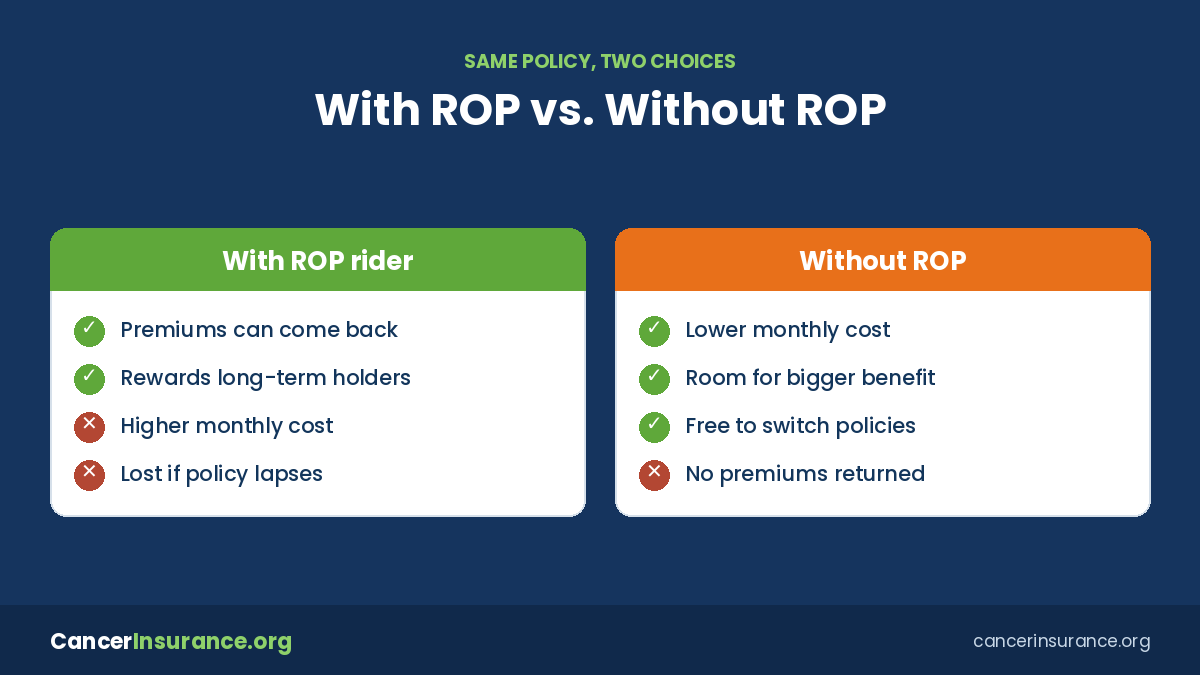
Cancer insurance with return of premium compared with the same policy without it

The refund is only as good as your staying power. Washington National’s footnote is blunt: the policy must remain in force until the end of the ROP or cash value period for the benefit to be paid. Aflac’s rider summary lists the same kinds of exits.

Missed premiums. Aflac’s rider terminates if its premium is not paid, subject to the policy’s grace period.

Dropping the base policy. If the cancer policy ends, the rider ends with it.

Death before maturity. Aflac’s rider terminates if you die before its 20th anniversary. Its summary does not describe a separate death refund.

Claims catching up. Once paid claims equal or exceed the value due, there is nothing left to return.

Fine-print alert: Aflac allows the rider to be cashed in for its cash value between the 5th and 20th anniversaries. If that surrender happens after a cancer diagnosis but before claims are filed, later claim payments are reduced by the cash value already paid out.

Compare Cancer Policies With ROP

Speak with a licensed insurance agent

1-888-891-0229

CancerInsurance.org logo

Is the Extra Cost Worth It?

No carrier document we reviewed printed a fixed price for its ROP rider, because the charge depends on your age, benefit level, state and policy. What is certain is the direction: you pay more each month than you would for the same cancer benefit without the refund.

Think of it as a trade between two uses of the same dollars. The extra premium could instead buy a bigger diagnosis benefit, or stay in your own savings where you can reach it at any time. With ROP, the money is locked up until the rider matures, and you get it back in full only if you keep paying, stay alive to the payout date in a living-benefit design, and file few or no claims.

Worth knowing: Ask whether the quote shows the base premium and the rider charge as separate lines. That is the only way to see what the refund feature itself costs and compare it with simply raising the cancer benefit amount.

Taxes can matter too. A refund of premiums you paid with after-tax dollars is generally treated differently than one tied to pre-tax payroll deductions. Rules depend on how you paid, so check with a tax professional before counting on the full amount.

Who a Return of Premium Rider Fits

ROP works best for a narrow kind of buyer. Use this side-by-side to see which column sounds more like you.

Often a fitOften a poor fit
You are buying young and plan to hold the policy 20 years or moreYou expect to switch jobs, policies or carriers within a few years
The higher premium fits your budget for the long haulPaying the extra would force a smaller cancer benefit
You dislike paying for coverage you may never useYou want the most cancer benefit per dollar today
You buy an individual policy you can keep anywhereYour coverage is a workplace plan that may not travel with you

If you are not sure, ask for two quotes on the same base policy, one with ROP and one without. Then compare both against other cancer insurance plans and our list of cancer insurance providers so the refund feature does not steer you toward a weaker policy.

Bottom Line

A cancer insurance return of premium rider can hand back much of what you paid, but only if the policy stays in force to the payout date, and most versions subtract claims first. Treat it as an optional extra on top of a supplemental cancer policy that never replaces health insurance, and buy it only if you can keep paying the higher premium for the full term.

Get Quotes With and Without ROP

Speak with a licensed insurance agent

1-888-891-0229

CancerInsurance.org logo

Cancer Insurance Return of Premium — Frequently Asked Questions

➤ Do I get all my premiums back if I never get cancer?

With some riders, yes, if the policy and rider stay in force for the full period. Aflac’s rider summary, for example, ties the maximum refund to 20 consecutive years in force. Other riders pay a percentage, so read the schedule.

➤ Will filing a cancer claim lower my refund?

Usually. Aflac pays its ROP benefits less any claims paid, and Washington National’s critical illness rider returns premiums minus claims. Washington National notes some products pay regardless of claims, so confirm which type you have.

➤ What happens to the ROP rider if I die?

It depends on the design. Aflac’s rider ends if you die before its 20th anniversary, while Mutual of Omaha’s Critical Advantage critical illness policy includes a return of premium benefit on death in its base benefit.

➤ Can I cash out a return of premium rider early?

Some riders allow it. Aflac lets you surrender the rider for its cash value between the 5th and 20th anniversaries, which ends the rider and can reduce later claim payments if you were already diagnosed.

➤ Can I add return of premium to a policy I already own?

Some carriers allow it. Under Aflac’s rider summary, only premium paid after the rider’s effective date counts toward the refund, so adding it late shrinks the payback.

➤ Is the refund paid at a certain age?

Some riders use an age trigger. Washington National pays its Premium-Return at the end of the set period, or at the rider anniversary closest to age 75 if that comes first.

➤ Does every cancer policy offer return of premium?

No. Mutual of Omaha’s Critical Advantage cancer policy lists a cash value rider rather than ROP, and USAble Life’s 2026 CancerCare Elite brochure lists no ROP rider at all.

➤ Does a return of premium rider make cancer insurance a replacement for health insurance?

No. The rider only changes what happens to your premiums. The policy is still supplemental, limited-benefit coverage that pays alongside your health plan, not in place of it.

Cancer Insurance Quotes

Call a Licensed Agent Now

Compare cancer insurance plans and cash benefits from several insurance companies in one call.

☎ 1-888-891-0229

No obligation to buy

Ready to Compare? Get Free Cancer Insurance Quotes

Speak with a licensed insurance agent

1-888-891-0229

CancerInsurance.org logo

ZRN Health & Financial Services, LLC, a Texas limited liability company