




Speak with a licensed insurance agent

1-888-891-0229

Accident and Critical Illness Insurance: What Each Pays, Where They Overlap and When to Buy Both

Updated November 2026

Key Takeaway

Accident and critical illness insurance are two separate supplemental policies, often sold together at work: accident insurance pays set cash amounts for injuries such as fractures, ER visits and hospital stays, while critical illness insurance pays a lump sum when you are diagnosed with a listed condition such as cancer, heart attack or stroke. Only critical illness coverage pays for cancer, and neither replaces health insurance.

2027 by the Numbers

$3.06

monthly employee cost of one state employer’s Securian low accident plan, same at every age (State of Delaware FY26 rates)

$2.06-$23.08

monthly cost of $15,000 Securian critical illness coverage by age band, non-nicotine (State of Delaware FY26 rates)

$8,700

2027 self-only out-of-pocket maximum for an HSA-qualified high-deductible plan (IRS Rev. Proc. 2026-24)

Benefits enrollment menus often put accident and critical illness side by side, and sometimes under one heading. They are two different products with two different claim triggers. One responds to something that happens to your body from the outside, such as a fall or a car crash. The other responds to a doctor’s diagnosis of a serious disease.

This page compares the two using rate sheets and plan summaries employers have posted for real groups. Both are supplemental, limited-benefit insurance: they pay cash to you on top of a medical plan and do not count as health coverage. For a full look at the illness side, see our guide to critical illness insurance.

Compare Accident and Critical Illness Options

Speak with a licensed insurance agent

1-888-891-0229

CancerInsurance.org logo

Injury Claims vs. Diagnosis Claims: The Basic Split

Accident and critical illness insurance compared: injury-based cash payments versus lump sums for a covered diagnosis

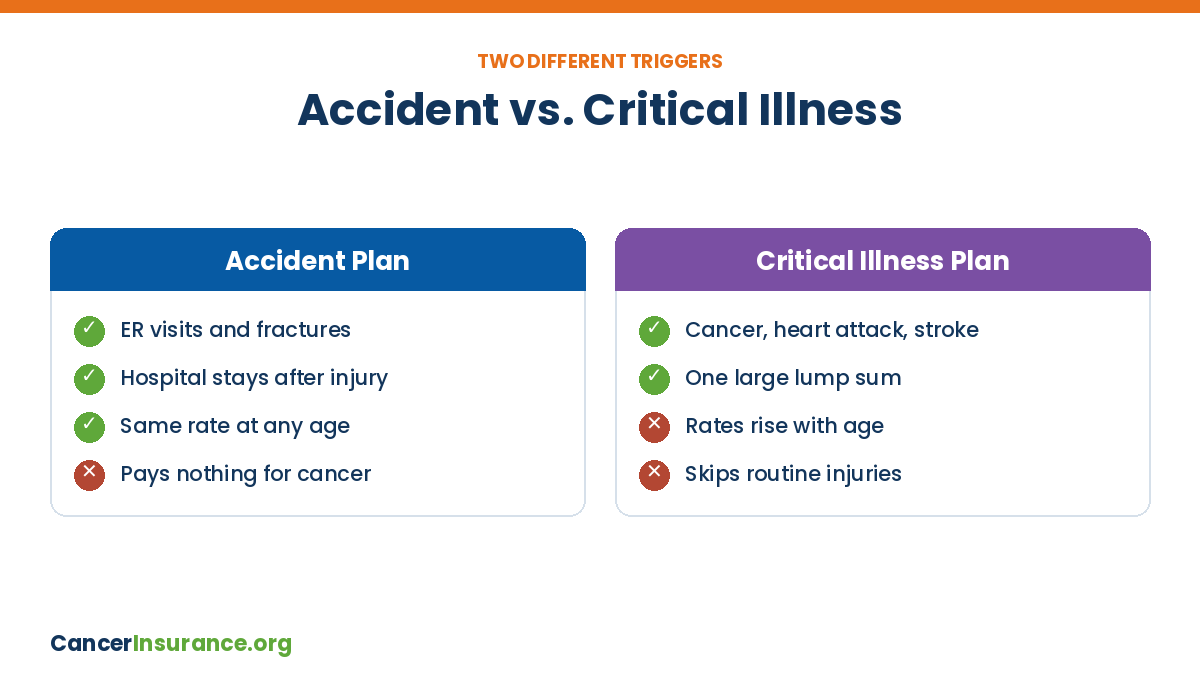
Accident insurance works like a price list. Each covered injury or treatment has a fixed dollar amount, such as a set payment for an emergency room visit, another for a fracture and another for each day in the hospital. Critical illness insurance works like one large check. If a covered condition is diagnosed after your coverage starts, the plan pays a percentage of the benefit amount you chose.

Accident pays per event. Payments follow the injury and the care: ambulance, ER, X-ray, fracture, dislocation, surgery, hospital days. Disease and sickness are excluded in the plans reviewed.

Critical illness pays per diagnosis. Payments follow a named condition, such as invasive cancer, heart attack, stroke or kidney failure. How you were treated does not change the amount.

Both pay you directly. The cash can go toward a deductible, rent, travel or lost pay.

Cancer Insurance Quotes

Call a Licensed Agent Now

Compare cancer insurance plans and cash benefits from several insurance companies in one call.

☎ 1-888-891-0229

No obligation to buy

Four Posted Plans Compared Line by Line

The table below pulls actual figures from two accident plans and two critical illness plans that public employers have posted for their workers. Each column is one employer’s design, not every plan that carrier sells.

FeatureSecurian accident (State of Delaware)Lincoln accident (Johns Hopkins)Securian critical illness (State of Delaware)Lincoln critical illness (San Diego County)
What triggers a paymentCovered injury, 24-hour coverageCovered injury off the jobDiagnosis of a listed conditionDiagnosis of a listed condition
Sample amountsER $65 or $125; non-surgical fracture up to $2,000 or $4,000ER $150 or $200; hip fracture $1,500 or $3,000$15,000 or $30,000 lump sum$10,000 to $40,000 lump sum
CancerNot covered (illness excluded)Not covered (disease excluded)Full benefit 100%; partial benefit 25%Invasive 100%; in situ 30%; skin cancer $750 lifetime
How the premium is setFlat by coverage tierFlat by tier; does not change with ageAge band and nicotine useAttained-age bands
Wellness or screening benefit$50 per covered person a year$50 a year$50 per insured a year$100 a year

From State of Delaware Securian accident and critical illness summaries and FY26 rate sheet, the Johns Hopkins Lincoln accident summary and the San Diego County Lincoln critical illness summary. Your employer’s plan and state rules may differ; the certificate controls.

What the columns show: Accident plans pay small, frequent amounts and ignore illness. Critical illness plans pay larger, rarer amounts priced by age. Off-the-job accident plans also exclude work injuries, which workers’ compensation is meant to handle.

Where the Two Overlap and Where Neither Pays

The line between the two is not perfectly clean. Some critical illness plans list injury results as conditions, and some events fall outside both.

A shared zone. The Lincoln critical illness plan above pays 100% for severe burns, permanent paralysis and traumatic brain injury including coma. A crash causing one of these could trigger accident benefits and a critical illness payment, if both plans list the loss.

Cancer is one-sided. Both accident plans exclude disease, so a cancer diagnosis pays nothing there. Cancer is usually the core condition on a critical illness list, often with a smaller payment for early or in situ cancer.

Common injuries are one-sided too. A broken wrist or a sprain is an accident claim. Critical illness plans pay only for the severe losses they name, not routine injuries.

Gaps in both. An illness not on the list, such as a chronic back condition, and an injury from an excluded activity, such as racing or intoxicated driving in the plans reviewed, pay nothing from either policy.

If cancer is the main concern, a cancer-only policy is a third option. Our page on cancer insurance versus critical illness insurance explains how those two differ.

Why Accident Rates Stay Flat While Critical Illness Rates Climb

Accident and critical illness insurance monthly rates by age from one State of Delaware Securian rate sheet

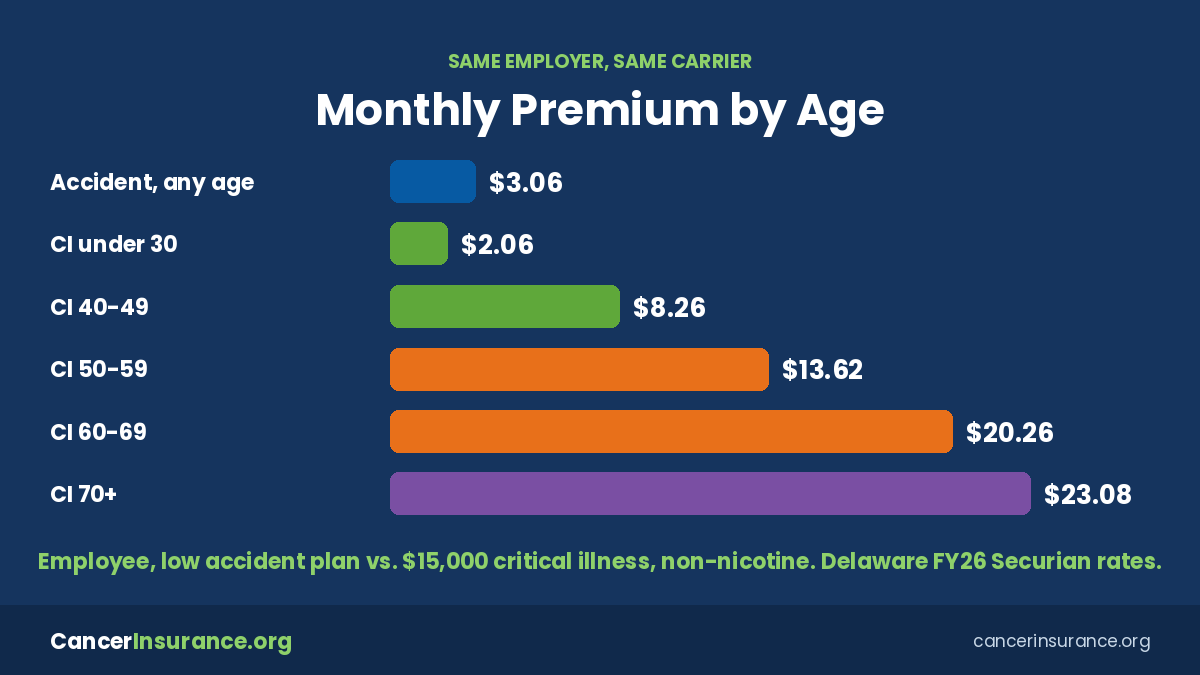
The same employer, the same carrier and the same plan year show the pricing gap clearly. In the State of Delaware’s FY26 rates, the Securian low accident plan costs an employee $3.06 a month at any age. The $15,000 Securian critical illness benefit costs a non-nicotine employee $2.06 a month under 30, $8.26 in their 40s and $20.26 in their 60s. Nicotine users in their 60s pay $41.48.

Carriers price critical illness by age because the risk of cancer, heart attack and stroke rises as people get older. The accident plans reviewed price by family tier instead. For younger workers the two can cost about the same. After 50, critical illness is usually the larger line on the paycheck. Our guide to critical illness insurance cost covers the other price factors.

Rate sheet check: Look for the words attained age or issue age on a critical illness rate sheet. Attained-age plans move you into a higher band as you age. The Delaware plan also cuts employee and spouse coverage to 50% at age 70.

Compare Accident and Critical Illness Options

Speak with a licensed insurance agent

1-888-891-0229

CancerInsurance.org logo

When People Carry Both Policies

Pairing the two fits best when a large deductible is the main exposure: one policy answers injuries, the other serious illness.

High-deductible plans. For 2027, an HSA-qualified plan can have an out-of-pocket maximum of up to $8,700 self-only or $17,400 family under IRS Rev. Proc. 2026-24. Federal HSA rules list coverage for accidents and for a specified disease or illness as permitted insurance, but confirm any wellness or extra benefits with your HSA administrator.

ACA Marketplace plans. Federal rules at 45 CFR 148.220 treat accident-only coverage and specified-disease coverage as excepted benefits. That means neither counts as a health plan, and neither can stand in for one.

Medicare-age buyers. Original Medicare Part B generally leaves you 20% of approved costs. Cash from either policy can help, but some group plans cut benefits at older ages, and individual policies set their own issue-age limits.

Households with children. In the Johns Hopkins accident plan, one child tier covers all children for one price. Delaware’s critical illness plan also covers all eligible children for one premium.

Taxes and a Checklist Before You Enroll

How you pay changes how the benefit is taxed. Carrier and benefits-law guidance, citing IRS Chief Counsel Memorandum 201703013 on fixed indemnity coverage, says benefits from policies paid with pre-tax payroll dollars or by the employer can be taxable income, while benefits from policies paid with after-tax dollars are generally not taxable. Check with a tax advisor. See whether cancer insurance payouts are taxable for the same rule applied to cancer policies.

1

List your biggest exposure. Note your medical plan’s deductible and out-of-pocket maximum, the amount the cash is meant to backfill.

2

Check the hours of the accident plan. Off-the-job plans skip work injuries; 24-hour plans include them.

3

Read the critical illness condition list. Note the cancer percentages, any injury-type conditions and the recurrence rules.

4

Compare the two rates at your age. Use the rate sheet, including the nicotine rate if it applies.

5

Confirm the enrollment window. Delaware’s critical illness plan allows enrollment only within 30 days of eligibility, at open enrollment or after a qualified status change.

Shopping outside work? Our cancer insurance providers page lists carriers that sell individual coverage.

Bottom Line

Accident insurance pays small, fixed amounts for injuries and is usually priced the same at every age; critical illness insurance pays a larger lump sum for diagnoses like cancer and gets more expensive as you get older. Many people with high deductibles carry both, but each is supplemental cash on top of health insurance, never a replacement for it.

Get Free Supplemental Coverage Quotes

Speak with a licensed insurance agent

1-888-891-0229

CancerInsurance.org logo

Accident and Critical Illness Insurance — Frequently Asked Questions

➤ Is accident and critical illness insurance one policy or two?

Usually two. Employers often group them on one enrollment page, but each has its own certificate, premium and claim form.

➤ Does accident insurance pay if I am diagnosed with cancer?

No. The accident plans reviewed exclude disease and sickness. Cancer is covered under critical illness or a cancer-only policy.

➤ Can one event pay from both policies?

It can, if a crash causes a loss such as permanent paralysis or coma that the critical illness plan lists.

➤ Which costs more?

It depends on your age. In one state employer’s Securian rates, the low accident plan was $3.06 a month at any age, while $15,000 of critical illness coverage ran from $2.06 under 30 to $23.08 at 70 and older for non-nicotine employees.

➤ Does an off-the-job accident plan cover injuries at work?

No. Off-the-job plans exclude injuries from work for pay, which workers’ compensation generally covers. A 24-hour plan covers injuries on and off the job.

➤ Can I keep my HSA if I buy these policies?

Generally yes. Federal HSA rules list accident coverage and insurance for a specified disease or illness as permitted coverage alongside a qualifying high-deductible plan. Confirm any added benefits with your HSA administrator.

➤ Are the benefit payments taxable?

They can be if premiums were paid pre-tax or by your employer. Benefits from policies paid with after-tax dollars are generally not taxable, so check how your payroll deduction is set up.

➤ Do accident or critical illness policies replace health insurance?

No. Both are supplemental, limited-benefit coverage that pays you cash. You still need a medical plan through work, the ACA Marketplace or Medicare.

Cancer Insurance Quotes

Call a Licensed Agent Now

Compare cancer insurance plans and cash benefits from several insurance companies in one call.

☎ 1-888-891-0229

No obligation to buy

Ready to Compare? Get Free Cancer Insurance Quotes

Speak with a licensed insurance agent

1-888-891-0229

CancerInsurance.org logo

ZRN Health & Financial Services, LLC, a Texas limited liability company