


Speak with a licensed insurance agent

1-888-891-0229

Child Critical Illness Insurance: How Kids Are Covered on a Parent's Plan

Updated November 2026

Key Takeaway

Child critical illness insurance in the U.S. is usually a dependent tier on a parent’s workplace critical illness plan that pays a lump sum, often 25% to 100% of the parent’s benefit, if a covered child is diagnosed with a listed illness, typically up to age 26. Many group plans add children at no extra premium, but the parent must enroll, and the cash does not replace health insurance.

2027 by the Numbers

Age 26

when child coverage ends in most carrier plan documents reviewed

25%-100%

child share of the parent’s benefit across seven carrier plans reviewed

14

childhood conditions listed in one 2026 MetLife plan summary

Most parents first meet child critical illness insurance as a line on an open enrollment screen, Employee + Child(ren) or Family, next to the critical illness plan. Picking it means a covered child can trigger a cash payment for a serious diagnosis, and many plans also list conditions seen only in children.

This page explains how that coverage works in the U.S., using benefit summaries employers have posted. New to the product? Start with our guide to critical illness insurance. Every plan below is supplemental, limited-benefit insurance: it pays a set amount of cash and does not replace a child’s medical coverage through a health plan, CHIP or Medicaid.
Compare Critical Illness Plans for Families

Speak with a licensed insurance agent

1-888-891-0229

CancerInsurance.org logo

What Child Coverage on a Critical Illness Plan Actually Is

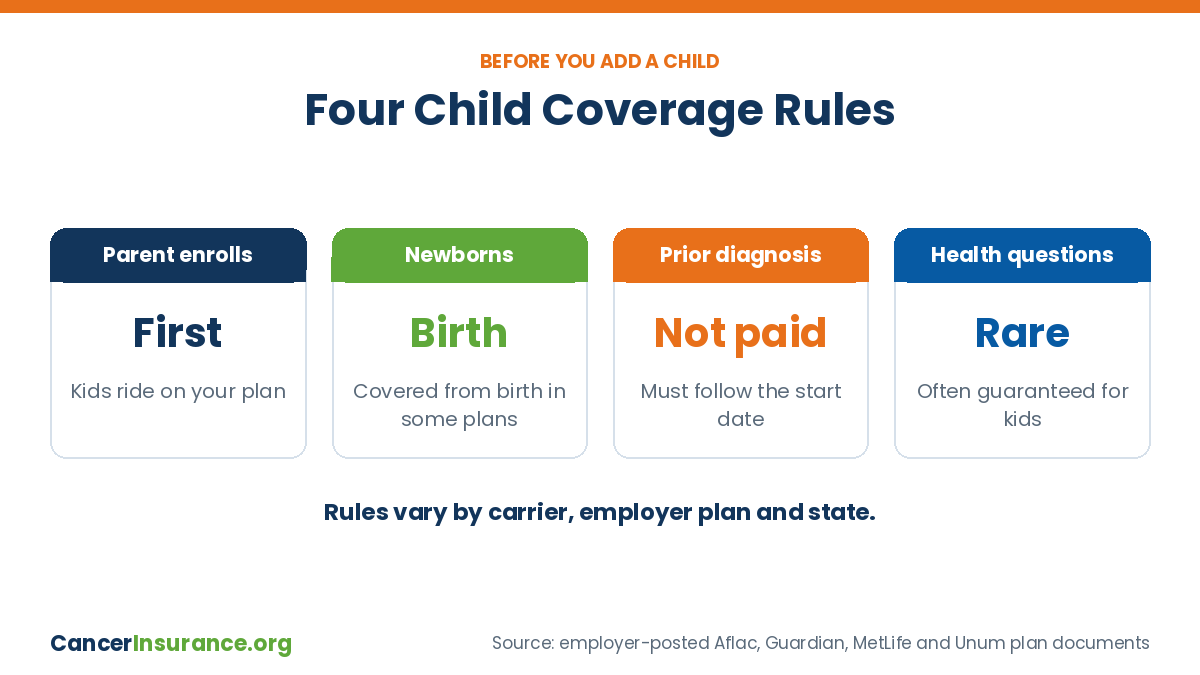
Child critical illness insurance basics: parent enrolls first, newborn coverage, diagnosis timing and health questions

A workplace critical illness plan pays a lump sum when a covered person is diagnosed with a listed condition, such as cancer, a heart attack or a stroke. Children are added as dependents under the parent’s certificate. Their benefit is usually a share of the parent’s amount, and the cash can be spent on anything.

Kids are rarely covered on their own. The Aflac group brochure for District of Columbia government workers says children-only coverage is not available, and Guardian’s City of Gainesville plan says the employee must enroll to cover family members.

Worth knowing: Child coverage is cash paid on a diagnosis. It does not pay doctors or hospitals and does not count as health coverage. Some states require the insured to have medical coverage, as MetLife plan summaries note.

Cancer Insurance Quotes

Call a Licensed Agent Now

Compare cancer insurance plans and cash benefits from several insurance companies in one call.

☎ 1-888-891-0229

No obligation to buy

Child Benefits in Seven Carrier Plan Documents

No carrier publishes a side-by-side view of child rules, so the table pulls them from one posted plan per carrier. Each row is one employer’s design; the same carrier can sell a different design elsewhere, as the two Colonial Life summaries reviewed show.

Carrier (employer plan)Child benefitChild age limitChild premiumChildhood conditions listed
Aflac / Continental American (D.C. government)50% of the primary insured’s amountUnder 26; newborns covered from birthNo additional chargeCystic fibrosis, cerebral palsy, cleft lip or palate, Down syndrome, PKU, spina bifida, type 1 diabetes at 50%; autism $3,000 one time
Allstate Benefits / American Heritage Life (Missouri State University)50% of the basic benefitEnds at 26 (age 30 for certain Illinois veterans)Separate Employee + Children and Family rate tiersNone listed separately
Colonial Life (Cameron County, Texas)50% of the employee amount; 25% in another Colonial summaryNot stated in the summaries reviewedNo additional costCerebral palsy, cleft lip or palate, cystic fibrosis, Down syndrome, spina bifida at 100%
Guardian (City of Gainesville)25% of the employee’s lump sumBirth to 26Included with employee electionEight, including clubfoot and muscular dystrophy, at 100%, first occurrence only
MetLife (Utah and Nevada university plans)50% of the employee’s initial benefitBirth to 26 in the Nevada plan; varies by stateNo additional charge in the Nevada planUp to 14, including congenital heart disease needing surgery, sickle cell anemia and Pompe disease
Unum (Caltech)100% of the employee amountThrough the end of the month the child turns 26No extra costEight, including congenital heart disease and sickle cell anemia
Voya / ReliaStar Life (Texas State University)50% of the employee benefitBirth through 26; no limit on number of childrenNo additional costTwelve, including congenital birth defects, infantile Tay-Sachs and Zellweger syndrome

From employer-posted benefit summaries and brochures. Your employer’s plan and state rules may differ; the certificate controls.

On a $20,000 parent election, those percentages mean $5,000 for a child under the Guardian design, $10,000 under the 50% designs and the full $20,000 under the Unum design. These are example math, not quotes.

Conditions Written Only for Children

Children are generally covered for the parent’s adult list, including cancer, heart attack and stroke. Many plans then add a childhood category for conditions usually found at birth or early in life. The lists are not standard.

Short lists. The Colonial Life plan in Cameron County adds five: cerebral palsy, cleft lip or palate, cystic fibrosis, Down syndrome and spina bifida.

Longer lists. A 2026 MetLife summary for Nevada public employees lists 14, including rare inherited diseases such as Niemann-Pick disease and Zellweger syndrome.

Autism is handled differently. Where autism spectrum disorder appears, it pays less. Aflac’s D.C. brochure pays a one-time $3,000; MetLife summaries reviewed pay 25% or 50%.

Paid once. Guardian’s Gainesville plan marks childhood conditions first occurrence only, and MetLife lists no recurrence benefit for them.

Diagnosis rules matter too. Aflac’s brochure requires a PKU test for PKU and an A1C or blood sugar test for type 1 diabetes. If one condition worries you, find it by name in the certificate before you enroll.

Newborns, Age 26 and the Diagnosed-Before-Coverage Rule

Number of childhood conditions listed in child critical illness insurance plan summaries by carrier

Three timing rules decide whether a child’s claim gets paid: when the child’s coverage starts, when the diagnosis happens and when the child ages out.

1

Coverage begins. The Aflac D.C. brochure covers newborns from the moment of birth, and the Unum Caltech summary covers children from live birth. Other plans may require you to add a new child within a set window.

2

The diagnosis must come after the start date. MetLife will not pay for a condition diagnosed before the coverage effective date, and Unum requires the diagnosis to occur after the child’s coverage starts. Adding a child after a diagnosis will not make it payable.

3

Health questions are rare for kids. Guardian’s Gainesville plan treats every child amount as guaranteed issue. MetLife guarantees dependent coverage if the employee is actively at work and the child is not under a listed medical restriction.

4

Coverage ends around 26. Most plans reviewed end child coverage at 26. Allstate’s summary allows exceptions, including age 30 for certain Illinois veterans.

Timing matters: Conditions present at birth are often diagnosed in the first days of life. A plan that covers newborns from birth may pay for them; a plan that adds a child later may not. Enrolling before a planned birth or adoption is the safer order.

Compare Critical Illness Plans for Families

Speak with a licensed insurance agent

1-888-891-0229

CancerInsurance.org logo

Can You Buy Critical Illness Insurance Only for Your Child?

Many top search results for this topic describe Canadian, U.K. or Australian products. Sun Life’s Canadian child policy, for example, refers to provincial health coverage and offers return-of-premium and long-term care conversion options, features built for another country’s system.

In the U.S., child coverage usually comes through a parent’s group plan, and none of the plans reviewed here offered a child-only option. Without a workplace plan, check whether an individual critical illness or cancer policy allows family coverage; terms vary by carrier and state. For cancer-only options, see cancer insurance for children and our list of cancer insurance plans.

Shopping note: A cancer policy pays only for cancer. A critical illness plan may also cover childhood conditions such as cystic fibrosis or type 1 diabetes, but only those named in the certificate. Compare the actual lists, not the product name.

Is Child Coverage Worth It Next to Health Insurance, CHIP or Medicaid?

Medical bills belong to health coverage. Children can usually stay on a parent’s health plan until 26, and Medicaid and CHIP offer free or low-cost coverage to children and teens up to age 19 in qualifying families, according to the federal Insure Kids Now program. A child critical illness benefit sits on top and pays cash.

Expense after a child’s serious diagnosisHealth plan, CHIP or MedicaidChild critical illness benefit
Doctor, hospital and prescription billsPays under plan rulesCash can help with deductibles and copays
Parent’s unpaid time off workNot coveredCash can be used for it
Travel, lodging and meals near a children’s hospitalGenerally not coveredCash can be used for it
Conditions not on the plan’s listCovered as medical careNothing paid

The critical illness benefit is a fixed lump sum for a listed diagnosis; it is not a reimbursement of bills.

Child coverage is easiest to justify when it is included at no extra premium, as in most plans reviewed. It is harder to justify when the plan charges a separate child tier and the family already has savings. Our guide on whether to enroll in critical illness insurance covers the parent’s side, and critical illness insurance cost explains pricing. Compare carriers on our cancer insurance providers page.

Bottom Line

In the U.S., child critical illness insurance is mostly a dependent option on a parent’s workplace plan, paying 25% to 100% of the parent’s benefit for listed illnesses, usually to age 26. Check the childhood condition list, the newborn rule and whether children cost extra, and treat it as supplemental cash, not a replacement for health coverage.

Get Free Family Critical Illness Quotes

Speak with a licensed insurance agent

1-888-891-0229

CancerInsurance.org logo

Child Critical Illness Insurance — Frequently Asked Questions

➤ Are my kids covered automatically when I join a workplace critical illness plan?

Not always. Some plans, such as the Unum design reviewed, cover eligible children automatically once you enroll, while others ask you to select an Employee + Child(ren) or Family tier at enrollment.

➤ How much would my child receive?

It is a share of your benefit set by the plan. The documents reviewed ranged from 25% in a Guardian plan to 100% in a Unum plan, with most at 50%.

➤ Which childhood conditions do these plans list?

Common ones include cerebral palsy, cleft lip or palate, cystic fibrosis, Down syndrome, spina bifida and type 1 diabetes. Some plans add sickle cell anemia or congenital heart disease, so check your certificate.

➤ Until what age can a child stay on my critical illness coverage?

Most plans reviewed end child coverage at 26. A few allow exceptions, such as Allstate’s age 30 rule for certain Illinois veterans.

➤ Can I buy a critical illness policy just for my child?

In the plans reviewed, no. Aflac’s D.C. brochure states children-only coverage is not available, and child coverage generally depends on a parent being enrolled.

➤ Will the plan pay if my child was diagnosed before I signed up?

Usually not. MetLife and Unum documents say the diagnosis must come after the child’s coverage effective date.

➤ Is child coverage still useful if my child has CHIP or Medicaid?

It can be. CHIP and Medicaid pay for medical care, while a critical illness benefit is cash a family can use for lost wages, travel or other costs.

➤ Does child critical illness insurance replace my child’s health insurance?

No. It is supplemental, limited-benefit coverage that pays a lump sum for listed diagnoses. Your child still needs a health plan, CHIP or Medicaid for medical bills.

Cancer Insurance Quotes

Call a Licensed Agent Now

Compare cancer insurance plans and cash benefits from several insurance companies in one call.

☎ 1-888-891-0229

No obligation to buy

Ready to Compare? Get Free Cancer Insurance Quotes

Speak with a licensed insurance agent

1-888-891-0229

CancerInsurance.org logo

ZRN Health & Financial Services, LLC, a Texas limited liability company