




Speak with a licensed insurance agent

1-888-891-0229

Is Critical Illness Insurance Taxable? How the Way You Paid Decides the Payout's Tax

Updated November 2026

Key Takeaway

A critical illness insurance payout is generally not taxable if you paid the premiums yourself with after-tax money, but it is generally taxable income if your employer paid the premiums or you paid them pre-tax through a Section 125 cafeteria plan. The benefit amount and the illness do not change the answer; the source of the premium dollars does.

2027 by the Numbers

IRC 104(a)(3)

tax code section that excludes health benefits bought with after-tax premiums (IRS)

CCA 201703013

2017 IRS Chief Counsel memo: pre-tax fixed-payment benefits are taxable when paid

CCA 202323006

2023 IRS Chief Counsel memo: pre-tax wellness payments count as wages

A lump sum after a heart attack, stroke or cancer diagnosis can arrive at the worst possible moment, and the last thing anyone wants is a surprise tax bill months later. Whether that check counts as income comes down to one question most people never think about at enrollment: were the premiums paid with money that was already taxed?

Many of the pages that show up for this question are written for Canada, the UK or the Philippines, where the rules are different. This page sticks to U.S. federal rules, explains how a workplace payroll deduction can change the answer, and shows how to check your own paperwork. If you are new to the product, our critical illness insurance guide covers how the coverage works. This is general information, not tax advice; a tax professional can apply it to your return.

Compare Critical Illness Coverage

Speak with a licensed insurance agent

1-888-891-0229

CancerInsurance.org logo

Follow the Premium Dollars, Not the Diagnosis

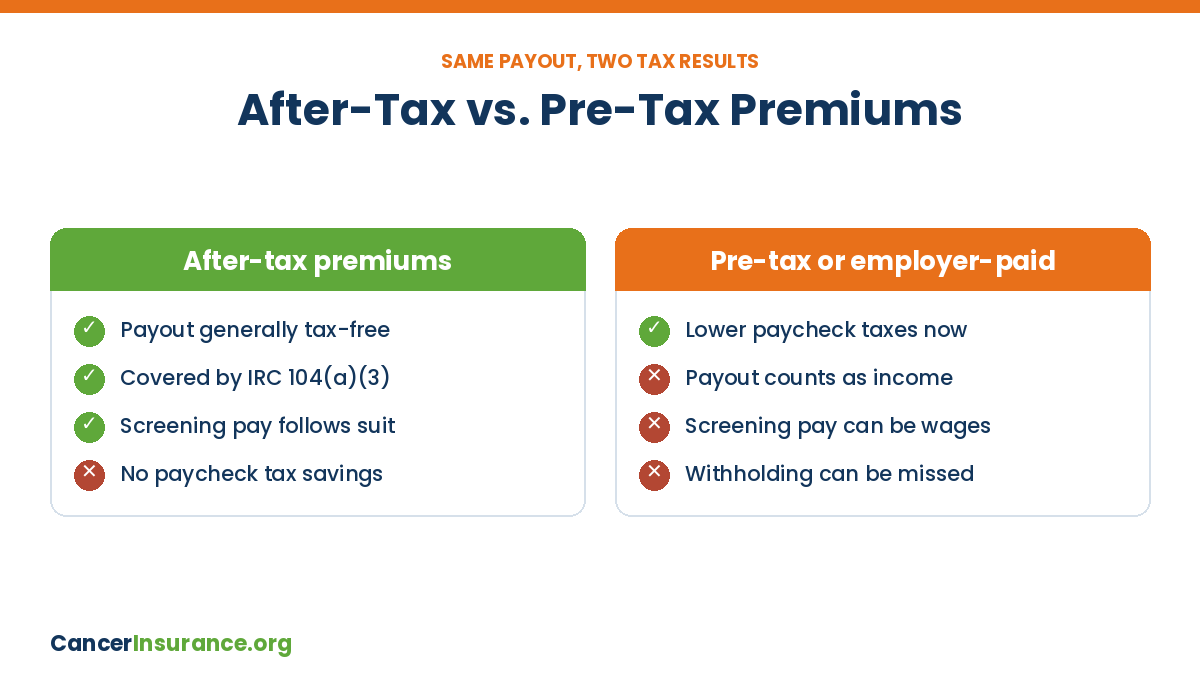
Is critical illness insurance taxable: after-tax premiums compared with pre-tax or employer-paid premiums

Critical illness insurance is a fixed-payment policy. It pays a set amount when a covered condition is diagnosed, no matter what your medical bills are. Because the money is not tied to actual expenses, the IRS does not treat it like a reimbursement from a health plan. Instead, the tax result tracks how the coverage was bought.

Taxed money in, tax-free money out. Section 104(a)(3) of the tax code excludes accident and health benefits you bought with after-tax dollars. A policy you pay for from your checking account fits here.

Untaxed money in, taxable money out. When an employer pays the premium, or you pay through a pre-tax payroll deduction, the premium never hit your taxable income. IRS Chief Counsel memo 201703013 says fixed-payment benefits from that kind of coverage are taxable when you receive them.

What you spend it on does not matter. Using the lump sum for chemo copays or for the mortgage does not change the tax result under that memo. Pre-tax coverage pays taxable money either way.

Remember that critical illness coverage, like cancer coverage, is a supplemental, limited-benefit policy. It pays cash on top of a health plan and does not replace health insurance.

Cancer Insurance Quotes

Call a Licensed Agent Now

Compare cancer insurance plans and cash benefits from several insurance companies in one call.

☎ 1-888-891-0229

No obligation to buy

Six Ways the Premium Gets Paid and What Each Means at Tax Time

No single source we found lines up every funding setup next to its likely tax result, so here is that comparison built from IRS guidance and IRS Chief Counsel memos. A Chief Counsel memo is not formal law and cannot be cited as precedent, but it shows how the IRS reads the rules.

How the premium is paidFederal tax on the payoutBasis
You buy an individual policy and pay from your own accountGenerally not taxableIRC 104(a)(3), after-tax premiums
Workplace plan, payroll deduction taken after taxesGenerally not taxableSame rule: the premium came from taxed pay
Workplace plan, pre-tax deduction through a Section 125 cafeteria planGenerally taxable as incomeIRS treats pre-tax premiums as employer-paid; CCA 201703013
Employer pays the whole premium as a free benefitGenerally taxable as incomePremium excluded from your pay under IRC 106, so the benefit is not
Employer pays part, you pay part after taxesUsually only the share tied to the employer’s moneyIRS applies a split like this to disability benefits; confirm for your plan
Critical illness rider on a life insurance policyDepends on the riderLife policy rules under IRC 101(g) address terminal and chronic illness; ask the insurer how it reports a critical illness payment

Federal income tax only. General information, not tax advice. Your plan documents, your state and your full tax picture can change the result.

The middle two rows surprise people most. The pre-tax deduction saves a little tax on each paycheck, and the trade-off arrives later if a claim is ever paid.

The Small Screening Benefit That Can Be Taxed Too

Many workplace critical illness plans include a health screening or wellness benefit, a small flat payment once a year for getting a covered test such as a mammogram or colonoscopy. Most articles on this topic stop at the diagnosis payout and never mention it.

IRS position to know: In Chief Counsel memo 202323006, released in June 2023, the IRS looked at a fixed-payment wellness benefit under coverage paid through pre-tax cafeteria plan deductions. It concluded the payment is taxable wages, subject to income tax withholding, Social Security and Medicare (FICA) and federal unemployment tax, unless the employee had unreimbursed medical costs tied to that payment. An earlier 2017 memo, 201703013, reached a similar result for wellness payments under pre-tax fixed-payment plans.

In practice, a screening check from a pre-tax plan is likely to count as pay, even with no illness at all. If the deduction was after-tax, the same payment generally falls under the after-tax rule instead. Employee benefits lawyers have suggested employers consider after-tax deductions for supplemental plans for this reason.

When a Taxable Payout Shows Up: Withholding, W-2s and State Rules

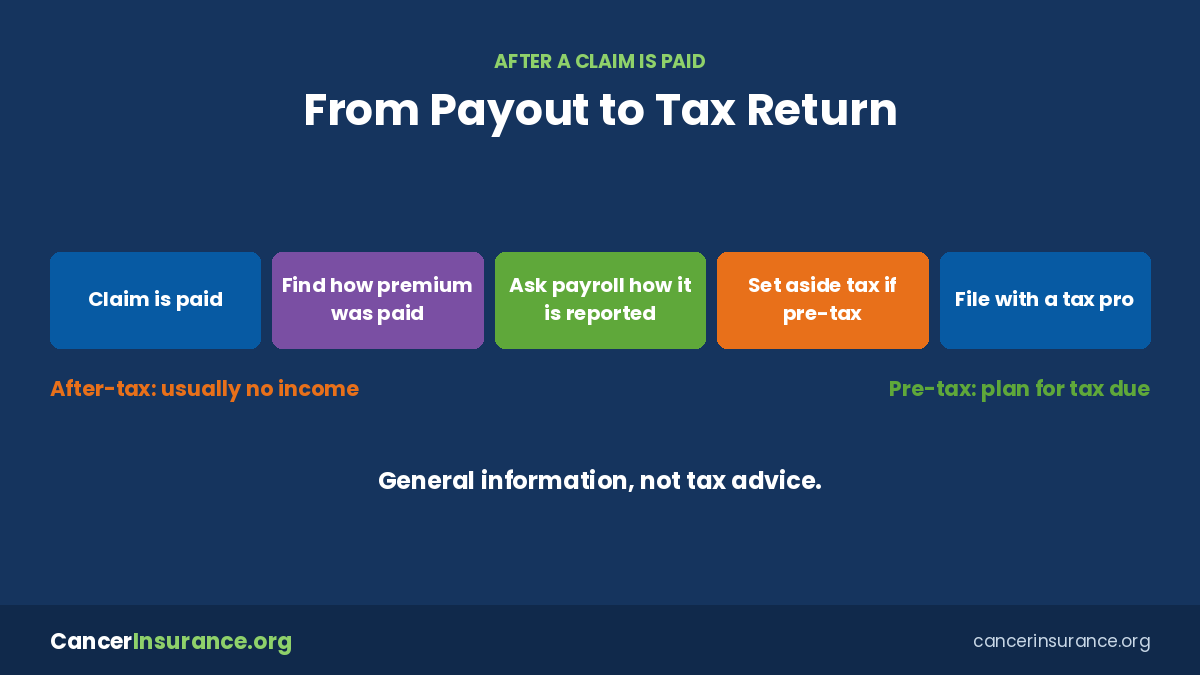
Is critical illness insurance taxable checklist from claim payment to filing your tax return

Because a taxable benefit from pre-tax coverage is treated as wages, an employer is expected to handle withholding and report it. That can break down in real life, because the insurer pays you directly and the employer may not learn about the claim right away.

Withholding can be missed. Employee benefits law firm Warner Norcross + Judd notes the insurer may have no way to withhold and send in the required taxes. If nothing is withheld, the tax may come due when you file.

Look for it on your W-2. A taxable payment treated as wages would normally be included in the wage boxes of your W-2. Ask payroll how your plan reports it before you file.

New Jersey is different. New Jersey’s Treasury bulletin says the state does not exclude most cafeteria plan salary reductions from state wages, so your state picture there can differ from the federal one.

No-wage-tax states. In states with no tax on wages, such as Florida and Texas, the question is federal only.

Most other states with an income tax start from federal figures, but each has its own rules. A tax preparer licensed in your state can confirm how your state treats the payment.

Compare Critical Illness Coverage

Speak with a licensed insurance agent

1-888-891-0229

CancerInsurance.org logo

How to Check Your Own Plan Before a Claim

The answer for your coverage is sitting in paperwork you already have. These steps take a few minutes and work whether you enrolled at work or bought a policy on your own.

1

Read a recent pay stub. Find the critical illness line. If it sits with deductions taken before taxes, it is likely pre-tax. If it sits with deductions taken after taxes, it is likely after-tax.

2

Check last year’s W-2. Some employers list cafeteria plan deductions in Box 14 with a label such as S125. The label is up to the employer, so treat it as a clue rather than proof.

3

Open the enrollment guide. Benefit guides often state outright whether each voluntary plan is deducted pre-tax or after-tax. The University of North Carolina’s benefits page, for example, says its critical illness premiums come out pre-tax.

4

Send HR three questions. Ask whether the premium is pre-tax or after-tax, whether the employer pays any part of it, and how a taxable claim or screening payment is reported and withheld.

5

Keep the claim paperwork. Save the insurer’s payment letter and the amount paid. A tax preparer will want both, along with any medical bills you paid out of pocket.

Bought your policy directly from an insurer and pay it yourself? You are almost always in the after-tax row. Compare options on our cancer insurance plans page or browse cancer insurance providers that also sell critical illness coverage.

HSAs, FSAs, Public Benefits and the Pre-Tax Choice at Enrollment

HSA owners. Specified disease coverage is listed as permitted insurance, so a fully insured critical illness policy by itself generally does not block HSA contributions. Ask HR about any extra features in your plan.

FSA spending. A critical illness payout is not an FSA or HSA deposit. Medical bills you pay with it stay your own bills, and any eligible ones may still be paid from those accounts under their normal rules.

Means-tested aid. Symetra notes critical illness benefits may affect eligibility for public assistance programs. Check before a large payment lands if you rely on one.

Some employers let you choose pre-tax or after-tax for supplemental plans. Pre-tax trims the tax on every paycheck; after-tax gives up that small saving so a future lump sum generally comes in tax-free. There is no single right pick, and a tax professional can weigh it against your income. Premium deductions are a separate issue covered in is critical illness insurance tax deductible, and cancer-only policies follow the same logic explained in are cancer insurance payouts taxable.

Bottom Line

Critical illness insurance is taxable or tax-free based on the money behind the premium: after-tax premiums generally mean a tax-free lump sum, while employer-paid or pre-tax cafeteria plan premiums generally make the payout, and even a small screening benefit, taxable income. Check your pay stub and enrollment guide now, and talk with a tax professional before you file the year a claim is paid.

Get Free Critical Illness Quotes

Speak with a licensed insurance agent

1-888-891-0229

CancerInsurance.org logo

Is Critical Illness Insurance Taxable — Frequently Asked Questions

➤ Is a critical illness lump sum counted as income if I bought the policy myself?

Generally no. When you pay the premiums with your own after-tax money, Section 104(a)(3) of the tax code generally keeps the benefit out of your income.

➤ My critical illness premium comes out of my paycheck. Is my payout taxable?

It depends on whether the deduction is pre-tax or after-tax. A pre-tax Section 125 deduction generally makes the payout taxable, while an after-tax deduction generally does not. Your pay stub or enrollment guide usually shows which one you have.

➤ Does using the money for medical bills make a pre-tax payout tax-free?

Not under IRS memo 201703013, which says pre-tax fixed-payment benefits are taxable regardless of medical costs. A 2023 memo on wellness payments allowed an exception for related unreimbursed medical costs, so ask a tax professional about your bills.

➤ Is the yearly health screening benefit taxable?

It can be. IRS memo 202323006 treated a wellness payment under pre-tax coverage as taxable wages subject to withholding and FICA. Under after-tax coverage, it generally follows the tax-free rule.

➤ Will I get a tax form for a taxable critical illness claim?

A taxable payment from pre-tax workplace coverage is treated as wages, so it would normally be reported on your W-2. Ask your payroll team how your plan reports it.

➤ What if my employer pays part and I pay part after taxes?

IRS rules for disability benefits tax only the share tied to the employer’s payments, and a similar split generally applies to other employer health plans. Confirm the split with HR and a tax professional.

➤ Does critical illness insurance affect my HSA?

A fully insured specified disease policy is listed as permitted insurance, so it generally does not block HSA contributions by itself. Ask your benefits team about any extra features in your plan.

➤ Do Canadian rules on critical illness taxes apply to me?

No. Many search results describe Canadian or UK rules, where payouts are often tax-free. U.S. residents follow IRS rules, where the answer turns on how the premium was paid.

Cancer Insurance Quotes

Call a Licensed Agent Now

Compare cancer insurance plans and cash benefits from several insurance companies in one call.

☎ 1-888-891-0229

No obligation to buy

Ready to Compare? Get Free Cancer Insurance Quotes

Speak with a licensed insurance agent

1-888-891-0229

CancerInsurance.org logo

ZRN Health & Financial Services, LLC, a Texas limited liability company