




Speak with a licensed insurance agent

1-888-891-0229

Critical Illness Insurance Claim: Proof Rules, Paperwork and Deadlines From Six Carrier Claim Forms

Updated November 2026

Key Takeaway

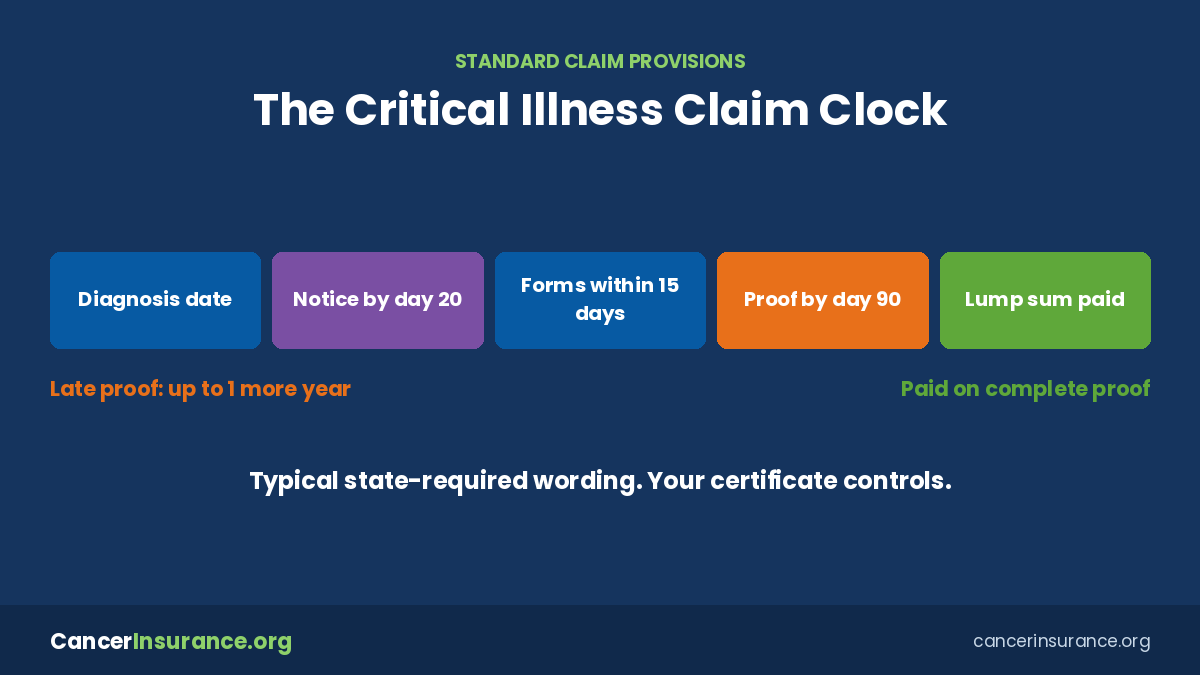
To file a critical illness insurance claim, send the insurer its claim form, a physician statement and medical records that show a covered diagnosis and its date, then the lump sum is paid to you once the claim is approved. Standard state policy provisions ask for notice within 20 days of the illness and proof of loss within 90 days, though late proof is generally accepted up to a year later.

2027 by the Numbers

0 of 6

carrier claim forms and claim pages reviewed that print a filing deadline

96 hours vs. 30 days

how long stroke deficits must last on the Cigna and Unum claim forms

10 business days

MetLife’s stated processing time for a complete group claim

A heart attack, a stroke or a kidney failure diagnosis does not pay a critical illness benefit by itself. The claim pays when the medical records prove that the event matches the policy’s own definition, on a date the policy was in force, and the insurer gets that proof in time.

This guide walks through those tests for critical illness coverage as a whole, using six claim forms and claim pages published by Unum, Cigna, Guardian, The Standard, MetLife and Colonial Life. Critical illness insurance is a supplemental, limited-benefit policy that adds cash on top of health coverage; it does not replace health insurance and does not pay hospitals or doctors. If the diagnosis is cancer only, our page on cancer insurance claims covers that path in detail.

Compare Critical Illness Coverage

Speak with a licensed insurance agent

1-888-891-0229

CancerInsurance.org logo

When a Diagnosis Counts as a Covered Claim

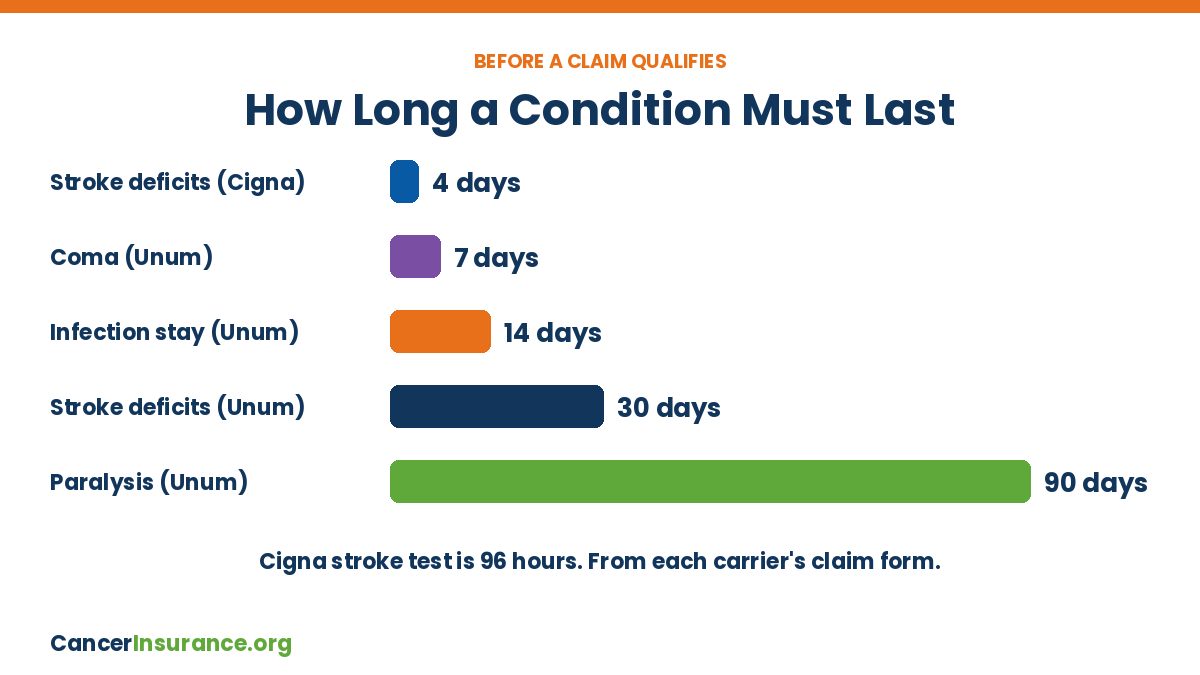
Critical illness insurance claim duration tests: days a condition must last on Cigna and Unum claim forms

Claims staff ask whether an illness fits the certificate’s wording, not whether it was serious. Cigna’s form says only the conditions listed on it may be covered.

The definition is met. Cigna’s form, for example, asks the doctor to confirm a heart attack with an EKG and raised cardiac enzymes, and coronary artery disease with a blockage of at least 70% in one artery or 50% in two or more.

The date falls inside coverage. The diagnosis must come after the effective date and outside any initial wait. Our guide to the critical illness insurance waiting period explains those clocks.

No pre-existing limit applies. Some policies look back at care received before coverage began. See critical illness insurance pre-existing conditions for how that look-back works.

Any duration test is passed. Several definitions require a condition to last a set time before it qualifies, which can push the claim date weeks past the event itself.

Definition detail: Unum’s group claim form asks for a stroke’s neurological deficits to be documented 30 days after diagnosis, a coma of 7 or more consecutive days, and paralysis of two or more limbs lasting 90 days or more. A claim filed before those dates may be pended until the records exist.

Cancer Insurance Quotes

Call a Licensed Agent Now

Compare cancer insurance plans and cash benefits from several insurance companies in one call.

☎ 1-888-891-0229

No obligation to buy

What Six Carrier Claim Forms Ask You to Send

No single source lines these requirements up. The table below is drawn from each insurer’s own claim form or claim page, mostly for employer group plans, where most critical illness coverage is sold.

Claim form or pageWho fills in whatProof it calls outDeadline or timing printed
Unum group form CL-1198Employee statement plus an attending physician statement; no employer sectionPathology with staging for cancer; biochemical markers and imaging for heart attackNo deadline printed
Cigna critical illness formEmployee, employer and dependent sections; physician section if records are not attachedRecords with the date of diagnosis and diagnosis codesNo deadline; date of diagnosis required
Guardian group formEmployee and claim sections; medical records attachedA modified Rankin Scale form from the doctor for any stroke claimNo deadline printed
The Standard group packetEmployee statement, signed authorization and a statement from each treating doctorTest results, clinical diagnoses and imagingNo deadline; unsigned statements are returned
MetLife group claim page (Kansas state plan)Claimant section 7, physician section 8Verified diagnosis, pathology, surgical notes or labs, and the diagnosis dateAbout 10 business days for complete claims; paid 7 to 10 business days after approval
Colonial Life claim pageAll sections on one form; online filing recommendedDiagnosis codes, date of diagnosis and doctor detailsNo deadline stated

Our review of each form or page as published by the insurer or an employer that offers it. The certificate, not the form, sets the deadlines and controls the claim decision.

What the forms leave out: None of the six documents prints a filing deadline. The time limits sit in the policy or certificate, usually in the claim provisions section, so the form alone gives no warning that the clock is running.

Building the Claim File for Each Type of Illness

The proof that settles a critical illness claim changes with the illness. Asking the right office for the right record saves weeks of back-and-forth.

Heart attack. Hospital records with EKG results and cardiac enzyme or biochemical marker levels, plus any imaging.

Stroke. Brain imaging and notes showing lasting deficits. Cigna looks for findings at least 96 hours after the event, and Guardian asks the doctor to complete a disability scale form.

Cancer. The pathology report, ideally with staging, since many policies pay less for non-invasive cancer. MetLife also names surgical notes and lab results as accepted proof.

Kidney or organ failure. Dialysis records for kidney failure, or the transplant list status and the date added for major organ failure, which Unum’s form requests by name.

For group plans, Cigna’s form has an employer section, while Unum’s and Guardian’s ask only for the employer’s name. Most forms also want the patient’s name on every page.

Claim Deadlines in Standard Policy Provisions

Critical illness insurance claim timeline from diagnosis to notice, proof of loss and payment

Most states require individual health and supplemental policies to carry uniform claim provisions based on an NAIC model. Minnesota’s law shows the standard time frames; any one certificate may differ.

ProvisionStandard time frameWhat it means for a critical illness claim
Notice of claimWithin 20 days of the loss, or as soon as reasonably possibleA short written notice can go in before the records are ready
Claim formsInsurer sends them within 15 days of noticeIf forms do not arrive, a written description of the illness can serve as proof
Proof of lossWithin 90 days; never later than 1 year after that, unless legally incapableA stroke or paralysis duration test can use up part of this window
Time of paymentImmediately on receipt of due written proofA lump sum has no reason to be held once proof is complete
Legal actionNot before 60 days after proof, and not after 3 yearsSets the outer limit for suing over a denied claim

Minnesota Statutes section 62A.04, the standard provisions most states adopted. Group certificates and state versions vary.

Timing fact: Insurers count from the date of the loss, which for critical illness is usually the date of diagnosis, not the date a doctor signs the form. A record request sent in the first week keeps the 90-day proof window comfortable.

Compare Critical Illness Coverage

Speak with a licensed insurance agent

1-888-891-0229

CancerInsurance.org logo

Full Payouts, Partial Payouts and Repeat Claims

A claim can be approved and still pay less than the full benefit amount. MetLife’s outline of coverage for the State of South Dakota group plan shows how partial benefits are scheduled.

Non-invasive cancer: 25%. Paid as a share of the benefit amount, with a later recurrence able to pay 100% of that initial benefit.

Bypass surgery: 50%. Coronary artery bypass graft pays half the amount on that schedule.

Sudden cardiac arrest: 50%. Also half the amount, with no recurrence benefit listed.

Skin cancer: 5%. The smallest share on the schedule, with a $250 minimum and no recurrence benefit.

The same outline sets a 30-day gap between two different covered conditions and a 90-day gap before the same condition can pay again. How the money arrives and can be used is covered in critical illness insurance lump sum payment.

Second-event check: A second claim needs its own form, fresh records and a diagnosis date past the separation period, even when the first claim paid in full.

If a Critical Illness Claim Is Denied

Denials usually turn on a definition, a date or a missing record. The appeal route depends on where the coverage came from.

1

Find the provision cited. Federal claim rules for employer plans covered by ERISA require a denial notice to name the specific plan provision it relied on and describe any extra information that could fix the claim.

2

Note the appeal window. Under the same rules, an employer plan must allow at least 60 days to appeal, and at least 180 days where group health or disability claim rules apply. The denial letter states which one applies.

3

Answer the reason directly. If a stroke claim failed for lack of lasting deficits, a later neurology note may supply it. If a heart attack claim lacked enzyme results, the lab report may settle it.

4

Use the state insurance department. Individual policies, and plans run by government employers, which ERISA does not cover, can be taken to the state department of insurance as a complaint.

5

Watch the outer limit. Standard provisions bar a lawsuit sooner than 60 days after proof or later than 3 years after proof was due.

Cancer-specific denial reasons are covered in cancer insurance claim rejection reasons. To compare carriers before buying or replacing coverage, see our list of cancer insurance providers.

Bottom Line

A critical illness insurance claim succeeds when the records match the policy’s definition, the diagnosis date falls inside coverage and proof reaches the insurer within the policy’s time limits, commonly 90 days. Claim forms rarely print those limits, so the certificate is worth reading the week of diagnosis. Keep health insurance in place, since this coverage only adds cash on top.

Related: multiple critical illness insurance How second, third and repeat claims pay, with gap rules and lifetime caps from 11 US plan documents.

Get Critical Illness Insurance Quotes

Speak with a licensed insurance agent

1-888-891-0229

CancerInsurance.org logo

Critical Illness Insurance Claim — Frequently Asked Questions

➤ Who can file a critical illness claim for me if I am in the hospital?

A family member can usually start it, but the insured or a legal representative must sign the authorization. Guardian’s form, for example, asks for power of attorney papers when someone else signs.

➤ Does my doctor have to fill out part of the critical illness claim form?

Usually yes. Unum, The Standard and MetLife forms include a physician section, and Cigna’s physician section can be skipped only when full medical records are attached.

➤ Why was my stroke claim put on hold?

Many definitions require deficits that last a set time, such as 96 hours on Cigna’s form or 30 days on Unum’s. The insurer may wait for records from after that point.

➤ What is the deadline to file a critical illness insurance claim?

Standard provisions call for notice within 20 days and proof within 90 days of the diagnosis, with late proof generally accepted up to a year later. Your certificate states the exact terms.

➤ How fast is a critical illness claim paid after approval?

MetLife’s claim page for one state employer plan says payment arrives 7 to 10 business days after approval, with complete claims processed in about 10 business days. Missing records are the usual cause of delay.

➤ Can a critical illness claim pay only part of the benefit?

Yes. Some conditions are scheduled as partial benefits, such as 25% for non-invasive cancer and 50% for bypass surgery on one MetLife group plan.

➤ Can I claim for a heart attack after a paid cancer claim?

Often yes, if the policy covers both and the second diagnosis falls after the separation period between conditions, which was 30 days on the MetLife plan reviewed.

➤ Does a critical illness claim replace a health insurance claim?

No. Critical illness insurance is a supplemental, limited-benefit policy paid to you, and medical bills still go through your health plan.

Cancer Insurance Quotes

Call a Licensed Agent Now

Compare cancer insurance plans and cash benefits from several insurance companies in one call.

☎ 1-888-891-0229

No obligation to buy

Ready to Compare? Get Free Cancer Insurance Quotes

Speak with a licensed insurance agent

1-888-891-0229

CancerInsurance.org logo

ZRN Health & Financial Services, LLC, a Texas limited liability company