




Speak with a licensed insurance agent

1-888-891-0229

Critical Illness Insurance Waiting Period: The First-Month Cancer Wait, Survival Rules and Gaps Between Claims

Updated November 2026

Key Takeaway

The typical critical illness insurance waiting period is 30 days and usually applies only to cancer on individual policies, while many employer group plans list no waiting period at all. Heart attack and stroke are commonly covered from the effective date, and a second claim usually needs a gap of 30 days to 6 months between diagnoses.

2027 by the Numbers

30 days

cancer-only wait in the Aflac, Assurity and Mutual of Omaha individual documents reviewed

0 of 9

US critical illness documents in our review that list a survival period

30 days to 6 months

gap required before a different illness pays, across the plan documents reviewed

A critical illness policy does not run on one clock. It can run on three: a short wait after the start date before some diagnoses count, a survival rule that a few policies outside the US attach to heart attack and stroke, and a spacing rule that decides when a second or repeat illness can pay. Most buyers hear about the first clock and miss the other two.

This page pulls those clocks out of nine real US plan documents, individual and employer group, and lines them up. It sticks to critical illness rules. For cancer-only policies, see cancer insurance waiting periods explained. Critical illness coverage is a supplemental, limited-benefit policy that pays cash on top of health insurance and does not replace it; the basics are in our critical illness insurance guide.

Compare Critical Illness Coverage

Speak with a licensed insurance agent

1-888-891-0229

CancerInsurance.org logo

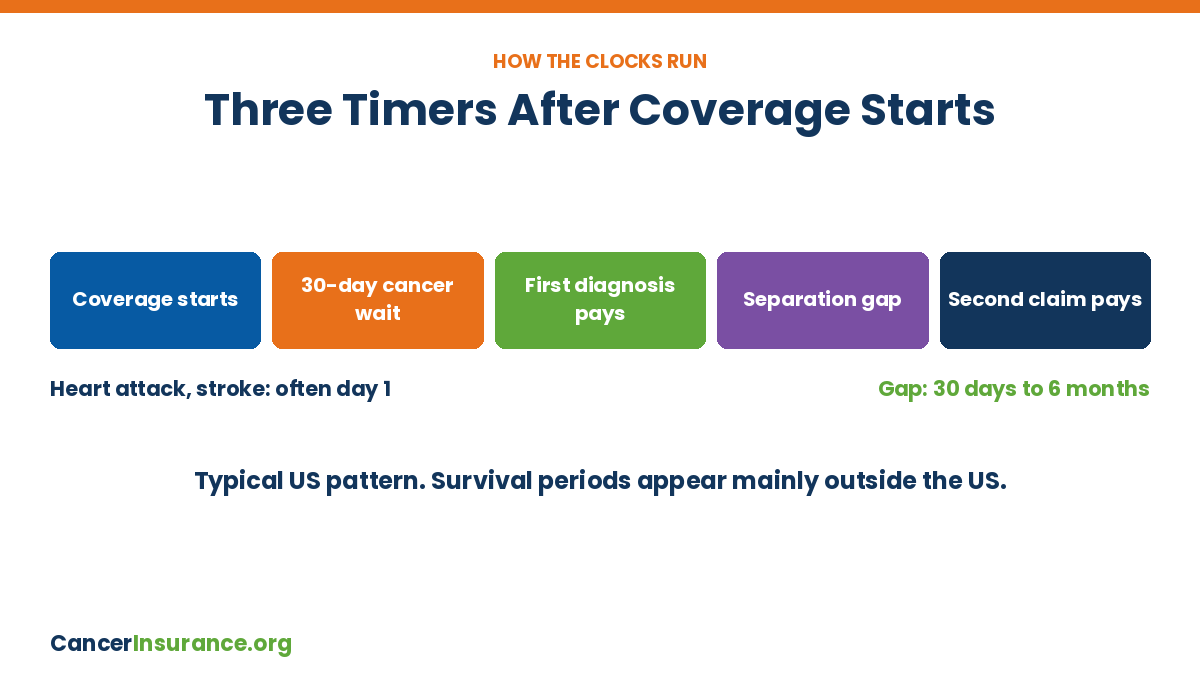
Three Separate Clocks Inside One Policy

Timeline of a critical illness insurance waiting period, survival period and separation period after coverage starts

Each clock answers a different question, and mixing them up is a common source of surprise at claim time.

Initial waiting period. Starts on the effective date. A covered illness first diagnosed inside this window does not earn the lump sum. In the US documents reviewed, it was either 30 days for cancer only or not listed at all.

Survival period. Requires the insured to live a set number of days after a diagnosis or surgery before the benefit is owed. Common in Canada and Asia, it did not appear in any of the US documents reviewed here.

Separation period. Sets how far apart two diagnoses must be before a second payment is made. It applies to a new, different illness and, often with a longer gap, to the return of the same one.

A fourth rule, the pre-existing condition limit, looks backward rather than forward and can last up to 12 months. It is covered on our critical illness insurance pre-existing conditions page, so this page leaves it aside.

Cancer Insurance Quotes

Call a Licensed Agent Now

Compare cancer insurance plans and cash benefits from several insurance companies in one call.

☎ 1-888-891-0229

No obligation to buy

Waiting and Spacing Rules in Nine Plan Documents

No public source puts these rules side by side. The table below does, using each insurer’s own outline of coverage, sample policy, product guide or an employer’s published plan summary.

DocumentTypeInitial waitSurvival ruleGap before a different illnessRepeat of the same illness
Aflac lump sum specified critical illness, form B71125GAIndividual30 days, internal cancer onlyNone listedNot statedCancer must be treatment-free 12 months in a row
Assurity critical illness product guideIndividual30 days, invasive and non-invasive cancerNone listedAt least 6 monthsNot stated in the guide
Combined Insurance sample policy, form 16648Individual30 days (shown as a variable)None listedMore than 6 months6 months treatment-free and back at work 6 months; up to 2 recurrences
Mutual of Omaha Cancer, Heart Attack and Stroke, form CHS10-22901Individual30 days, cancer onlyNone listedNot statedNot stated
Colonial Life GCI6000, Cameron County, Texas summaryEmployer groupNone listed for illness benefitsNone listedNot stated25% of the amount after 12 treatment-free months in complete remission
Aflac group, Continental American policy series C21000Employer groupNone listedNone listedAt least 6 monthsDiagnoses 12 months apart
Cigna group summary, DartmouthEmployer groupNone listedNone listed90 days12 months after the earlier diagnosis
Unum group summary, CaltechEmployer groupNone listedNone listed180 days, unless unrelatedCan pay 100%; skin cancer excluded
United of Omaha group summary, 2026Employer groupNo benefit waiting periodNone listed30 days90 days treatment-free

Our review of each document as published by the insurer or employer. Not stated means the document reviewed does not give a figure; the certificate or policy may. State versions and employer contracts vary, and your own policy controls.

Pattern in the documents: Every individual document reviewed set a 30-day wait aimed at cancer, while none of the five employer summaries listed an initial wait for the illness benefits. Colonial Life’s summary applies a 30-day wait only to a separate Wellbeing Assistance Benefit.

Survival Periods: A Rule US Buyers Rarely Face

Search for this topic and many top results come from insurers in India, which describe a waiting period of 90 days or more plus a survival period after diagnosis. Those rules are real, but they describe a different market. A survival period means the claim is paid only if the insured is still alive a set number of days after the event.

Canada example. Sun Life’s Canadian critical illness policy requires the insured to survive 30 days after a heart attack or stroke diagnosis, or after heart surgery such as a bypass, and applies a 90-day exclusion window to cancer.

US documents reviewed. None of the nine US documents in the table lists a survival period. Payment turns on a covered diagnosis, the waiting period and any pre-existing limit.

Why it matters. Articles written for other markets can make a US policy sound stricter than it is. The rules that bind are the ones printed in the US certificate or outline of coverage.

Diagnosed Before the Wait Ends

Critical illness insurance waiting period comparison of a cancer diagnosed in the first 30 days versus after the wait

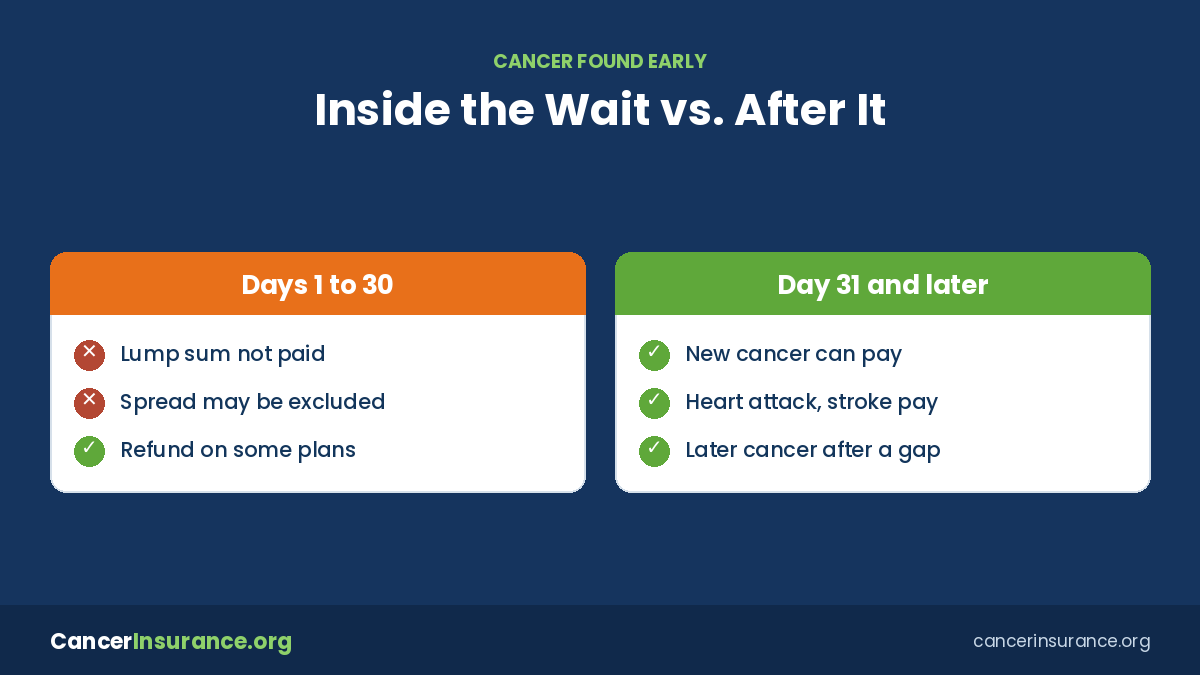
What happens to a cancer found in the first 30 days depends on the wording, and the documents reviewed handle it in three different ways.

1

Refund option. Aflac’s outline B71125GA says no benefits are payable for an internal cancer diagnosed in the first 30 days, or for its recurrence or spread, and lets the policyholder void the coverage for a full premium refund.

2

Later diagnosis can still count. Assurity’s guide says a cancer found during the first 30 days can pay on a later diagnosis if the insured is free of symptoms and treatment for at least 12 consecutive months.

3

Simple exclusion. Mutual of Omaha’s Cancer, Heart Attack and Stroke brochure says it does not pay for cancer first diagnosed within 30 days of the effective date, and does not mention a refund.

In all three, the wait does not touch a heart attack or stroke diagnosed on day 10. Assurity states that coverage begins immediately for its other covered conditions.

Compare Critical Illness Coverage

Speak with a licensed insurance agent

1-888-891-0229

CancerInsurance.org logo

Separation Periods and a Second Payout

Spacing rules matter most when two events come close together, such as a heart attack followed by a stroke. If the second diagnosis lands inside the gap, the policy may treat it as part of the first event or pay nothing for it.

Different illness. Gaps in the documents reviewed ran from 30 days under the United of Omaha summary to 180 days under Unum, whose summary asks for 180 days between diagnoses or two conditions that are not related.

Same illness again. Repeat claims usually need a longer quiet stretch, often 12 months, and sometimes pay only part of the amount, such as the 25% in the Colonial Life summary.

Work test. Combined’s sample policy adds a condition top results do not mention: the insured must have returned to work for at least 6 months before a recurrence pays.

Claim timing fact: Separation periods are measured between dates of diagnosis, not dates of claim. Filing the second claim later does not change which side of the gap the diagnosis falls on.

Planning Around the Waiting Clock

A 30-day wait is short, but it can collide with a screening visit, a job change or a lapse in coverage.

1

Keep old coverage until the new wait ends. Dropping a policy on the day a new one starts leaves a gap where a cancer diagnosis may pay under neither.

2

Use open enrollment when you can. The group summaries reviewed listed no initial wait. Our guide on individual critical illness insurance covers when buying on your own makes sense.

3

Ask whether coverage is portable. Unum’s summary says its coverage can follow an employee who leaves or retires, which avoids a new wait under a new policy.

4

Write down the gaps. Note the separation period for a different illness and the rule for a repeat, so a second claim is not filed too early.

5

Compare carriers side by side. Our cancer insurance providers list shows who sells cancer and critical illness coverage.

Bottom Line

In the US, the critical illness insurance waiting period is usually a 30-day cancer-only wait on individual policies and often none at all on employer plans. The rules that more often decide a second claim are separation periods, which ranged from 30 days to 12 months in the documents reviewed. Read all three clocks in your own certificate, and keep health insurance in place, since this coverage only adds cash on top.

Related: how a critical illness insurance claim is filed and paid Proof each carrier asks for by illness, standard claim deadlines, partial payouts and appeal windows.

Get Free Critical Illness Quotes

Speak with a licensed insurance agent

1-888-891-0229

CancerInsurance.org logo

Critical Illness Insurance Waiting Period — Frequently Asked Questions

➤ Does the critical illness waiting period apply to heart attacks?

Usually not in the US documents reviewed. The 30-day wait in the Aflac, Assurity and Mutual of Omaha individual documents targets cancer, and Assurity states other conditions are covered right away.

➤ Do employer critical illness plans have a waiting period?

None of the five group summaries reviewed listed an initial wait for the illness benefits, and the United of Omaha summary states there is no benefit waiting period. Your employer’s certificate is the final word.

➤ What is a survival period in critical illness insurance?

It is a rule that the insured must live a set number of days, often 30 in Canada, after a diagnosis or surgery before the benefit is paid. None of the US documents reviewed here included one.

➤ Why does a website say the critical illness waiting period is 90 days?

Many top results describe policies sold in India, where 90-day waits are common. US documents reviewed here used 30 days for cancer or no initial wait at all.

➤ How long must I wait between two critical illness claims?

For a different illness, the gap in the documents reviewed ran from 30 days to 6 months. A repeat of the same illness often needs about 12 months between diagnoses or free of treatment.

➤ Can I get a refund if cancer is found in the first 30 days?

Some policies allow it. Aflac’s individual outline B71125GA lets the policyholder void the coverage for a full premium refund, but other documents reviewed did not mention a refund.

➤ Does a new waiting period start if I change policies?

A new individual policy usually brings its own wait. Keeping the old policy until the new one clears its wait, or carrying portable group coverage, avoids a gap.

➤ Is critical illness insurance a replacement for health insurance?

No. It is a supplemental, limited-benefit policy that pays a lump sum on top of health coverage. Medical bills still go through a health plan.

Cancer Insurance Quotes

Call a Licensed Agent Now

Compare cancer insurance plans and cash benefits from several insurance companies in one call.

☎ 1-888-891-0229

No obligation to buy

Ready to Compare? Get Free Cancer Insurance Quotes

Speak with a licensed insurance agent

1-888-891-0229

CancerInsurance.org logo

ZRN Health & Financial Services, LLC, a Texas limited liability company