




Speak with a licensed insurance agent

1-888-891-0229

Critical Illness Insurance for Seniors: Age Limits, Benefit Cuts and Medicare

Updated November 2026

Key Takeaway

Critical illness insurance for seniors is a lump-sum policy that pays cash after a covered diagnosis such as a heart attack, stroke or cancer, but most multi-illness policies stop accepting new applicants somewhere between ages 64 and 70. After that, people on Medicare usually build similar protection from narrower policies, such as cancer-only or heart attack and stroke plans that some insurers issue up to age 89.

2027 by the Numbers

$1,776

2027 Part A hospital deductible, owed each benefit period (CMS)

$292

2027 Part B yearly deductible before Part B pays its share (CMS)

$9,850

2027 cap on in-network out-of-pocket costs a Medicare Advantage plan may set (CMS)

Turning 65 changes the critical illness market more than most shoppers expect. The same policy a 50-year-old can buy in ten minutes may be closed to a 66-year-old, and a workplace plan that paid $20,000 at age 68 may pay half that after a birthday. None of this shows up on a quote screen unless you know where to look.

This page sorts out the age rules: who still sells coverage after 65, which designs shrink the benefit later in life, and how a cash payout works next to Original Medicare, Medigap or Medicare Advantage. Like every policy in this category, it is supplemental, limited-benefit insurance. It does not pay doctors, hospitals or drug costs the way Medicare does and never replaces your Medicare coverage. For the basics of how the payout works, see our critical illness insurance guide.

Compare Senior Critical Illness Options

Speak with a licensed insurance agent

1-888-891-0229

CancerInsurance.org logo

Why Coverage Gets Harder to Find After 64

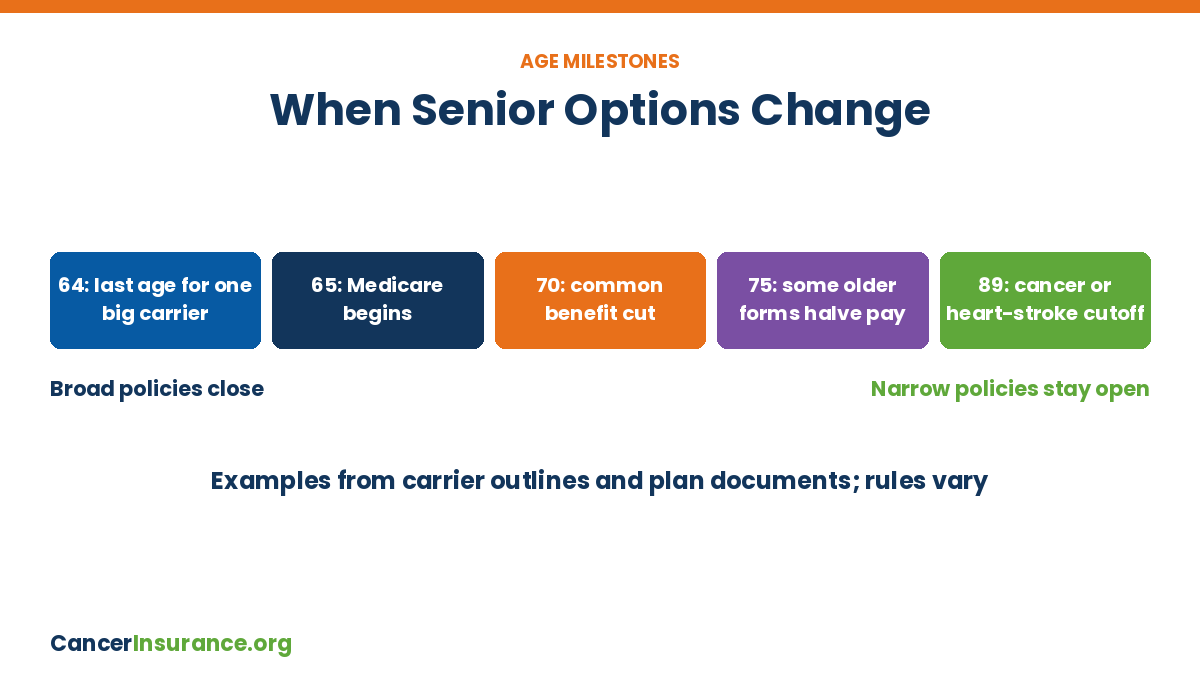
Timeline of age milestones for critical illness insurance for seniors from age 64 to 89

Insurers price critical illness coverage on the odds of a diagnosis, and those odds climb steeply with age. Rather than charge very high rates, many carriers simply set a last age to apply. Mutual of Omaha issues its individual critical illness policy with lifetime coverage only through age 64, and its term versions only through 54. Assurity’s individual policy accepts applicants through age 70.

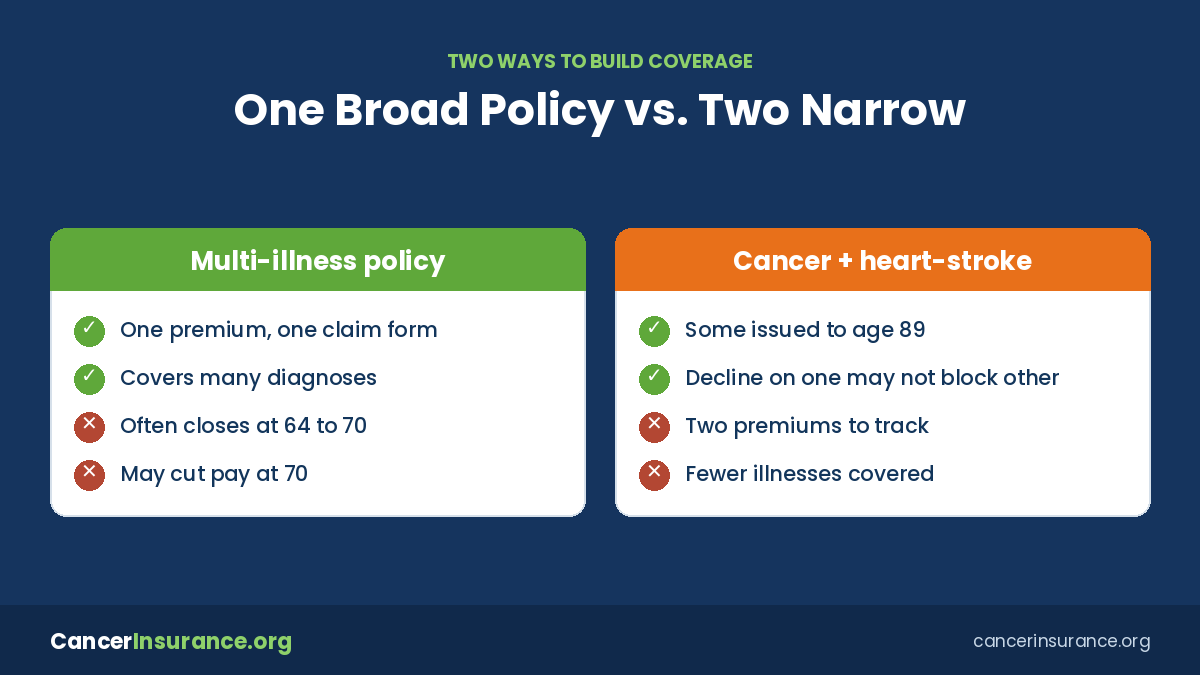
Narrower policies stay open much longer. Aetna’s individual heart attack or stroke policy and its cancer policy are issued to adults 18 to 89 through licensed agents, and Mutual of Omaha’s lifetime cancer policy can also be bought up to age 89. That split is the single most useful fact for a senior shopper: a broad, many-illness policy may be out of reach, while a pair of focused policies can still cover the two diagnoses that drive most claims.

Age to check: Issue-age limits are usually based on age last birthday on the application date. Applying a few weeks before a birthday can keep a policy available, while waiting until after can close it.

Cancer Insurance Quotes

Call a Licensed Agent Now

Compare cancer insurance plans and cash benefits from several insurance companies in one call.

☎ 1-888-891-0229

No obligation to buy

Age Rules by Carrier, Side by Side

No single carrier brochure lines up these limits next to each other, so we pulled them from each insurer’s own outlines, highlights and employer-posted certificates. The columns that matter after 60 are the last age to apply and what happens to the benefit as you get older.

Carrier and policyLast age to applyWhat changes with age
Mutual of Omaha individual critical illness (lifetime)64No age-based benefit cut in the outline reviewed
Assurity individual critical illness70Benefit drops 50% at the anniversary after the later of age 70 or 3 years from issue
Aetna individual heart attack or stroke89Covers heart attack and stroke only, not cancer
Mutual of Omaha cancer policy (lifetime)89Covers internal cancer and malignant melanoma only
Voya workplace planSpouse must be under 70Benefit drops 50% at the employee’s 70th birthday; premium stays the same
Unum workplace plan (older EN-1775 design)Set by employerEmployee and spouse amounts drop 50% at first anniversary after age 70
Aflac older individual series A73100Not statedAll benefits cut in half at age 75

Our review of Mutual of Omaha brochure 459893, Assurity product highlights (form I H1820), Aetna’s agent product page, Voya’s consumer page, Unum form EN-1775 flyers and Aflac A73100 materials. State versions differ; your policy controls.

Two patterns stand out. Workplace plans tend to cut the benefit rather than end it, so an older employee keeps paying the same premium for less coverage. Individual policies tend to close the door at a set age but, once issued, some keep the full benefit for life. If you want a policy whose benefit never shrinks, ask the agent to show you the renewability section, not just the brochure.

Where a Lump Sum Fits Next to Medicare

A critical illness payout is cash sent to you, not to a provider, so it can fill holes that Medicare leaves no matter which path you chose. What those holes look like depends on your coverage.

Original Medicare only. You face the Part A deductible each benefit period and 20% Part B coinsurance with no yearly cap, so a lump sum can soak up a long hospital stay and months of outpatient care.

Medigap. A plan like G already covers most cost-sharing beyond the Part B deductible, so the cash usually goes to travel, home help, lost income for a working spouse or bills at home.

Medicare Advantage. Copays add up until you reach your plan’s out-of-pocket limit, which CMS caps at $9,850 in network for 2027. A lump sum can cover that gap in a heavy treatment year.

Part D drugs. The 2027 Part D out-of-pocket cap is $2,400, and the payout can cover that amount plus costs Part D never touches.

Because a lump sum pays the same amount whatever your medical bills are, it is easier to compare with your own savings than with a health plan. If a heart attack or cancer diagnosis would not strain your cash reserves, a smaller benefit, or none, may be enough. For a cancer-specific look at Medicare costs, see our cancer insurance for seniors overview.

Keeping Workplace Coverage After You Retire

Comparison of a broad critical illness policy and separate cancer and heart attack or stroke policies for seniors

Many people in their 60s first get critical illness coverage at work. Leaving that job can end it unless the plan lets you keep it, and the deadlines are short.

1

Find the portability section. Some group plans let you carry coverage after leaving work. In one Voya certificate, you have 31 days after coverage would end to choose portability and must elect it before age 70.

2

Check for an age stop. A Lincoln Financial plan FAQ at Grand Valley State University says employees who leave or retire before age 70 can apply within 31 days to keep coverage.

3

Ask how long it lasts. In a Principal design, a person under 70 who has been insured 12 months and has not had a covered illness can keep coverage for 3 years, 5 years or to age 70 without health questions.

4

Compare the cost. Ported coverage is often billed directly and may cost more than the payroll rate. Price an individual policy before you decide.

If your plan has no portability or you are past its age limit, an individual policy is the next step. Our individual critical illness insurance page covers how to buy coverage you own outright.

Compare Senior Critical Illness Options

Speak with a licensed insurance agent

1-888-891-0229

CancerInsurance.org logo

Health Questions an Older Applicant Will See

Individual policies sold to people over 60 are usually simplified issue: no exam, only yes-or-no health questions. Mutual of Omaha, for example, uses express underwriting up to a $50,000 benefit and simplified underwriting from $51,000 to $100,000, with look-back periods that can reach 10 years for some conditions. A yes to a question about past cancer, heart disease or stroke usually means a decline for the policy covering that illness.

Worth knowing: A decline on a broad critical illness policy does not rule out a narrower one. Someone with a past heart attack may still qualify for a cancer-only policy, and a cancer survivor may still qualify for heart attack or stroke coverage, if the answers on that application allow it.

Even after approval, illnesses tied to conditions treated shortly before coverage started may be excluded for a time. Our page on critical illness insurance and pre-existing conditions shows how those look-back rules work.

Is It Worth It After 65? A Practical Test

Premiums climb with age because the risk does. In one Hartford employer plan posted by Lansing Community College, $10,000 of employee-only coverage cost $2.55 a month under age 25 and $32.47 a month at ages 65 to 69. That is still a modest bill, but the gap shows why older buyers should size the benefit carefully.

It may fit if… you have Original Medicare without Medigap, a high Medicare Advantage out-of-pocket limit, limited savings, or a family history of cancer or heart disease.

It may not be needed if… you have Medigap Plan G, solid emergency savings and no one depending on your income.

Read before buying… the age-based reduction rule, the cancer waiting period and whether a second diagnosis can pay again.

If cancer is your main worry, a cancer policy can pay more over a long treatment than a single lump sum. Compare both on our cancer, heart attack and stroke insurance page and our list of the 5 best cancer insurance policies.

Bottom Line

Seniors can still buy critical illness protection, but the choices narrow with every birthday after 64, and many plans quietly cut benefits at 70 or 75. Check the last issue age, the reduction rule and how the cash would fit with your Medicare coverage before you compare prices.

Get Free Quotes for Ages 60 and Up

Speak with a licensed insurance agent

1-888-891-0229

CancerInsurance.org logo

Critical Illness Insurance for Seniors — Frequently Asked Questions

➤ Can I buy critical illness insurance at age 70?

Some individual policies still accept applicants at 70, such as Assurity’s, which is issued through that age. Many others close earlier, so at 70 and beyond you may need cancer-only or heart attack and stroke policies, which some insurers issue up to age 89.

➤ What is the oldest age to buy critical illness insurance?

It depends on the carrier and the type of policy. Broad multi-illness policies often stop between 64 and 70, while narrower heart attack or stroke and cancer policies from carriers such as Aetna and Mutual of Omaha can be issued up to age 89.

➤ Does Medicare cover critical illness insurance?

No. Medicare does not sell or pay for critical illness insurance. It is a separate private policy that pays you cash, and you keep your Medicare coverage for medical bills.

➤ Can I have critical illness insurance with a Medicare Advantage plan?

Yes. A critical illness policy pays regardless of your health coverage, so you can hold one alongside Medicare Advantage. The cash can help with copays up to your plan’s out-of-pocket limit.

➤ Do critical illness benefits go down as I get older?

Many do. Some workplace plans cut benefits by 50% at age 70, some MetLife plans cut 25% at 65 and 50% at 70, and an older Aflac series halved benefits at 75. Some individual policies, such as Mutual of Omaha’s, have no age-based cut.

➤ Is there an open enrollment period for seniors?

Not for individual policies. You can apply any time of year, but approval depends on your health answers. Workplace plans usually follow the employer’s annual enrollment window.

➤ Can I keep my work critical illness plan after I retire?

Sometimes. Some plans offer portability if you elect it within about 31 days of leaving and before age 70. Check your certificate for the exact rules and cost.

➤ Is a cancer policy better than critical illness insurance for seniors?

Neither is better in general. A critical illness policy covers several diagnoses with one lump sum, while a cancer policy covers only cancer but may pay more over a long treatment. Many people over 70 can only qualify for the narrower one anyway.

Cancer Insurance Quotes

Call a Licensed Agent Now

Compare cancer insurance plans and cash benefits from several insurance companies in one call.

☎ 1-888-891-0229

No obligation to buy

Ready to Compare? Get Free Cancer Insurance Quotes

Speak with a licensed insurance agent

1-888-891-0229

CancerInsurance.org logo

ZRN Health & Financial Services, LLC, a Texas limited liability company