

Speak with a licensed insurance agent

1-888-891-0229

Guardian Critical Illness Insurance: Old vs. New Contracts, Payouts and Recurrence Rules

Updated November 2026

Key Takeaway

Guardian critical illness insurance is a workplace group plan from The Guardian Life Insurance Company of America that pays you a cash lump sum, such as $10,000 to $40,000 in recent employer designs, when you are diagnosed with a covered condition like invasive cancer, heart attack or severe stroke. You enroll through your employer with payroll deduction, and the plan is supplemental coverage that does not replace health insurance.

2027 by the Numbers

A++ (Superior)

AM Best financial strength rating for Guardian Life, affirmed September 12, 2025 (AM Best)

$40,000

top employee lump sum in the Jefferson Parish School Board plan summary, contract CI-23-P (Guardian)

6 months

symptom-free and treatment-free gap before a repeat diagnosis pays under contract CI-23-P (Guardian)

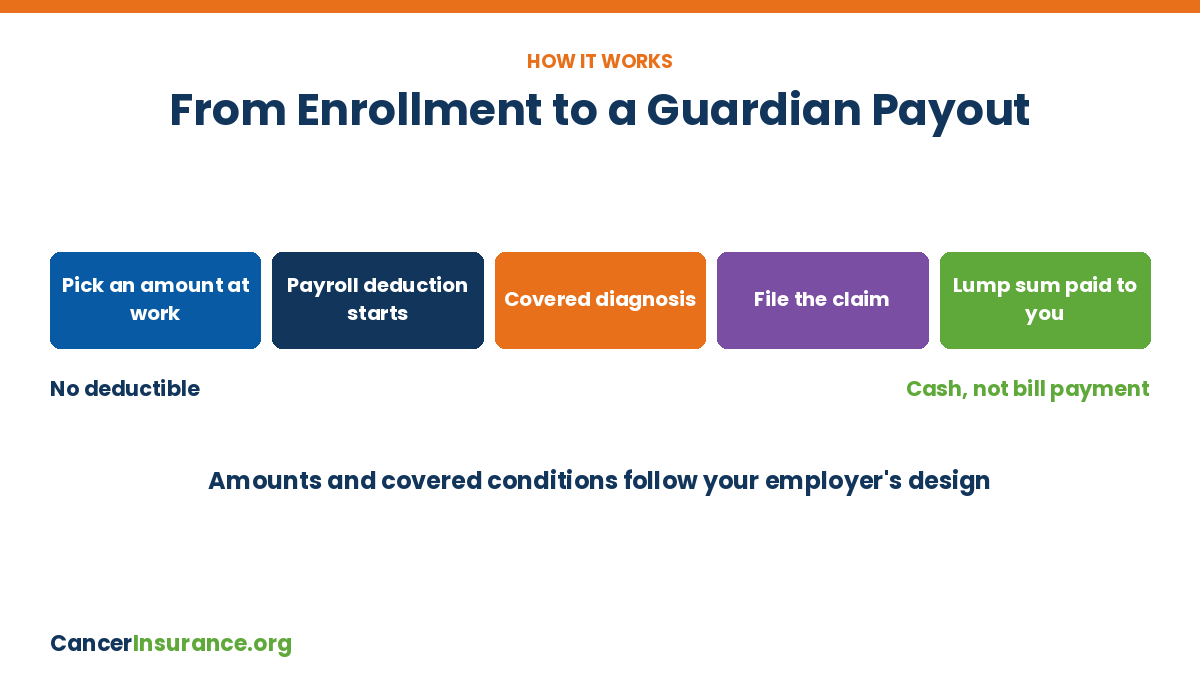
Guardian is a mutual life insurer based in New York, and most people meet its critical illness plan on an open enrollment screen at work. You pick a coverage amount, the premium comes out of your paycheck, and a qualifying diagnosis triggers a cash payment sent to you rather than to a hospital.

Guardian has rewritten this product, so two coworkers at different employers can hold very different versions. This guide explains how to spot which contract you have, lines up four real employer summaries, and walks through the second-diagnosis rules. Keep one point in view the whole way: this is a supplemental, limited-benefit policy. It pays fixed amounts for listed illnesses, it does not cover doctor or hospital bills, and it cannot stand in for health insurance. For the basics of how lump-sum coverage works, start with our critical illness insurance overview.
Compare Critical Illness and Cancer Coverage

Speak with a licensed insurance agent

1-888-891-0229

CancerInsurance.org logo

What Guardian Actually Sells Under This Name

How Guardian critical illness insurance moves from workplace enrollment to a lump-sum payout

The insurer on the certificate is The Guardian Life Insurance Company of America in New York, New York. Guardian markets critical illness as a group product for employers, usually as a voluntary benefit the worker pays for. Its own consumer page notes that this kind of coverage can be bought individually, but it is far more often offered at work, so the realistic path to a Guardian plan is your employer’s benefits menu.

On September 12, 2025, AM Best affirmed Guardian Life’s financial strength rating of A++ (Superior), its highest grade, with a stable outlook. The same rating covers two core subsidiaries, The Guardian Insurance & Annuity Company and Berkshire Life Insurance Company of America. Guardian’s group page says the plan has no deductible and no lifetime maximum, that it is not minimum essential coverage under federal law, and that the product is not available in every state.

Coverage reminder: A Guardian critical illness payment is cash for a listed diagnosis. It does not pay providers, does not count as health coverage under the ACA and is meant to sit on top of an employer, Marketplace or Medicare health plan.

Cancer Insurance Quotes

Call a Licensed Agent Now

Compare cancer insurance plans and cash benefits from several insurance companies in one call.

☎ 1-888-891-0229

No obligation to buy

Two Contract Generations: GP-1-CI-14 and CI-23-P

Every Guardian benefit summary prints a contract number near the top or bottom. Older designs show contract GP-1-CI-14. Newer ones show CI-23-P, issued under policy form GP-1-LAH-12R. Guardian announced that the revamp doubled the number of covered illnesses and conditions, and the newer summaries bear that out.

BRCA gene results. CI-23-P summaries list BRCA1 and BRCA2 at 30% of the lump sum, a benefit Guardian ties to preventive steps after a positive gene test. It is not on the older contract.

Earlier brain-disease payouts. Alzheimer’s now pays 50% at an early stage and 100% at an advanced stage in the Chapel Hill design. Guardian says early-stage payouts for Alzheimer’s, MS and Parkinson’s are not offered in Pennsylvania.

Stroke by severity. The older contract paid stroke at 100%. CI-23-P splits it into moderate stroke at 50% and severe stroke at 100%.

More child conditions. Guardian added autism, congenital heart defects and multisystem inflammatory syndrome linked to COVID-19, plus an optional family-planning benefit for infertility treatment and pregnancy complications.

Four Employer Summaries Compared

Guardian’s public pages give no dollar figures, because each employer chooses its own design. The table below lines up four summaries that employers posted for their workers, two on each contract generation.

FeatureWVU Research Corp. (GP-1-CI-14, 2019)Community Action Wayne/Medina (GP-1-CI-14, 2023 kit)Town of Chapel Hill (CI-23-P, 2025)Jefferson Parish School Board (CI-23-P)
Employee lump sum$5,000 to $20,000$5,000 to $30,000$10,000, $20,000 or $30,000Up to $40,000
Spouse amountUp to 50% of employee50% of employeeUp to 100%, max $30,000100% of employee
Invasive cancer, 1st / 2nd100% / 50%100% / 100%100% / 100%100% / 100%
Carcinoma in situ30%, once30%, once30%, once30%, once
Benign brain tumor75%75%100% (brain or spinal)100% (brain or spinal)
Repeat-diagnosis gap12 months12 months6 months6 months
Yearly wellness payment$50 per person$50 per person$100 per person$75 per person

Our comparison of Guardian benefit summaries posted by each employer. Skin cancer paid a flat $250 one time in all four. Your own certificate and state rules control.

Two patterns stand out. The newer contract roughly halves the wait before a repeat diagnosis pays, and it pays more for a benign brain tumor. Within the same contract, employers still differ on spouse limits and the screening amount. Premiums vary by age band: Jefferson Parish lists $10,000 of coverage from $3.00 a month under age 25 to $39.20 at 70 and over, with spouse rates based on the employee’s age and child coverage included at no extra cost.

Where It Overlaps With a Guardian Cancer Plan

Guardian critical illness insurance compared with a Guardian cancer plan

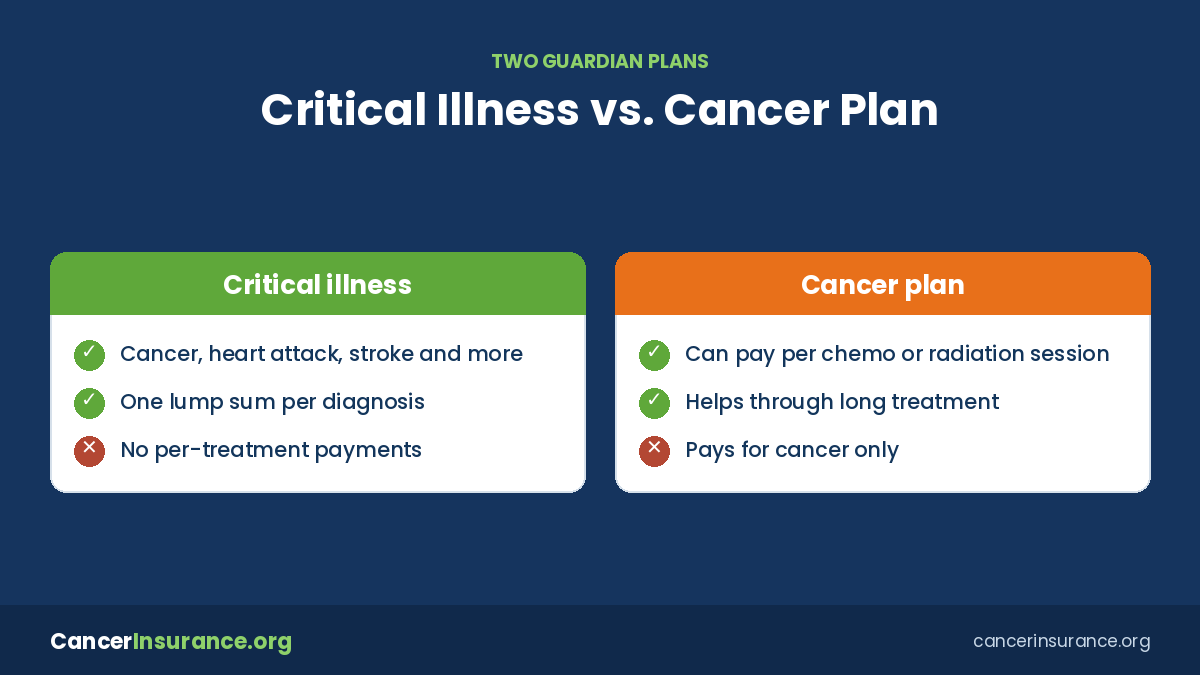
Some employers offer both a Guardian cancer plan and Guardian critical illness. Guardian describes the split simply: critical illness covers a broad list of conditions with a lump sum, while a cancer plan pays only for cancer and may pay per treatment, such as each chemotherapy or radiation session.

If cancer is your main worry, the cancer plan’s treatment payments can keep arriving through a long course of care, which a single lump sum does not do. If heart disease or stroke runs in your family, critical illness reaches conditions a cancer plan never pays. Our Guardian Life cancer insurance guide covers the cancer policy in detail, and the cancer insurance versus critical illness insurance page compares the two product types across carriers.

Stacking note: Holding both plans means two premiums and two separate claims for one cancer diagnosis. Each plan pays under its own terms, so read both summaries before deciding whether the second deduction is worth it.

Compare Critical Illness and Cancer Coverage

Speak with a licensed insurance agent

1-888-891-0229

CancerInsurance.org logo

Getting Paid a Second Time

A Guardian plan can pay more than once, but the summaries set firm conditions. This is the order the rules apply in the CI-23-P designs reviewed above.

1

The first diagnosis pays its listed share. Invasive cancer pays 100% of your lump sum; carcinoma in situ pays 30% and does not pay again.

2

Linked illnesses pay once. If one illness causes or contributes to another, the plan pays only the larger of the two benefits. If they are equal, the employee chooses which one.

3

The quiet period runs. A second occurrence of the same illness pays only after at least 6 months in a row with no symptoms, care or treatment for it. Preventive medicine and routine follow-up visits do not reset that clock.

4

Some lines never repeat. Benign brain or spinal tumor, BRCA1 and BRCA2, carcinoma in situ and skin cancer show no second-occurrence payment in the newer summaries.

On the older GP-1-CI-14 contract, the quiet period was 12 months, and a different illness in the same category, cancer or vascular, could not pay its first benefit within 3 months of a related claim. If your summary shows the old contract number, plan around those longer timelines.

Leaving Your Job, Waiver of Premium and Other Limits

Portability. All four summaries list portability as included, which lets you keep coverage after employment ends by paying premiums yourself under the certificate’s terms.

Waiver of premium. The CI-23-P summaries waive premiums once you have been disabled for 90 days by a covered critical illness diagnosed after your effective date.

Age reduction. The 2019 WVU design cut benefits 50% at age 70. The newer summaries reviewed do not state an age reduction, so check your own.

Past diagnoses. Guardian pays nothing for an illness diagnosed before your effective date, and care received outside the U.S. is excluded unless the diagnosis is confirmed in the U.S.

Health questions are usually skipped up to the guaranteed issue amount during initial or annual enrollment, which was $30,000 to $40,000 for employees in the newer designs. Above that, Guardian can ask medical questions. If your employer does not offer Guardian, compare other carriers in our cancer insurance providers directory or see the 5 best cancer insurance policies.

Bottom Line

Guardian critical illness insurance is a group lump-sum plan backed by an A++ rated insurer, and the contract number on your summary tells you a lot: CI-23-P adds BRCA, early-stage brain disease and a shorter 6-month repeat-claim gap, while GP-1-CI-14 uses a 12-month gap. Employers still choose the amounts, so compare your own summary to the table above and treat any payout as cash on top of real health insurance.

Get Free Critical Illness Quotes

Speak with a licensed insurance agent

1-888-891-0229

CancerInsurance.org logo

Guardian Critical Illness Insurance — Frequently Asked Questions

➤ How can I tell which Guardian critical illness contract I have?

Look for the contract number on your benefit summary or certificate. GP-1-CI-14 is the older design, and CI-23-P is the newer one Guardian rolled out with roughly double the covered conditions.

➤ Does Guardian critical illness pay anything for a BRCA gene result?

Under contract CI-23-P, the summaries reviewed list BRCA1 and BRCA2 at 30% of the lump sum, paid once. Guardian ties it to preventive measures after a positive gene finding. The older contract does not include it.

➤ What share of the lump sum does carcinoma in situ pay?

All four employer summaries compared here pay 30% of the elected amount for carcinoma in situ, with no second payment. Invasive cancer pays 100%.

➤ Can my spouse get the same coverage amount I choose?

On the newer designs, often yes: Chapel Hill and Jefferson Parish allow up to 100% of the employee amount. Older designs limited a spouse to 50%.

➤ Is there a lifetime cap on Guardian critical illness benefits?

Guardian’s group page says the plan has no lifetime maximum. Individual lines still have their own limits, such as the one-time $250 skin cancer benefit and conditions that pay only once.

➤ What happens to my premiums if a covered illness keeps me from working?

The CI-23-P summaries include a waiver of premium after 90 days of disability caused by a covered critical illness diagnosed after your effective date.

➤ Can I keep Guardian critical illness coverage after I change jobs?

Each of the four summaries reviewed lists portability as included, so you can usually continue coverage by paying premiums directly. The certificate sets the exact deadlines and terms.

➤ Should I sign up for both Guardian critical illness and a Guardian cancer plan?

It depends on your health history and budget. Critical illness covers many conditions with one lump sum, while a cancer plan can pay for each treatment. Both are supplemental and neither replaces health insurance.

Cancer Insurance Quotes

Call a Licensed Agent Now

Compare cancer insurance plans and cash benefits from several insurance companies in one call.

☎ 1-888-891-0229

No obligation to buy

Ready to Compare? Get Free Cancer Insurance Quotes

Speak with a licensed insurance agent

1-888-891-0229

CancerInsurance.org logo

ZRN Health & Financial Services, LLC, a Texas limited liability company