




Speak with a licensed insurance agent

1-888-891-0229

Is Proton Therapy Covered by Insurance? Medicare, Private Plans and Cancer Policy Cash

Updated November 2026

Key Takeaway

Proton therapy is covered by insurance when the plan agrees it is medically necessary, which Medicare usually finds for tumors near critical organs, childhood cancers and repeat radiation, while private plans approve it far less often and treat it as equal to standard radiation for prostate cancer. Expect prior authorization from almost every plan, and appeal a denial, since many are reversed.

2027 by the Numbers

91% vs 30%

first-request proton approval rate, Medicare vs private insurance, at one high-volume center (Int. J. Radiat. Oncol. Biol. Phys., 2019)

3 vs 14 days

median wait for a coverage decision, Medicare vs private insurance, same study

$12,000

2027 ACA out-of-pocket cap for one person on in-network covered care (HHS)

Proton therapy uses a beam that releases most of its energy at the tumor and then stops, so less radiation reaches tissue behind it. Standard photon radiation, such as IMRT, keeps going through the body. That is why oncologists choose protons for tumors beside the eye, brainstem, spinal cord or a child’s growing organs, and why health plans ask hard questions before paying.

Below is who pays for proton beam therapy: Original Medicare, Medicare Advantage, employer and ACA plans, plus where a supplemental cancer or critical illness policy fits. For other newer treatments, see cancer insurance and experimental treatments. The treatment choice belongs with a radiation oncologist.

Compare Cancer Insurance Plans

Speak with a licensed insurance agent

1-888-891-0229

CancerInsurance.org logo

How Health Plans Decide Whether to Pay for Protons

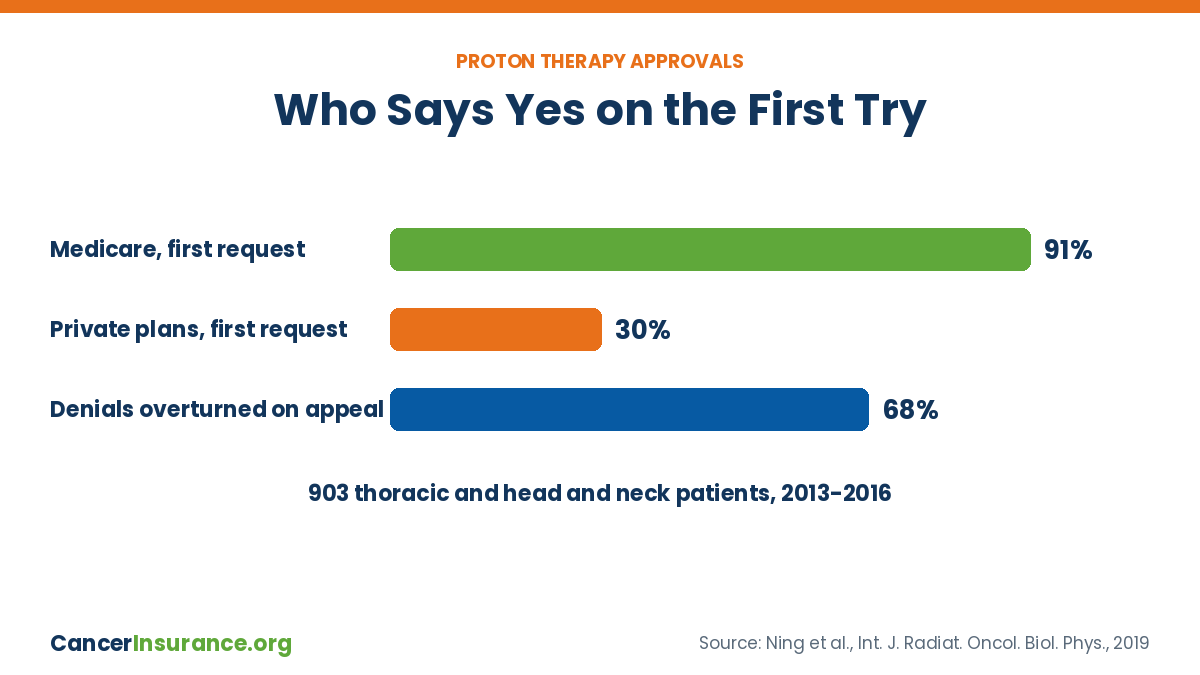
Bar chart of approval rates showing whether proton therapy is covered by insurance on first request under Medicare and private plans

Almost no plan covers proton therapy for every cancer, and almost none refuses it outright. Reviewers ask three questions about the specific patient.

Where is the tumor? Approval comes most readily for eye, skull base and certain brain and spine tumors, cancers in children and young adults, and re-treating an area already radiated.

Can photons do the job? Many policies want proof that an IMRT or other photon plan cannot spare nearby tissue as well, and some now require a side-by-side dose comparison.

Is it part of a study? For less proven uses, such as lung or breast cancer, some rules tie coverage to a clinical trial, a registry or a center that collects outcome data.

The American Society for Radiation Oncology (ASTRO) publishes a model policy that many insurers and Medicare contractors draw on. Group 1 lists uses where protons are generally supported; for Group 2, ASTRO recommends coverage when the patient is in a clinical trial or qualifying registry. ASTRO’s April 2026 newsletter reported that oropharyngeal cancers, including many throat and tonsil cancers, moved into Group 1 after a phase 3 trial.

Cancer Insurance Quotes

Call a Licensed Agent Now

Compare cancer insurance plans and cash benefits from several insurance companies in one call.

☎ 1-888-891-0229

No obligation to buy

Proton Coverage Rules Compared by Cancer Type

The table pulls the main points from four published rule sets into one view. A plan’s own benefit booklet can add exclusions, so read it too.

Rule setApplies toProstate cancerBreast or lung cancerGenerally approved uses
ASTRO model policyGuidance for all payersGroup 2 (trial or registry) unless bulky pelvic node disease fits Group 1Group 2Under-40 patients, eye, skull base, esophagus, liver, re-irradiation
Medicare LCD L35075 (Wellpoint Federal)Original Medicare in IL, MN, WI, NY and New EnglandGroup 2: covered with documented selection criteriaGroup 2: providers with data-collection experienceEye, skull base, certain brain and childhood tumors
Aetna CPB 0270 (reviewed Apr. 14, 2026)Aetna commercial membersEqual to IMRT; benefit plan decidesExperimental for adultsBrain, head and neck, age 21 and under, esophagus, eye, re-irradiation
UnitedHealthcare policy (revised Mar. 1, 2026)UnitedHealthcare commercial members 19+Equal to IMRT; benefit plan decidesUnproven unless a photon comparison supports an exceptionSkull base, eye, liver, mediastinum, re-irradiation, some head, neck and brain tumors

Summarized from each published policy, November 2026. Policies change often.

Prostate cancer stands out. Both big commercial insurers call protons and IMRT clinically equivalent and leave medical necessity to the member’s benefit plan, while the Medicare contractor rule can approve the same patient when the records show its selection criteria were met.

Original Medicare, Medigap and Medicare Advantage

Original Medicare covers proton therapy when it is reasonable and necessary. Inpatient treatment falls under Part A; the usual outpatient course falls under Part B, where the patient generally owes 20% of the Medicare-approved amount after the deductible. With no national rule for protons, regional contractors publish local coverage determinations (LCDs) such as L35075, in place since October 2015.

Medicare fact: Under a CMS rule effective in 2024, Medicare Advantage plans must follow the criteria in Medicare’s national and local coverage determinations and may not deny care using stricter internal criteria when Medicare’s rules are fully set out. Prior authorization is still allowed.

A Medigap plan that pays the Part B coinsurance can cover most of that 20% once Medicare approves. Approval odds also differ by payer: in a 2019 study of 903 thoracic and head and neck patients at one large proton center, Medicare approved 91% of first requests and private insurers 30%, and 68% of appealed denials were overturned.

Employer and ACA Plans: Getting Proton Therapy Approved

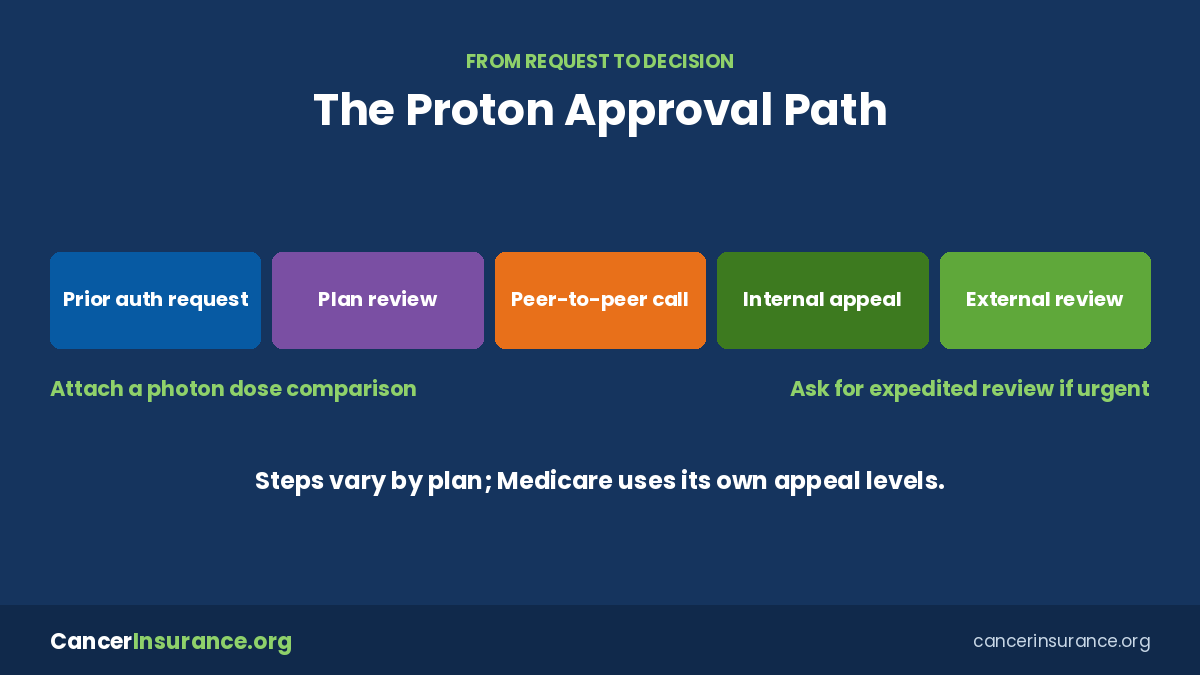
Timeline of the prior authorization and appeal path when asking whether proton therapy is covered by insurance

Employer and marketplace plans handle proton requests through prior authorization, often run by an outside radiation benefit manager. First denials are common, so build the request around what the reviewer checks.

1

Find the plan’s proton policy. Ask which written policy applies and compare its listed uses with the diagnosis on the request.

2

Include a photon comparison. Have the radiation team attach a dose plan showing what IMRT would deliver to nearby organs.

3

Request a peer-to-peer review. After a denial, the treating oncologist can ask to speak with the plan’s reviewing doctor.

4

Appeal, then go outside. File the internal appeal, asking for an expedited decision when delay could harm health. After a final denial, most plans must offer independent external review.

ACA protections. Marketplace and most employer plans cannot set annual or lifetime dollar limits on essential health benefits or refuse coverage over a pre-existing condition.

Out-of-pocket cap. For 2027 plans the in-network cap is $12,000 for one person and $24,000 for a family. Charges for denied treatment do not count toward it.

If a supplemental policy declines its own benefit instead, see cancer insurance claim rejection reasons.

Compare Cancer Insurance Plans

Speak with a licensed insurance agent

1-888-891-0229

CancerInsurance.org logo

Where a Cancer or Critical Illness Policy Fits

A cancer insurance policy does not decide whether protons are approved. It is a supplemental, limited-benefit policy that pays set cash amounts after a covered diagnosis, and it does not replace health insurance. The cash still matters: only a few dozen U.S. centers offer protons and a course often runs several weeks, so many patients travel and stay near the center.

Filed outlineHow radiation is paidTravel benefitLodging benefit
Aflac cancer policy, outline B70225RTX (Texas)Physician-administered radiation paid once per calendar month40 cents a mile, up to $1,200 per round trip, beyond 50 miles$65 a day beyond 50 miles, up to 90 days a year
Colonial Life CanAssist, outline 77302Paid once per calendar week, not per session50 cents a mile beyond 50 miles one wayPlan-level daily amount, up to 70 days a year

From the carriers’ filed outlines, reviewed November 2026. Neither names proton therapy; the insurer applies its radiation wording to each claim. Amounts vary by state and plan level.

A critical illness policy is simpler: it typically pays one lump sum when a covered cancer is diagnosed, whatever treatment follows, though many pay a reduced share for early or non-invasive cancers. Either policy must be in force, and past any waiting period, before diagnosis. Compare cancer insurance plans.

What Proton Therapy Costs When Coverage Falls Short

Current self-pay prices are rarely published and vary by center, cancer and number of sessions. The best public benchmark is dated: a Yale study in the Journal of the National Cancer Institute, using 2008-2009 Medicare prostate cancer claims, found about $32,428 per proton course versus $18,575 for IMRT. Get a written estimate before starting.

Coverage note: When a plan rates protons as equal to IMRT, ask in writing what it will pay toward proton treatment and what balance the center would bill. Plan approval, a self-pay discount and a clinical trial slot are three separate questions.

Health savings and flexible spending accounts can generally pay for treatment a plan denies. For policies that pay on diagnosis, see the 5 best cancer insurance policies and our cancer insurance providers list.

Bottom Line

Proton therapy is covered when the plan agrees it is medically necessary, a bar that is easier to clear with Medicare and for tumors near critical organs, in children or in previously treated areas. Private plans approve fewer first requests and treat protons as equal to IMRT for prostate cancer, so build a strong request, appeal promptly and use cancer or critical illness cash for travel and bills, not as a substitute for health coverage.

Get Free Cancer Insurance Quotes

Speak with a licensed insurance agent

1-888-891-0229

CancerInsurance.org logo

Proton Therapy Insurance Coverage — Frequently Asked Questions

➤ Does Medicare cover proton beam therapy for prostate cancer?

Often, yes. Under local rules such as L35075, prostate cancer without distant spread can qualify when the doctor documents the selection criteria. Part B coinsurance still applies.

➤ Why do private insurers deny proton therapy more often than Medicare?

Commercial insurers write their own policies and often rate protons as unproven or equal to photon radiation outside a short list of uses. In one 2019 study, private plans approved 30% of first requests versus 91% for Medicare.

➤ What is the ASTRO model policy for proton therapy?

It is a coverage guide from the American Society for Radiation Oncology. Group 1 lists uses where protons are generally supported, and Group 2 covers other uses when the patient is in a clinical trial or qualifying registry.

➤ Does UnitedHealthcare cover proton therapy?

Its commercial policy, revised March 1, 2026, lists skull base, eye, liver and certain head, neck and brain tumors as proven. For prostate cancer it treats protons and IMRT as equivalent.

➤ Can a Medicare Advantage plan refuse proton therapy that Original Medicare would cover?

It must follow Medicare’s coverage criteria where they are fully set out, but can still require prior authorization. A member denied care that meets the local rule can appeal.

➤ Is proton therapy covered for children?

Childhood cancers are among the uses most widely accepted. Aetna lists malignancies in patients 21 and under as medically necessary, and ASTRO’s model policy places pediatric tumors in Group 1.

➤ Will a cancer insurance policy pay for proton radiation?

Many cancer policies include a radiation benefit, but wording differs and the outlines reviewed here do not name protons. Travel and lodging benefits may help when the nearest center is far away.

➤ How long does a proton therapy appeal take?

It varies. In the 2019 study, overturned denials took a median of 21 days from first inquiry, and urgent cases can ask for an expedited review.

Cancer Insurance Quotes

Call a Licensed Agent Now

Compare cancer insurance plans and cash benefits from several insurance companies in one call.

☎ 1-888-891-0229

No obligation to buy

Ready to Compare? Get Free Cancer Insurance Quotes

Speak with a licensed insurance agent

1-888-891-0229

CancerInsurance.org logo

ZRN Health & Financial Services, LLC, a Texas limited liability company