


Speak with a licensed insurance agent

1-888-891-0229

Lincoln Financial Critical Illness Insurance: Cancer Payouts, Screening Pay and Fine Print

Updated November 2026

Key Takeaway

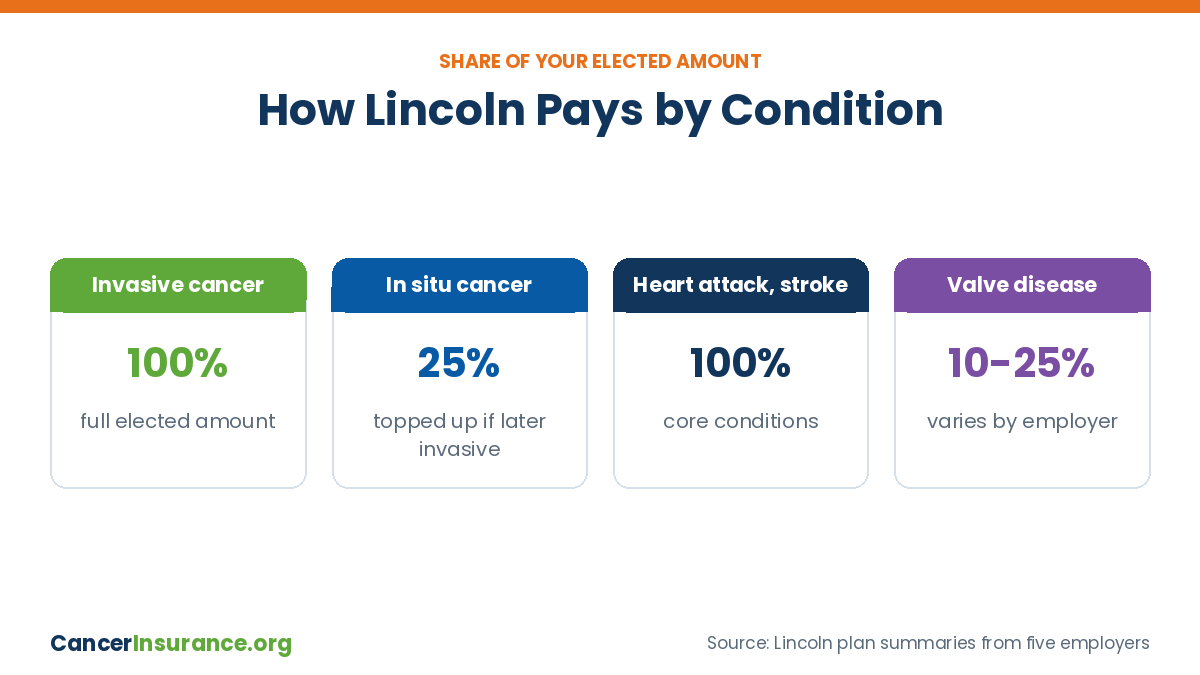
Lincoln Financial critical illness insurance is a group plan you buy through an employer, issued by The Lincoln National Life Insurance Company, that pays you a cash lump sum after a covered diagnosis, with invasive cancer paying 100% of your elected amount and in situ cancer paying 25%. Employee amounts in recent employer summaries run from $10,000 to $30,000, and most plans add a yearly cash payment for a routine screening.

2027 by the Numbers

A (Excellent)

AM Best financial strength rating for The Lincoln National Life Insurance Company, affirmed March 13, 2026 (AM Best)

$50, $75 or $100

yearly health assessment benefit options an employer can pick, per covered person (Lincoln Financial product flyer)

31 days

window to apply to keep coverage after leaving a job, in one employer’s Lincoln FAQ (Grand Valley State University)

Lincoln Financial Group is best known for life insurance and retirement accounts, but its group protection business also sells critical illness coverage to employers. If you saw it in your benefits portal, you are looking at a plan your employer designed with Lincoln, priced by age band and paid through payroll.

This page reads the documents employers actually hand out and pulls out what decides your payout when cancer is the diagnosis. One rule covers every version: this is supplemental, limited-benefit insurance. Lincoln’s own summaries say it does not meet the Affordable Care Act’s minimum essential coverage standard, so it cannot replace a health plan from work, the Marketplace or Medicare. New to lump-sum coverage? Our critical illness insurance guide covers the basics.

Compare Cancer and Critical Illness Coverage

Speak with a licensed insurance agent

1-888-891-0229

CancerInsurance.org logo

Who Stands Behind a Lincoln Critical Illness Plan

Lincoln Financial critical illness insurance payout shares for cancer and heart conditions

Lincoln Financial is the marketing name. The insurer printed in every summary we reviewed is The Lincoln National Life Insurance Company of Fort Wayne, Indiana. In New York, the coverage is issued by Lincoln Life & Annuity Company of New York.

AM Best affirmed The Lincoln National Life Insurance Company’s A (Excellent) financial strength rating, with a stable outlook, on March 13, 2026. That grade reflects claims-paying strength, not how generous your employer’s design is.

How the plan is sold: Every Lincoln critical illness document located for this page came from an employer, union or benefits platform. The employer chooses the covered conditions, amounts, riders and screening benefit.

Cancer Insurance Quotes

Call a Licensed Agent Now

Compare cancer insurance plans and cash benefits from several insurance companies in one call.

☎ 1-888-891-0229

No obligation to buy

What Has to Happen for Cancer to Pay

Lincoln pays cancer in tiers. Invasive cancer pays 100% of the amount you elected, and noninvasive cancer, also called in situ, pays 25% in every summary reviewed. A frequently asked questions sheet Lincoln prepared for Grand Valley State University (GVSU) in Michigan explains that when a cancer first paid as noninvasive is later staged as invasive, an added amount is paid to bring the claim up to the invasive level.

1

Diagnosis after your start date. The cancer must be diagnosed on or after your coverage effective date. A diagnosis made before then is not covered.

2

The right kind of proof. The GVSU FAQ says the diagnosis must come from a board-certified oncologist or pathologist, and a mammogram alone does not count. A biopsy is required, though a clinical diagnosis can be accepted when a biopsy is medically unsafe.

3

Leukemia staging. The same FAQ treats leukemia above stage zero as invasive cancer for payout purposes.

4

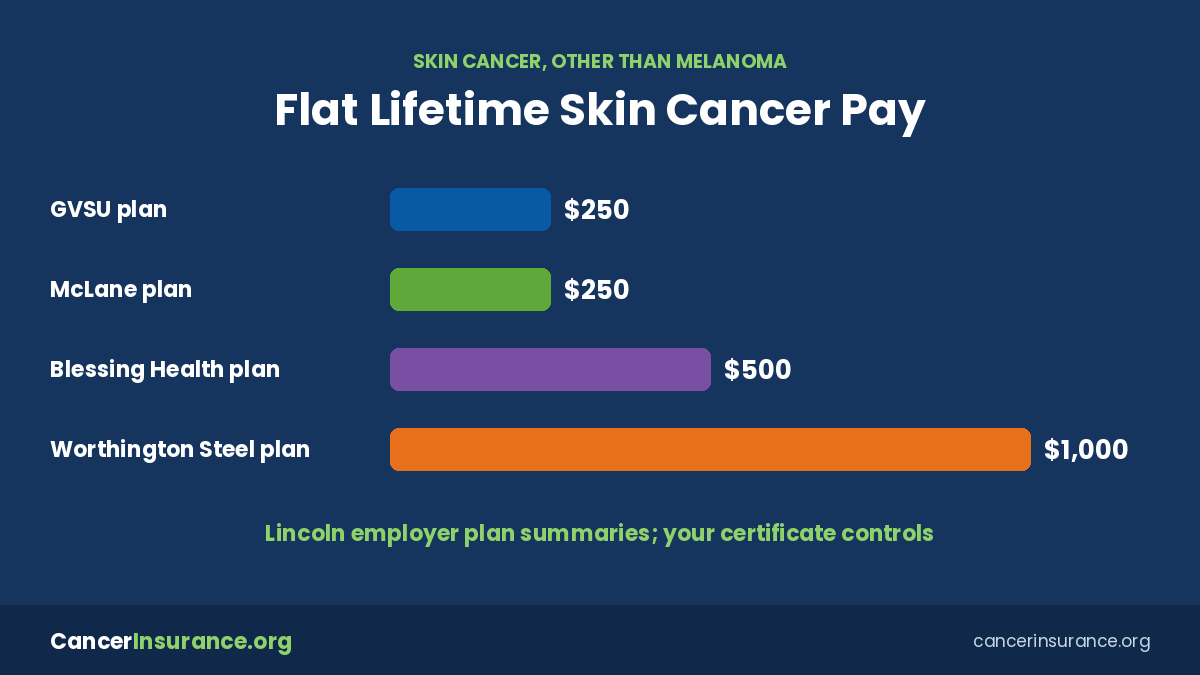
Skin cancer is separate. Skin cancer other than melanoma pays a small flat amount, not a percentage, and the figure varies by employer.

If cancer is your main worry and your employer’s plan treats it as one line on a long list, a cancer-only policy that pays for treatment may fit better. Our cancer insurance plans guide explains how those policies differ.

Five Employer Plans Built on the Lincoln Product

Lincoln’s public pages give no dollar amounts, so the table lines up summaries that five employers posted for their staff.

Employer documentEmployee amountsSpouse amountsChild amountsYearly screening payPre-existing wording
Chapman University (2027 enrollment)$10,000, $20,000 or $30,000$5,000 to $15,000, up to 50%50% of employee amount, no added cost$50Diagnosed before coverage starts: not covered
Grand Valley State Univ. (2024)$10,000, $15,000 or $20,000$5,000 to $10,000, up to 50%$5,000 to $10,000, up to 50%Not in summaryNot applicable
Worthington Steel$10,000, $20,000 or $30,000$10,000 to $30,000, up to 100%$5,000 to $15,000$50Diagnosed before coverage starts: not covered
Blessing Health (2026 enrollment)$10,000, $20,000 or $30,000$5,000 to $15,000, up to 50%$5,000 to $15,000, up to 50%$50Not in summary
Hologic (July 2025 to June 2026)$10,000 or $20,000$5,000 or $10,000, up to 50%$2,500 or $5,000$100Not in summary

Our comparison of Lincoln critical illness summaries posted by Chapman University, Grand Valley State University, Worthington Steel, Blessing Health System and Hologic. Your certificate and state rules control.

Premiums differ just as much. Worthington Steel’s sheet charges $1.588 a month per $1,000 at ages 45 to 49 and $4.287 at ages 60 to 64. Our math puts a $20,000 employee amount at about $31.76 a month in the first band and $85.74 in the second. Those rates belong to that employer only, so check your own group’s sheet.

Fine Print: Skin Cancer, Repeat Claims and Look-Backs

Lincoln Financial critical illness insurance flat skin cancer benefit by employer plan

Three lines in a Lincoln summary decide whether a later or smaller claim pays.

A second diagnosis. The GVSU FAQ says a new diagnosis tied to a condition already paid can pay after more than 12 months without treatment, and an unrelated covered condition can pay more than six months after the earlier one. The same sheet also shows shorter figures in places, so confirm the gap in your certificate.

Pre-existing conditions. The GVSU and McLane summaries list the pre-existing limit as not applicable. Chapman’s and Worthington Steel’s only say that a condition diagnosed before coverage begins is not covered. Some older Lincoln designs used a 12-month look-back, so read your own.

Common exclusions. Summaries exclude suicide attempts, felonies, war, riots, time spent incarcerated and a heart attack or cardiac arrest that happens during a medical procedure.

None of these summaries describes a benefit cut at age 70 or a set lifetime cap. They show premiums rising by age band, and they call the policy limited and conditionally renewable.

Compare Cancer and Critical Illness Coverage

Speak with a licensed insurance agent

1-888-891-0229

CancerInsurance.org logo

The Health Assessment Benefit and Optional Riders

Most Lincoln plans pay a small cash amount once each plan year when you or a covered family member completes a qualifying test. Lincoln’s product flyer lets employers set it at $50, $75 or $100 per person, with level or increasing options, which is why Hologic’s plan pays $100 while Chapman’s pays $50.

Tests that count. A Lincoln health assessment flyer lists cancer screenings such as mammography, Pap smear, colonoscopy, PSA and HPV tests, oral cancer screening and blood tumor markers, plus heart tests, diabetes, HIV and hepatitis screening.

One per year. The flyer allows one covered test per plan year, with no waiting period.

State limits. The same flyer says the benefit is not available in Minnesota or Missouri, and that applicants in California and New York must also have major medical coverage.

Riders. Lincoln’s flyer names add-ons such as supplemental conditions, accidental injury, occupational disease and recovery assistance. Availability varies by state and by employer.

Premium relief: The GVSU FAQ describes a waiver of premium when an employee is totally and continuously disabled by a covered critical illness for more than six months. The waiver can then last up to two years. Not every Lincoln plan includes it.

Filing a Claim, Leaving Your Job or Buying Your Own

Lincoln’s claim flyer for Chapman University describes an online process at LincolnFinancial.com that covers critical illness and health assessment claims alike.

1

Register and log in. Create an individual account the first time, then choose the critical illness coverage and select Submit a claim.

2

Upload the records. Add the Authorization for Release of Information form from the Forms page, plus medical records that prove the diagnosis, such as a pathology report.

3

Answer follow-ups quickly. A claims specialist may contact you, your doctor or your employer, and a decision is made once Lincoln has everything it needs.

Leaving work does not have to end coverage. Most summaries list portability as included, and the GVSU FAQ says employees who leave or retire before age 70 can apply within 31 days to keep it. Lincoln does not appear to sell this plan to people outside an employer group. If you have no workplace option, or want coverage that stays with you, compare individual critical illness insurance and the carriers on our cancer insurance providers list.

Bottom Line

Lincoln Financial critical illness insurance is an employer plan from an A-rated Lincoln insurer that pays 100% for invasive cancer and 25% for in situ cancer in every summary reviewed. Amounts, skin cancer pay, screening pay and pre-existing wording change from one employer to the next, so the certificate matters more than the brand. Treat the cash as an add-on to real health insurance, not a replacement for it.

Get Free Critical Illness Quotes Today

Speak with a licensed insurance agent

1-888-891-0229

CancerInsurance.org logo

Lincoln Financial Critical Illness Insurance — Frequently Asked Questions

➤ Which company actually pays a Lincoln critical illness claim?

The Lincoln National Life Insurance Company in Fort Wayne, Indiana, in most states. In New York, the issuer is Lincoln Life & Annuity Company of New York. Lincoln Financial is the marketing name for both.

➤ How much does Lincoln pay for skin cancer?

A flat lifetime amount, not a percentage. Summaries we reviewed paid $250 (GVSU and McLane), $500 (Blessing Health) and $1,000 (Worthington Steel) for skin cancer other than melanoma.

➤ Does a mammogram count as proof of breast cancer for a Lincoln claim?

Not by itself, according to a Lincoln FAQ for GVSU employees. A biopsy is required, unless a biopsy would be medically unsafe and a clinical diagnosis is accepted instead.

➤ Will Lincoln pay more if my early-stage cancer turns out to be invasive?

Yes, under the design described in the GVSU FAQ. The plan first pays the noninvasive share, then pays an added amount if later staging shows the cancer is invasive.

➤ Can my children be covered under my Lincoln plan?

Usually, yes. Child amounts range from $2,500 to $15,000 in the summaries reviewed, and Chapman’s plan covers children at 50% of the employee amount at no added cost. Children can stay on until the end of the month they turn 26 in the GVSU plan.

➤ Which screenings pay the Lincoln health assessment benefit?

Lincoln’s flyer lists tests such as mammograms, Pap smears, colonoscopies, PSA and HPV tests, stress tests and diabetes screening. One test per covered person pays each plan year.

➤ Is a Lincoln critical illness payout taxable?

Lincoln’s summaries reviewed here do not address taxes. In general, cash from a plan paid with pre-tax payroll dollars can be taxable, so ask your employer how premiums are deducted.

➤ Does Lincoln critical illness insurance replace my health plan?

No. Lincoln’s summaries call it a limited policy that does not meet the ACA’s minimum essential coverage requirement, and California requires a qualifying medical plan first. It pays cash on top of your health coverage.

Cancer Insurance Quotes

Call a Licensed Agent Now

Compare cancer insurance plans and cash benefits from several insurance companies in one call.

☎ 1-888-891-0229

No obligation to buy

Ready to Compare? Get Free Cancer Insurance Quotes

Speak with a licensed insurance agent

1-888-891-0229

CancerInsurance.org logo

ZRN Health & Financial Services, LLC, a Texas limited liability company