




Speak with a licensed insurance agent

1-888-891-0229

Mutual of Omaha Critical Illness Insurance: Benefits, Ages and Claim Rules

Updated November 2026

Key Takeaway

Mutual of Omaha critical illness insurance is an individual lump-sum policy that pays you $10,000 to $100,000 if you are diagnosed with one of 11 covered conditions, including cancer, heart attack and stroke, and you can apply between ages 18 and 64. It is a supplemental, limited-benefit policy that adds cash on top of your health plan and does not replace health insurance.

2027 by the Numbers

$10K–$100K

lump-sum benefit range (Mutual of Omaha)

18–64

issue ages for lifetime coverage (Mutual of Omaha)

11

covered diagnoses in the individual policy (carrier brochure)

A+

AM Best financial strength, affirmed April 2026

Mutual of Omaha sells its critical illness coverage two ways: as an individual policy you buy on your own, and as a group plan offered by some employers. This guide focuses on the individual version, which is issued by Mutual of Omaha Insurance Company and pays one cash benefit straight to you after a covered diagnosis. The check does not go to a doctor or hospital, and you decide how to spend it.

The sections below are built from the carrier’s brochure, application and outline of coverage. They cover the 11 conditions and what each one pays, the health questions on the application, the rule that ends the policy after a full payout, and what moves the premium. To see how this kind of coverage works in general, start with the critical illness insurance hub.

Compare Critical Illness and Cancer Plans

Speak with a licensed insurance agent

1-888-891-0229

CancerInsurance.org logo

How the Mutual of Omaha Critical Illness Policy Is Built

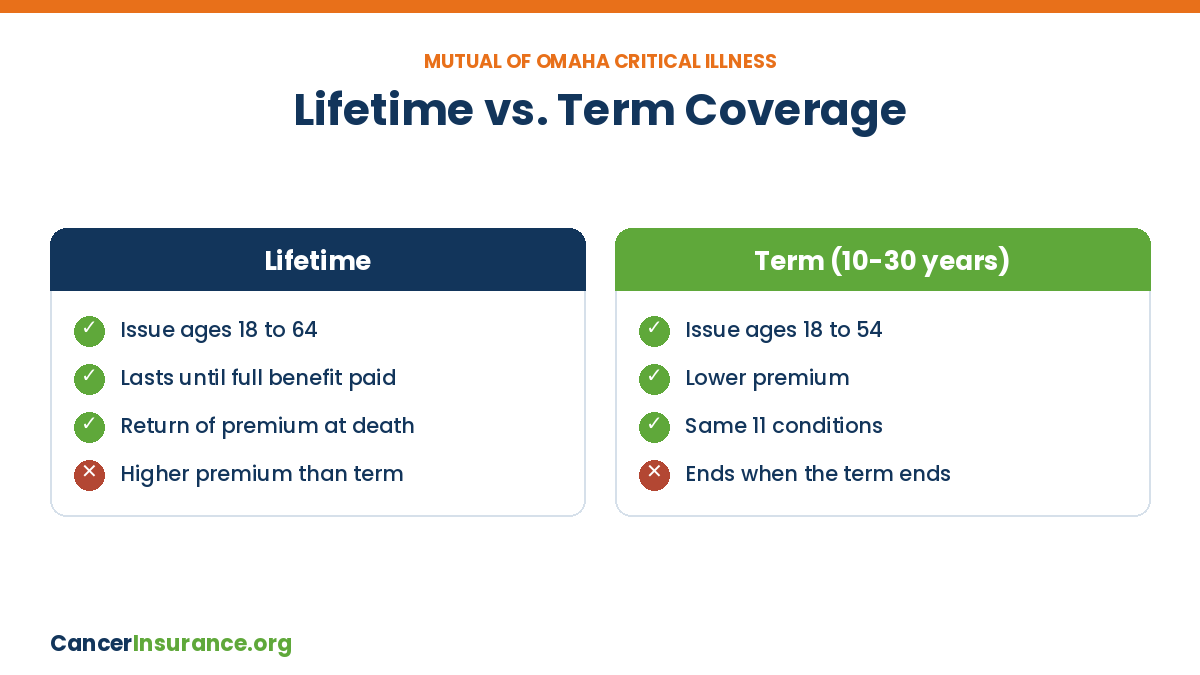
Mutual of Omaha critical illness insurance lifetime coverage compared with term coverage

You pick one benefit amount between $10,000 and $100,000. On the application form reviewed for this guide, the amount is chosen in $1,000 steps. You then pick how long the coverage lasts: for life, or for a term of 10, 15, 20 or 30 years. Lifetime coverage can be bought from age 18 to 64. Term coverage has a lower cap and is issued from age 18 to 54.

Who can be covered. Mutual of Omaha offers individual, single-parent and family plans. The carrier says a family pays the same price no matter how many children are on the policy. The application reviewed lists a child benefit equal to the parent’s amount, up to $50,000.

Return of premium at death. If the insured person dies while the policy is in force, the premiums paid, minus any benefits already paid, go to the beneficiary. This is built into the base policy.

No cut at older ages. The benefit is not reduced at age 65 or any later age, which differs from many workplace plans that trim benefits after 65 or 70.

Optional riders. Riders such as a cash value rider or an intensive care unit rider can be added for extra premium. Rider availability varies by state.

Keep in mind: Mutual of Omaha’s own materials call this a limited-benefit health policy and a supplement to health insurance, not a substitute for major medical coverage. It pays a fixed amount after a covered diagnosis. It does not pay your hospital or doctor bills, and you still need employer, ACA Marketplace or Medicare coverage.

Cancer Insurance Quotes

Call a Licensed Agent Now

Compare cancer insurance plans and cash benefits from several insurance companies in one call.

☎ 1-888-891-0229

No obligation to buy

The 11 Covered Conditions and What Each One Pays

Nine conditions pay the full amount you chose. Two heart procedures pay a quarter of it. The last column shows what each would pay on a $25,000 policy, simple math on the carrier’s percentages and not a quote.

Covered conditionShare of lump sumOn a $25,000 policy
Internal cancer or malignant melanoma100%$25,000
Heart attack100%$25,000
Stroke100%$25,000
Kidney (renal) failure100%$25,000
Major organ transplant100%$25,000
Alzheimer’s disease100%$25,000
Blindness, deafness or paralysis (each listed separately)100%$25,000
Coronary artery bypass surgery25%, once per policy$6,250
Coronary angioplasty surgery25%, once per policy$6,250

Source: Mutual of Omaha critical illness brochure and outline of coverage (policy series CP1/CP4 or state equivalent). Definitions and availability vary by state; the policy you receive controls.

A 25% payment is not extra money. The outline of coverage says any partial payment lowers the lump sum left for that person’s future claims. So if a $25,000 policy pays $6,250 for bypass surgery, $18,750 is left for a later heart attack, stroke or cancer. Cancer coverage is limited to internal cancer and malignant melanoma, so skin cancers other than melanoma are not named as covered conditions.

Health Questions on the Mutual of Omaha Application

There is no medical exam. Benefit amounts of $10,000 to $50,000 go through a shorter express process, and $51,000 to $100,000 uses simplified underwriting. Either way, a yes answer to a health question on the application leaves that person off the policy. The questions fall into four groups.

HIV and AIDS. Any past diagnosis or treatment of HIV, AIDS or ARC, with no time limit.

Cancer, 10-year look-back. Internal cancer, malignant tumor, lymphoma, leukemia or melanoma in the past 10 years, plus any test in the past 3 years that has not ruled cancer out.

Heart and blood vessels. A heart or blood vessel disorder in the past 10 years (controlled high blood pressure or cholesterol does not count), pending heart tests in the past 3 years, and certain types of diabetes.

Other critical illnesses. Kidney problems, dementia, chronic liver disease, eye or ear disease, neurological conditions such as MS or Parkinson’s, organ transplant and severe lung disease in the past 10 years.

The diabetes question is narrower than it looks. It asks about Type 1 diabetes, Type 2 diagnosed before age 30, an A1C above 7.0 in the past 12 months, or diabetes combined with tobacco use. Gestational diabetes is excluded. Some policy schedules can also carry a separate pre-existing condition limitation, which applies only if it is printed on the schedule.

Application check: Each question covers every person named on the application, not only the main applicant. A spouse or child with a yes answer is removed from the policy while the others can still be issued. Coverage starts only after the policy is issued and the first premium is paid, because the application does not give temporary coverage.

After a Claim: The 30-Day Cancer Rule and When the Policy Ends

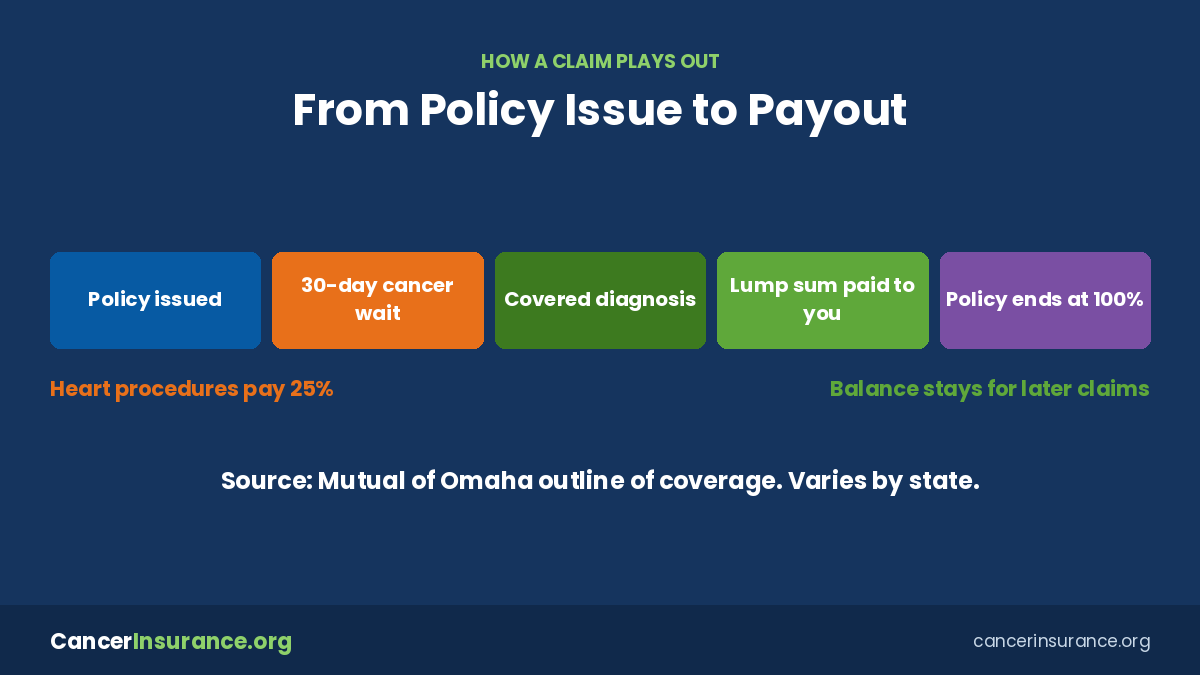
Mutual of Omaha critical illness insurance claim path from issue to the end of the policy

Two rules in the outline of coverage shape every claim. Neither is spelled out on the carrier’s main product page, so they are easy to miss.

1

Clear the cancer waiting period. Cancer must be diagnosed at least 30 days after the policy’s effective date or reinstatement date. A cancer found inside that window is not paid as a normal claim, and coverage for that person ends. The outline ties this 30-day rule to cancer.

2

Get a covered diagnosis. Your doctor confirms the condition and the date it was diagnosed. The claim pays the share shown in the table above.

3

Receive the lump sum. The money is paid to you. No medical bills or receipts are needed to show how it is spent.

4

Watch the remaining balance. After a 25% heart procedure claim, the rest of the benefit stays in force for other conditions.

5

Know when coverage stops. Once Mutual of Omaha has paid 100% of the primary insured’s lump sum, the policy ends unless a rider keeps paying. The outline does not describe a recurrence or second-occurrence benefit.

This is the biggest design difference from many group critical illness plans, which can pay again for a second condition or a cancer that comes back. With this individual policy, one full claim, such as a heart attack, uses up the benefit, and a later cancer would not be paid. A term policy also stops when its term ends. The return of premium benefit pays only at death and is reduced by any claims already paid.

Compare Critical Illness and Cancer Plans

Speak with a licensed insurance agent

1-888-891-0229

CancerInsurance.org logo

Individual Policy vs. Mutual of Omaha's Workplace Plan

Many people see Mutual of Omaha critical illness coverage on an employer benefits menu. That is a different product from a different company in the same group. The side-by-side below pulls the key terms from each product’s own disclosures.

FeatureIndividual policyEmployer (group) plan
InsurerMutual of Omaha Insurance CompanyUnited of Omaha Life Insurance Company (Mutual of Omaha Insurance Company in New York)
How you get itApply on your own, ages 18 to 64Enroll at work during open enrollment
Covered conditions11 named diagnosesMore than 130 conditions in the 2024 redesign, depending on plan
Benefit amount$10,000 to $100,000, your choiceSet by the employer’s plan design
Health questionsYes, express or simplifiedDepends on the employer’s plan

Sources: Mutual of Omaha individual brochure and outline of coverage; Mutual of Omaha employer critical illness page and 2024 product announcement. Group terms vary by employer.

The individual policy stays with you no matter where you work, which matters for anyone who changes jobs or retires before 65. The workplace plan may cover far more conditions, but its terms are chosen by the employer, so read your plan certificate. Both are underwritten by companies that AM Best rated A+ (Superior) with a stable outlook in April 2026.

What Moves the Price and How It Fits Next to the Cancer Policy

Mutual of Omaha does not publish a rate table for this policy, and prices vary by state. These are the inputs that set your premium.

Age when you apply. Rates are set by issue age, and the outline says premiums cannot rise later because you get older, get sick or file a claim. A general rate change for everyone in a class needs 60 days’ written notice.

Benefit amount and length. A bigger lump sum costs more, and lifetime coverage costs more than a shorter term.

Who is on the policy. Adding a spouse raises the premium. Adding children costs the same whether there is one child or several.

Riders and state. Each optional rider adds premium, and both rates and benefits can differ by state.

Mutual of Omaha’s separate cancer policy uses the same $10,000 to $100,000 range but covers only internal cancer and malignant melanoma, and its lifetime version can be bought up to age 89. That makes it the only one of the two open to buyers 65 and older. The full side-by-side is on the Mutual of Omaha cancer insurance vs. critical illness insurance page. For typical price ranges across carriers, see how much critical illness insurance costs, and compare other carriers in the cancer insurance providers list or the 5 best cancer insurance policies.

Bottom Line

Mutual of Omaha critical illness insurance gives adults 18 to 64 one lump sum of $10,000 to $100,000 for 11 serious diagnoses, with no age-based benefit cut and a return of premium at death. The trade-offs are a 30-day wait for cancer, health questions with 10-year look-backs, and a policy that ends after one full payout. It is limited-benefit coverage, so keep your health insurance and compare it with a cancer-only plan before you buy.

Get Free Cancer Insurance Quotes

Speak with a licensed insurance agent

1-888-891-0229

CancerInsurance.org logo

Mutual of Omaha Critical Illness Insurance — Frequently Asked Questions

➤ What conditions does Mutual of Omaha critical illness insurance cover?

The individual policy pays 100% for internal cancer or malignant melanoma, heart attack, stroke, kidney failure, major organ transplant, Alzheimer’s disease, blindness, deafness and paralysis. Coronary artery bypass surgery and coronary angioplasty each pay 25%, once per policy.

➤ How old can you be to buy it?

Lifetime coverage is issued from age 18 to 64, and term coverage from 18 to 54. People 65 and older would need to look at Mutual of Omaha’s cancer policy or another carrier.

➤ Can the policy pay more than once?

It can pay a 25% heart procedure benefit and later pay the rest of the lump sum for another condition. Once 100% of the primary insured’s benefit has been paid, the policy ends unless a rider continues benefits.

➤ Is there a waiting period for cancer?

Yes. Cancer must be diagnosed at least 30 days after the effective date or reinstatement date. A cancer found in that window is not paid as a regular claim, and coverage for that person ends.

➤ Does Mutual of Omaha require a medical exam?

No exam is required. Benefits up to $50,000 use express underwriting and $51,000 to $100,000 use simplified underwriting, both based on yes-or-no health questions.

➤ What is the return of premium benefit?

If the insured person dies while the policy is in force, Mutual of Omaha refunds the premiums paid, minus any benefits already paid, to the beneficiary. It is part of the base critical illness policy.

➤ Is the employer version the same product?

No. Workplace plans are issued by United of Omaha Life Insurance Company, outside New York, and can cover more than 130 conditions depending on the plan. The individual policy covers 11 diagnoses and you choose the benefit amount.

➤ Does it replace my health insurance?

No. Mutual of Omaha describes it as a limited-benefit supplement, not a substitute for major medical coverage. It pays cash after a covered diagnosis, while your health plan still pays the medical bills.

Cancer Insurance Quotes

Call a Licensed Agent Now

Compare cancer insurance plans and cash benefits from several insurance companies in one call.

☎ 1-888-891-0229

No obligation to buy

Ready to Compare? Get Free Cancer Insurance Quotes

Speak with a licensed insurance agent

1-888-891-0229

CancerInsurance.org logo

ZRN Health & Financial Services, LLC, a Texas limited liability company