




Speak with a licensed insurance agent

1-888-891-0229

Spouse Critical Illness Insurance: How Adding a Husband, Wife or Partner Works

Updated November 2026

Key Takeaway

Spouse critical illness insurance is coverage you add for your husband, wife or domestic partner through your own workplace critical illness plan, and it usually pays your spouse a lump sum set at 50% to 100% of your benefit or a fixed amount such as $5,000 to $15,000. In most group plans you must enroll yourself first, and amounts above the guaranteed issue limit require health questions.

2027 by the Numbers

50%

spouse share of the employee benefit in MetLife, Guardian and Unum plan summaries reviewed

$30,000

spouse guaranteed issue cap in one 2026 Cigna plan summary

31 days

window for a spouse to continue Unum coverage after the employee’s death or a divorce

Open enrollment screens often show an Employee + Spouse option next to the critical illness plan. Checking it gives your partner a lump-sum benefit for a covered diagnosis such as cancer, heart attack or stroke. Spouse coverage follows its own rules, though: a smaller benefit, different age limits and, in some plans, a different way of setting the price.

This guide lays out those rules using the carriers’ own published plan summaries and certificates. If you are new to the product, start with our overview of critical illness insurance. Like any critical illness policy, spouse coverage is supplemental, limited-benefit insurance. It pays cash on top of a health plan and does not replace employer, ACA Marketplace or Medicare coverage.

Compare Critical Illness Plans for Couples

Speak with a licensed insurance agent

1-888-891-0229

CancerInsurance.org logo

How Spouse Coverage Fits Into a Workplace Critical Illness Plan

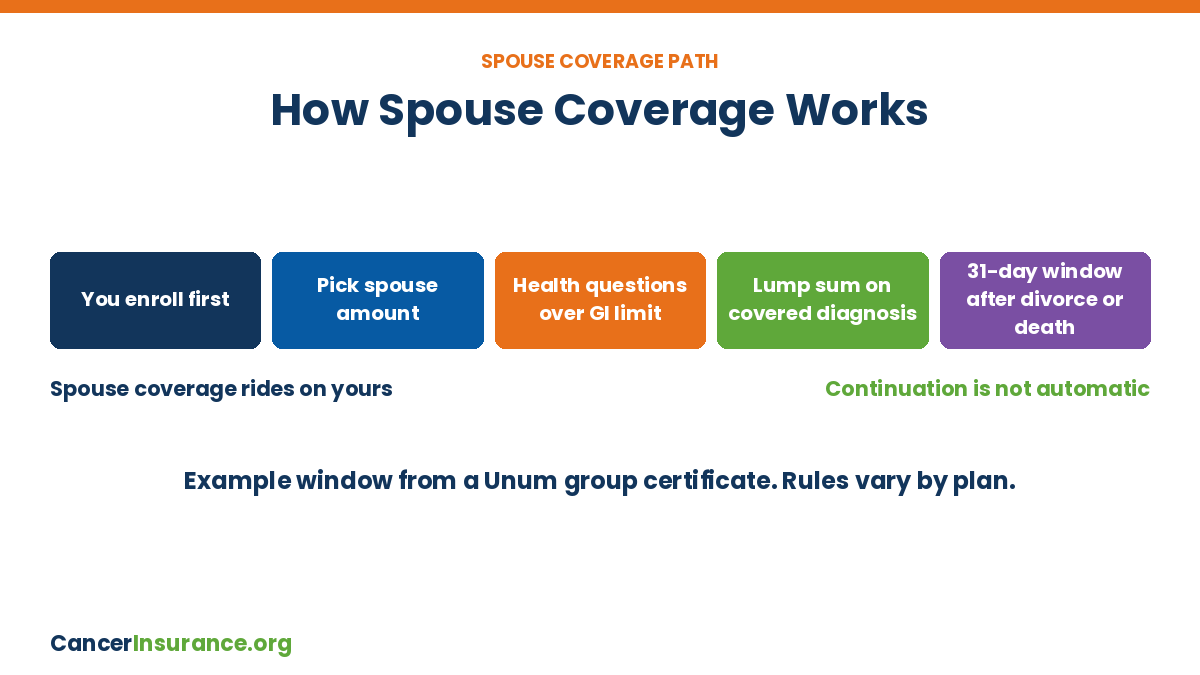
How spouse critical illness insurance works through a workplace plan, from employee enrollment to continuation after divorce or death

Most spouse coverage is an add-on to a group policy your employer offers. Your spouse becomes a covered person under your certificate, and the plan pays a set amount if your spouse is diagnosed with a covered condition after coverage starts. The adult condition list is usually the same one that applies to you.

You go first. Unum, Voya and Cigna summaries all say spouse coverage is only available when the employee elects coverage too. A spouse cannot hold the workplace plan alone.

A share of your amount. Many plans tie the spouse benefit to yours, most often at 50%. Others offer fixed spouse amounts that do not depend on your election.

Who counts as a spouse. Plans cover a legal spouse. Domestic partners and civil union partners are covered in many plans, but MetLife notes this varies by state.

Cancer Insurance Quotes

Call a Licensed Agent Now

Compare cancer insurance plans and cash benefits from several insurance companies in one call.

☎ 1-888-891-0229

No obligation to buy

Spouse Rules Side by Side: Six Carrier Plan Documents

No single source lines up spouse rules across carriers, so the table below pulls them from plan summaries and certificates employers have posted. Each row reflects one employer’s plan design, not every plan that carrier sells.

Carrier (sample plan)Spouse benefitHealth questionsOther spouse rule
MetLife (state and university group plans)50% of employee’s initial benefitGuaranteed if employee is actively at work and spouse has no medical restriction on the formDomestic partner coverage varies by state
Cigna (2026 university plan)100% of employee amount, up to $30,000None up to $30,000 for new hires enrolling on timeSpouse covered up to age 100 if employee is approved
Guardian (hospital employer plan)50% of employee’s lump sumRequired above $10,000 spouse guaranteed issueSpouse premium based on the employee’s age
Voya / ReliaStar (court employer plan)$5,000 or $10,000 fixedNo medical questions or testsSpouse must be under 70; benefits drop 50% after 70th birthday
Unum (group certificate)$5,000 to $15,000 in $5,000 stepsEvidence of insurability may be requiredSpouse may continue coverage within 31 days of employee’s death or divorce
Aflac (worksite policy outline)50% of primary insured’s amountNot stated for spouseBenefits reduce by half for losses on or after age 75

Compiled from employer-posted plan summaries, certificates and outlines of coverage for MetLife, Cigna, Guardian, ReliaStar Life (Voya), Unum and Aflac. Your employer’s plan may use different amounts, ages and state rules; your certificate controls.

Reading the table: A 50% rule means a $20,000 employee election gives a $10,000 spouse benefit. A fixed-amount rule lets the spouse amount be chosen separately, but the cap is often low, such as $10,000 or $15,000.

Health Questions, Age Limits and How Spouse Rates Are Set

Guaranteed issue means coverage is approved without health questions, up to a set amount. Spouse limits are usually lower than the employee’s and may apply only at first eligibility or open enrollment. Above the limit, your spouse answers health questions or submits evidence of insurability, and the carrier can decline.

Whose age sets the price. Guardian’s sample plan prices spouse coverage on the employee’s age, while Voya’s sample plan uses the spouse’s own age. A large age gap between partners can change the cost.

Age bands can raise rates. Plans priced on attained age raise premiums as a covered person moves into a new age band. Issue-age plans lock the rate to the age at enrollment.

Benefit cuts at older ages. Some plans keep charging the same premium but pay less after a birthday, such as the 50% reduction at 70 in the Voya plan and at 75 in the Aflac outline.

Prior conditions. Unum’s certificate applies a 12/12 pre-existing condition limit to spouses. MetLife pays nothing for a condition diagnosed before the coverage effective date.

Spouse Rider or a Separate Policy for Your Spouse?

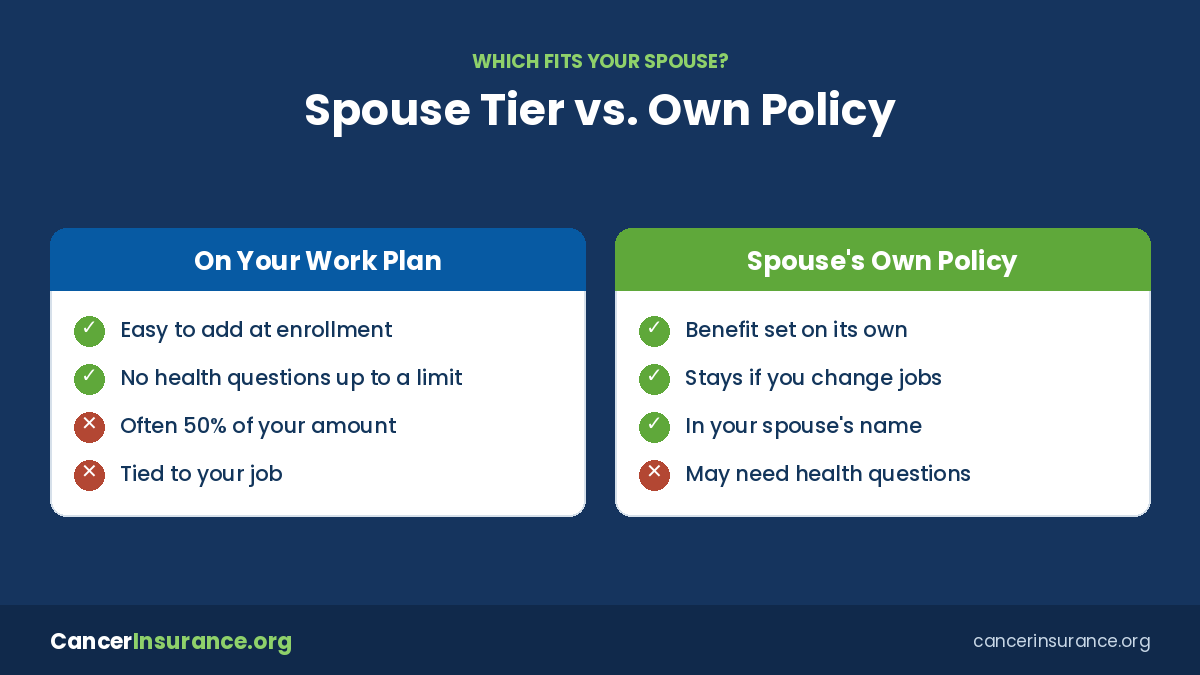
Spouse critical illness insurance on your workplace plan compared with a separate policy in your spouse's name

Adding your spouse to your plan is convenient, but a separate policy, through your spouse’s own employer or bought individually, can give a larger benefit and keeps coverage in your spouse’s name.

Your spouse has a job with benefits. Enrolling as an employee usually gives a higher benefit than a spouse tier. Unum’s certificate bars covering someone as a spouse if they are covered as an employee on the same policy.

You want more than half. A 50% spouse cap may leave a gap if your spouse earns as much as you do. Individual plans set their own amounts.

Your job may change soon. Spouse coverage rides on your employment. An individual policy does not end when you leave a job.

If cancer is the main worry, a cancer-only policy may also be worth pricing. Our list of cancer insurance plans shows options sold outside the workplace.

Compare Critical Illness Plans for Couples

Speak with a licensed insurance agent

1-888-891-0229

CancerInsurance.org logo

What Happens to Spouse Coverage After Divorce, Death or a Job Change

Group certificates list when spouse coverage ends, and most include the employee’s death, the date of divorce or annulment, and the end of the employee’s coverage. Few enrollees read this part before they need it.

1

Divorce or annulment. Spouse coverage ends on that date in the Unum certificate reviewed. The former spouse may apply to keep coverage but must apply and pay the first premium within 31 days and must have been insured on the date of divorce.

2

Death of the employee. Unum allows the same 31-day continuation for a surviving spouse. Aflac’s group brochure says a surviving spouse may continue at the existing spouse face amount.

3

Leaving your job. Portability lets you take coverage with you, often including your spouse, if you apply and pay within a deadline. Unum’s certificate sets that deadline at 31 days.

4

Using up your own benefit. Voya’s summary says that if you reach your benefit limit and end your own coverage, your spouse’s coverage cannot stay active; you must keep yours to keep theirs.

Deadline to note: Continuation windows are short and not automatic. Unum’s certificate requires the application and first premium inside 31 days.

Deciding Whether to Add Your Spouse at Open Enrollment

Spouse coverage is usually inexpensive at younger ages. In one MetLife university plan, monthly cost per $15,000 for ages 30 to 34 was $4.05 for Employee + Spouse compared with $2.85 for Employee Only. In a Guardian employer plan, a $5,000 spouse benefit ran from $1.70 a month under age 30 to $18.80 a month at 70 and older. Prices in your plan will differ, so check the rate sheet. For more on what drives premiums, see how much critical illness insurance costs.

Before you check the box, weigh whether a lump sum would help if your spouse were the one diagnosed, whether the spouse amount is large enough to matter, and whether your spouse can get better coverage elsewhere. Our guide on whether voluntary critical illness insurance is worth it covers the same trade-offs for your own coverage.

Before you enroll: Check the spouse section of the certificate for the benefit formula, the spouse guaranteed issue amount, the age at which benefits reduce and the continuation rules. Many plans also pay a yearly screening benefit for a covered spouse, such as $50 in the Aflac brochure and $100 in the Voya summary.

Bottom Line

Spouse critical illness insurance is a low-cost way to give your partner a lump-sum benefit through your job, but the benefit is often half of yours and depends on you staying enrolled. Compare your certificate’s spouse rules with what your spouse could get alone, and treat it as supplemental coverage on top of health insurance, not a replacement.

Related: child critical illness insurance How kids are covered on a parent’s plan, age limits and childhood conditions by carrier.

Get Free Critical Illness Quotes

Speak with a licensed insurance agent

1-888-891-0229

CancerInsurance.org logo

Spouse Critical Illness Insurance — Frequently Asked Questions

➤ Can my spouse get workplace critical illness coverage if I don’t enroll?

In most group plans, no. Unum, Voya and Cigna summaries all state that spouse coverage is available only when the employee elects coverage. If you skip it, your spouse would need coverage through their own job or an individual policy.

➤ How much coverage can a spouse get?

It depends on the plan. MetLife, Guardian and Unum sample plans pay a spouse 50% of the employee amount, a 2026 Cigna plan allows 100% up to $30,000, and Voya and another Unum plan use fixed amounts of $5,000 to $15,000.

➤ Does my spouse have to answer health questions?

Usually only above the guaranteed issue amount. A Guardian plan requires health questions for spouse elections over $10,000, while a Voya plan asks no medical questions for its spouse options.

➤ Is there an age limit for spouse coverage?

Some plans set one. A Voya plan requires the spouse to be under 70 to enroll and reduces benefits by 50% after age 70, while a Cigna plan covers a spouse up to age 100.

➤ Does my age or my spouse’s age set the spouse premium?

It varies by carrier. One Guardian plan bases spouse premiums on the employee’s age and one Voya plan on the spouse’s own age.

➤ What happens to my spouse’s coverage if we divorce?

Spouse coverage usually ends on the date of divorce. Unum’s certificate lets the former spouse apply to continue coverage if they apply and pay the first premium within 31 days.

➤ Can my spouse keep the coverage if I die?

Often, yes. Unum allows a surviving spouse to continue within 31 days, and Aflac’s group brochure says a surviving spouse may continue at the existing spouse face amount.

➤ Does spouse critical illness insurance replace health insurance?

No. It is supplemental, limited-benefit coverage that pays a lump sum for covered diagnoses. Your spouse still needs medical coverage through work, the ACA Marketplace or Medicare.

Cancer Insurance Quotes

Call a Licensed Agent Now

Compare cancer insurance plans and cash benefits from several insurance companies in one call.

☎ 1-888-891-0229

No obligation to buy

Ready to Compare? Get Free Cancer Insurance Quotes

Speak with a licensed insurance agent

1-888-891-0229

CancerInsurance.org logo

ZRN Health & Financial Services, LLC, a Texas limited liability company