




Speak with a licensed insurance agent

1-888-891-0229

Critical Illness Insurance and Pre-Existing Conditions: Look-Back Windows, Health Questions and What Still Pays

Updated November 2026

Key Takeaway

You can usually buy critical illness insurance with a pre-existing condition, most easily through a workplace plan with guaranteed issue, but it will not pay for an illness diagnosed before coverage starts, and illnesses tied to conditions treated in a 3- to 12-month look-back are typically excluded for the first 6 to 12 months. Individual policies sold on your own often ask health questions and may decline you after a recent cancer, heart attack or stroke.

2027 by the Numbers

12/12

look-back and limit months in the Aflac group critical illness brochure written by Continental American Insurance Company

3/6

look-back and limit months in a 2026 MetLife group summary, which skips the limit for heart attack and stroke

10 years

how far back the LifeSecure individual critical illness knockout questions reach for heart disease, stroke and cancer

Critical illness coverage pays a lump sum when a doctor diagnoses a listed condition, such as a heart attack, stroke, kidney failure, a major organ transplant or invasive cancer. Because the payout is tied to a diagnosis, insurers guard against illnesses already brewing before the start date. That is the job of the pre-existing condition clause.

Below you will find how the clause is built, six filed documents lined up side by side, how workplace plans differ from policies you buy alone, and what happens if you have already had a heart attack, stroke or cancer. Remember that critical illness insurance is a supplemental, limited-benefit policy that does not replace health insurance. For the product basics, start with our critical illness insurance guide.

Compare Critical Illness Coverage Options

Speak with a licensed insurance agent

1-888-891-0229

CancerInsurance.org logo

The Two Clocks Behind a Pre-Existing Condition Clause

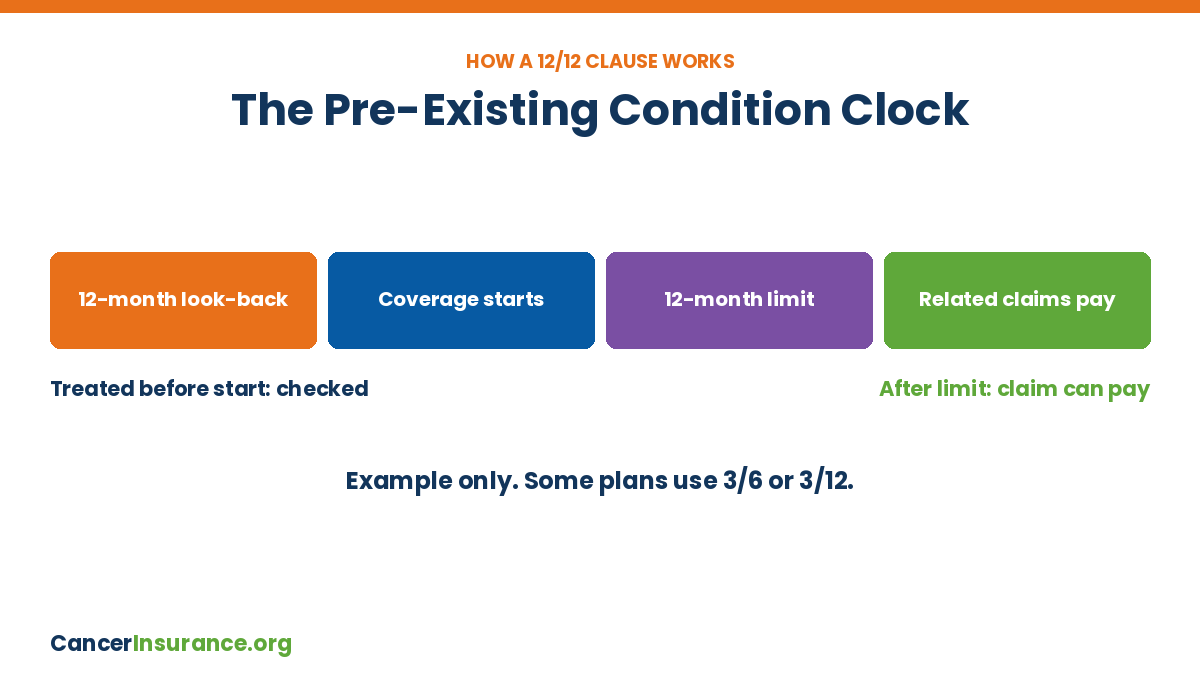
Timeline of a critical illness insurance pre existing conditions clause with a 12-month look-back and a 12-month limit

Most critical illness certificates describe the limit with two numbers, such as 12/12 or 3/6. The first number sets how far the insurer looks back before your effective date. The second sets how long after that date a related diagnosis will not pay. A third rule sits on top of both: an illness diagnosed before coverage begins never counts as a covered first diagnosis.

Look-back window. A condition counts only if you had advice, a diagnosis, care or treatment for it during the stated months before coverage. Symptoms you never saw a doctor about are handled differently from one document to the next, so read the definition itself.

Limit period. If a covered illness is diagnosed during this window and is caused by or tied to that earlier condition, the policy pays nothing for it. An unrelated new illness can still pay.

After the window. Once the limit period ends, a diagnosis linked to the old condition is generally treated like any other covered claim, subject to the policy’s own definitions.

The months matter more than the label. A 3/6 clause reaches only a short slice of your history, while a 12/12 clause could block a first-year heart attack claim tied to blood pressure treated last spring.

Cancer Insurance Quotes

Call a Licensed Agent Now

Compare cancer insurance plans and cash benefits from several insurance companies in one call.

☎ 1-888-891-0229

No obligation to buy

Six Filed Critical Illness Documents, Side by Side

No single public source compares how carriers word this clause, so the table below lines up six real documents: five employer plan summaries or certificates and one individual outline of coverage.

DocumentPlan typeLook-backLimit after startDetail worth knowing
MetLife summary, Muskegon Community College (2026)Employer group3 months6 monthsLimit does not apply to heart attack or stroke and is waived if you had existing coverage
Guardian employer benefit summaryEmployer group3 months12 monthsNo health questions up to $20,000 for employees and $10,000 for spouses
Aflac group brochure, Continental American Insurance Company (Fulton County, Ga.)Employer group12 months12 monthsApplies to illnesses caused by or affected by the earlier condition
Unum group certificate (White Earth Nation)Employer group12 months12 monthsNo limit for children born or adopted while covered
Cigna summary, Southwest Research Institute (2024)Employer groupNot stated in monthsNot stated in monthsDiagnosis date must fall while coverage is in force; cancer definition limits payment for the return or spread of a cancer diagnosed before coverage
Aflac individual outline of coverage, form B71125GAIndividual12 months12 monthsInternal cancer diagnosed in the first 30 days is not payable

Our review of each document as published by the employer or insurer. Group contracts and state filings differ, and the certificate or policy you receive controls.

ManhattanLife’s knowledge base lists 12/12 for its critical illness, hospital indemnity and disability products. The MetLife exception for heart attack and stroke is the kind of detail a brochure rarely puts up front.

Guaranteed Issue at Work vs. Health Questions on Your Own

Employer plans usually accept everyone who enrolls on time up to a set amount, called guaranteed issue. The Guardian summary above allows $20,000 for employees without health questions, and the Cigna summary lists up to $30,000 for employees and $15,000 for spouses. Elect more than the limit and you answer health questions for the extra amount. The trade-off is that guaranteed issue plans lean on the pre-existing clause instead of screening you.

Enrollment fact: Guaranteed issue usually applies at first eligibility or during open enrollment. Adding coverage or raising the amount later can require evidence of insurability, and Unum’s certificate says evidence may be required for spouse coverage and for coverage changes.

Policies bought on your own work the other way. They often screen with yes-or-no questions and then apply a lighter clause or none at all. LifeSecure’s critical illness guide declines any yes answer to questions covering heart disease, stroke, cancer, chronic lung disease, liver disease, impaired kidney function and diabetes in the past 10 years, abnormal tests still pending in the past 2 years, and Social Security disability income in the past 2 years. Its worksite version waives those questions at a $10,000 guaranteed issue amount. Our page on how to get critical illness insurance covers the buying routes in more depth.

Already Had a Heart Attack, Stroke or Cancer?

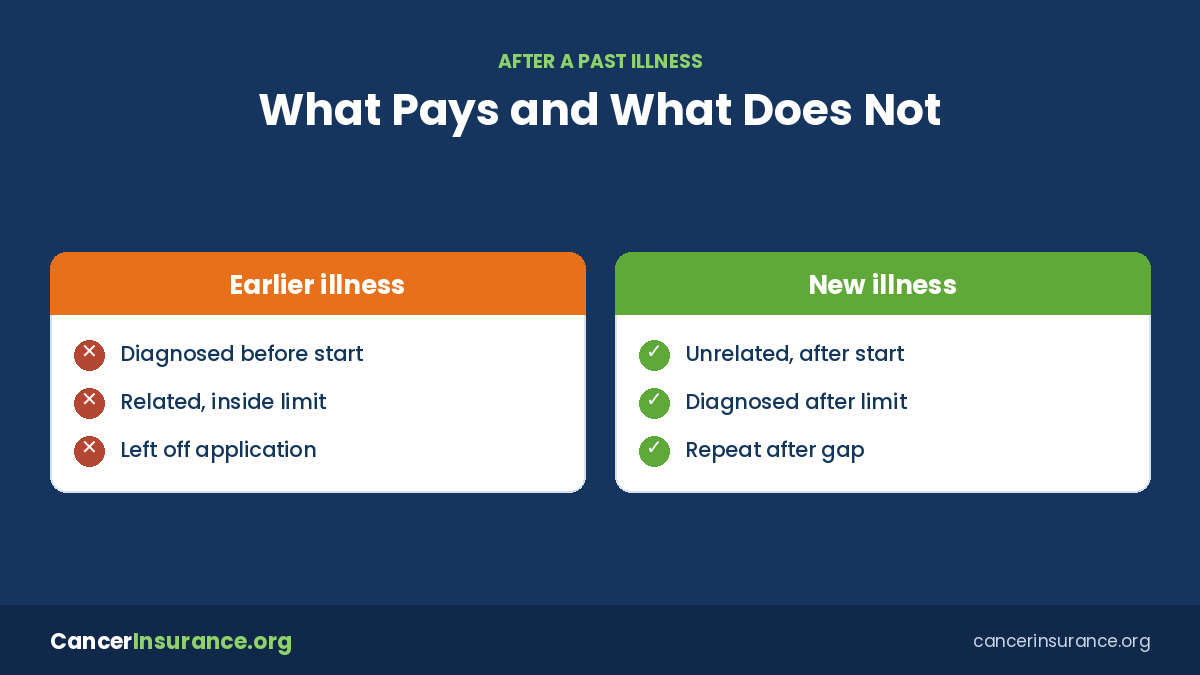
Critical illness insurance pre existing conditions comparison of an earlier diagnosis versus a new diagnosis after coverage starts

A past major event limits what a new policy can do, but it does not make one useless. The documents reviewed here follow a common pattern.

The earlier event will not pay. Every document requires the date of diagnosis to fall after coverage begins. A heart attack last year cannot become a claim on a policy that starts this year.

Other listed illnesses can still pay. Someone who survived a stroke may still collect for a later, unrelated condition such as kidney failure or invasive cancer, once any limit period has passed.

A repeat needs a gap. Recurrence rules apply only to illnesses first paid under the policy. Guardian requires 12 straight months without symptoms or treatment, the Aflac group plan requires 6 months between diagnoses, and MetLife pauses most recurrence payments for 365 days.

Cancer has extra hurdles. The Aflac group plan requires 12 treatment-free months and complete remission before a later cancer diagnosis, while MetLife requires 180 days without treatment or symptoms.

If cancer is the main worry after an earlier diagnosis, the rules for cancer-only policies differ in their own ways; see cancer insurance and pre-existing conditions.

Compare Critical Illness Coverage Options

Speak with a licensed insurance agent

1-888-891-0229

CancerInsurance.org logo

Why Health Insurance Rules Do Not Apply Here

The Affordable Care Act bars health plans from excluding pre-existing conditions. Critical illness and other specified disease coverage, however, count as excepted benefits when sold as a separate policy that does not coordinate with a health plan and pays regardless of other coverage. A Congressional Research Service report notes that excepted benefits are generally exempt from federal health insurance requirements, which is why look-back clauses remain legal.

State rule check: States set the limits instead. The NAIC model minimum standards regulation caps a pre-existing exclusion at 12 months for most individual policies, and its specified disease section uses a 6-month look-back and a 6-month cap. Each state adopts its own version, and how a state classifies a critical illness policy decides which cap applies.

The Aflac group brochure says its benefits do not satisfy the minimum essential coverage requirement, and Unum’s certificate calls itself a non-qualified plan that is not major medical.

Honest Applications, Contestability and Shopping Steps

Leaving a diagnosis off an application can cost more than a declined policy. Unum’s certificate allows the insurer to act on misstatements during the first two years coverage is in force, and fraud has no time limit. Aflac’s outline lets it void coverage when material facts are concealed or misrepresented in a claim.

1

Check work first. Open enrollment is often the only time you can get coverage without health questions. Note the guaranteed issue amount and stay at or under it if your history is complex.

2

Find the two numbers. Locate the look-back and limit months in the certificate, plus any exceptions such as MetLife’s heart attack and stroke carve-out.

3

Ask about prior coverage credit. MetLife waives its limit with existing coverage, and Unum skips evidence of insurability for up to $50,000 already in force when an employer replaces a plan within 31 days.

4

Answer every question accurately. If an individual policy declines you, a guaranteed issue workplace plan or a cancer-only policy may be the next step.

5

Compare carriers. Review our cancer insurance providers list and the 5 best cancer insurance policies to see who offers what.

Bottom Line

A pre-existing condition rarely blocks you from buying critical illness insurance, but it does shape what the policy will pay in its first months and whether an old illness can ever be claimed. Start with any guaranteed issue plan at work, read the look-back and limit months, and answer health questions honestly. Keep your health insurance in place, since this coverage only adds cash on top.

Related: critical illness insurance waiting period The 30-day cancer wait, survival periods and the gap needed between claims, from nine US plan documents.

Get Free Critical Illness Quotes

Speak with a licensed insurance agent

1-888-891-0229

CancerInsurance.org logo

Critical Illness Insurance and Pre-Existing Conditions — Frequently Asked Questions

➤ Can I buy critical illness insurance after a heart attack?

Often yes, through a workplace plan with guaranteed issue, but that heart attack will never be paid. Many individual policies ask about heart disease, and LifeSecure’s questions reach back 10 years, so an outside application may be declined.

➤ What does 12/12 mean on a critical illness summary?

It means conditions treated or diagnosed in the 12 months before your start date are excluded for the first 12 months of coverage. After that, a related diagnosis can be paid if it meets the policy definition.

➤ Does high blood pressure count as a pre-existing condition for a stroke claim?

It can, if you were treated for it in the look-back window and the stroke is diagnosed during the limit period and is tied to that condition. MetLife’s summary reviewed here exempts heart attack and stroke from its limit, so wording matters.

➤ Will my spouse face a pre-existing condition limit too?

Usually. Unum’s certificate applies its limit to every insured person, and spouse amounts above the guaranteed issue level may require health questions. Children born or adopted while covered are exempt under that certificate.

➤ Does switching employers restart the limit?

Often it does, because a new employer plan is a new certificate. Some plans give credit for prior coverage, as MetLife does when you had existing coverage, so ask the benefits office before you drop an older policy.

➤ Can an insurer cancel my critical illness coverage over my medical history?

Insurers can act on application misstatements during a contestable period, two years in Unum’s certificate, and fraud has no time limit. Accurate answers protect a future claim.

➤ Is there critical illness insurance with no pre-existing condition limit?

Some workplace plans list none in their summaries, and others waive it for prior coverage or certain illnesses. Even then, an illness diagnosed before your start date is never paid as a first diagnosis.

➤ Does critical illness insurance count as health coverage under the ACA?

No. It is an excepted benefit, and plan documents such as Aflac’s group brochure say it does not satisfy minimum essential coverage. It pays cash on top of a health plan and does not replace one.

Cancer Insurance Quotes

Call a Licensed Agent Now

Compare cancer insurance plans and cash benefits from several insurance companies in one call.

☎ 1-888-891-0229

No obligation to buy

Ready to Compare? Get Free Cancer Insurance Quotes

Speak with a licensed insurance agent

1-888-891-0229

CancerInsurance.org logo

ZRN Health & Financial Services, LLC, a Texas limited liability company