




Speak with a licensed insurance agent

1-888-891-0229

Critical Illness Insurance Providers: Who Sells It and How You Buy From Each

Reviewed by Russell Noga, Licensed Insurance Agent — Last updated November 24, 2026

Key Takeaway

Critical illness insurance providers in the U.S. include MetLife, Guardian, Cigna, Colonial Life and The Standard, which sell mainly through employers, and Mutual of Omaha, Assurity, Bankers Life, Aflac and UnitedHealthcare’s Golden Rule, which sell policies to individuals through agents or online. Which one you can use depends first on whether your job offers a plan, then on your age and the amount you need.

2027 by the Numbers

18-85

issue ages for Bankers Life Critical Benefit without the optional rider (Bankers Life)

March 19, 2025

Cigna’s sale of its supplemental benefits business to HCSC closed (Cigna 8-K)

April 1, 2025

The Standard completed its purchase of Allstate’s workplace benefits business (The Standard)

A search for critical illness insurance providers turns up the same dozen brand names, but most lists skip the detail that decides whether you can actually buy from them: the sales channel. Several of the largest names write this coverage only as a group benefit, so the only way in is an employer that has signed a contract with them. Others sell a policy you own personally, through a licensed agent or an online quote.

This directory sorts the main U.S. carriers by how you reach them, adds each insurer’s AM Best financial strength grade from its most recent rating action, and flags two ownership changes that put new company names on older policies. Critical illness insurance is a supplemental, limited-benefit policy that pays cash after a covered diagnosis. It does not replace health insurance. For carriers that also sell cancer-only plans, see our cancer insurance providers guide.

Compare Critical Illness Providers

Speak with a licensed insurance agent

1-888-891-0229

CancerInsurance.org logo

Two Ways In: Your Employer or Your Own Application

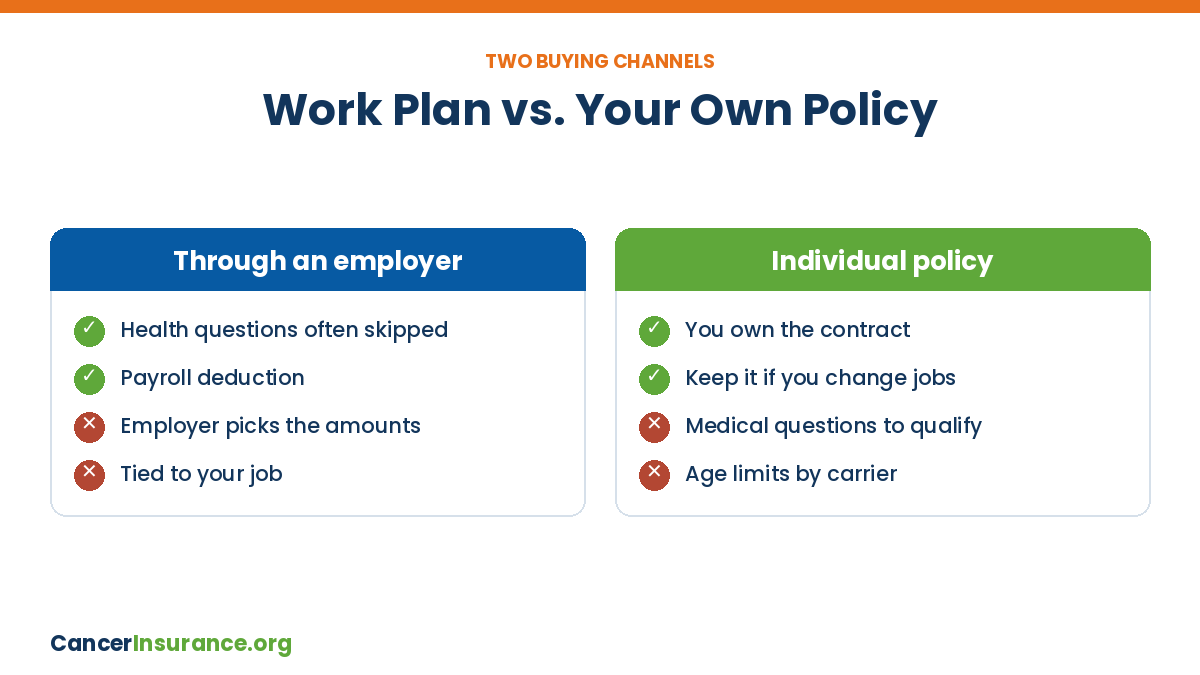
Critical illness insurance providers compared by channel: employer group plan versus individual policy

Every provider below reaches customers through one of two doors. Workplace coverage is a group contract your employer picks, with payroll deduction and an enrollment window once a year. Individual coverage is a contract between you and the insurer, usually sold by a licensed agent, sometimes with an online quote, and it stays in force as long as you pay the premium.

The channel shapes the whole experience. A workplace plan often accepts every eligible employee without health questions, while an individual application asks about your medical history and can be declined. The employer also sets the benefit choices on a group plan, so two people with the same carrier can see very different options.

Start here: Check your benefits portal or open enrollment packet before shopping anywhere else. If your employer already offers a critical illness plan, that sets the baseline you compare individual quotes against.

Cancer Insurance Quotes

Call a Licensed Agent Now

Compare cancer insurance plans and cash benefits from several insurance companies in one call.

☎ 1-888-891-0229

No obligation to buy

Provider Directory by Sales Channel and AM Best Rating

The table pulls together each carrier’s own product pages and AM Best’s latest published action on the company that issues the coverage. No single source we found lists channel and rating side by side for these carriers.

Provider (issuing company)How you buy itAM Best ratingDetail worth knowing
MetLife (Metropolitan Life Insurance Co.)Employer group planA+ (Apr 2026)Acceptance guaranteed if your employer offers it
Guardian (Guardian Life Insurance Co. of America)Employer group planA++ (Sept 2025)30+ illnesses; repeat diagnosis can pay again
Cigna (Cigna Health and Life Insurance Co.)Employer group planA (Mar 2026)Former individual supplemental line now with HCSC
Colonial Life (Colonial Life & Accident Insurance Co.)At work, individual or group formsA (Sept 2025)Unum Group company; online policyholder portal
The Standard, formerly Allstate Benefits (American Heritage Life)Employer planA (May 2025)Rating lowered from A+ after the 2025 sale
Aflac (Continental American Ins. Co. for group)Employer plan or individual policyA+ (Sept 2025)Individual policy can be quoted online
Mutual of Omaha (Mutual of Omaha Insurance Co.)Individual policy through an agentA+ (Apr 2026)Issue ages 18-64; 11 covered conditions
Assurity (Assurity Life Insurance Co.)Individual policy through a licensed agentA- (Nov 2025)Issue ages 18-70; simplified underwriting
Bankers Life (Bankers Life and Casualty Co.)Individual policy through a Bankers Life agentA (Apr 2026)Issue ages 18-85; home visits available
UnitedHealthcare (Golden Rule Insurance Co.)Individual policy online or by agentNot confirmed for Golden RuleGuaranteed renewable for life in most states

Sources: carrier product pages and plan materials; AM Best rating releases dated as shown. AM Best rated UnitedHealthcare’s health insurers A (Excellent) in August 2025, but the release did not name Golden Rule. Availability varies by state.

Carrier-by-carrier details are on our pages for MetLife critical illness insurance and Guardian critical illness insurance, two of the most common employer plans.

Carriers You Reach Only Through a Job

If you are self-employed, retired or working somewhere without voluntary benefits, these names will not help you directly. Their own websites point consumers to an HR department, not to an application.

MetLife. Describes its product as a limited-benefit group policy. There are no medical exams or health questions when your employer offers it, and coverage can often be continued after a job change or retirement under a premium-paying continuation provision.

Guardian. Sells through many employers and tells shoppers to contact their benefits office. Its consumer page lists first-diagnosis lump sums of $1,000 to $50,000, set by the employer’s plan design.

Cigna. Markets critical illness to employers. Its individual supplemental products moved to Health Care Service Corporation in the March 2025 sale.

The Standard. Took over Allstate’s employer voluntary benefits business, which was largely American Heritage Life, on April 1, 2025.

Unum, Hartford, Principal, Prudential, Sun Life, Voya and Lincoln Financial follow the same workplace-only pattern on the plan materials we reviewed for their carrier pages.

Carriers That Sell Policies to Individuals

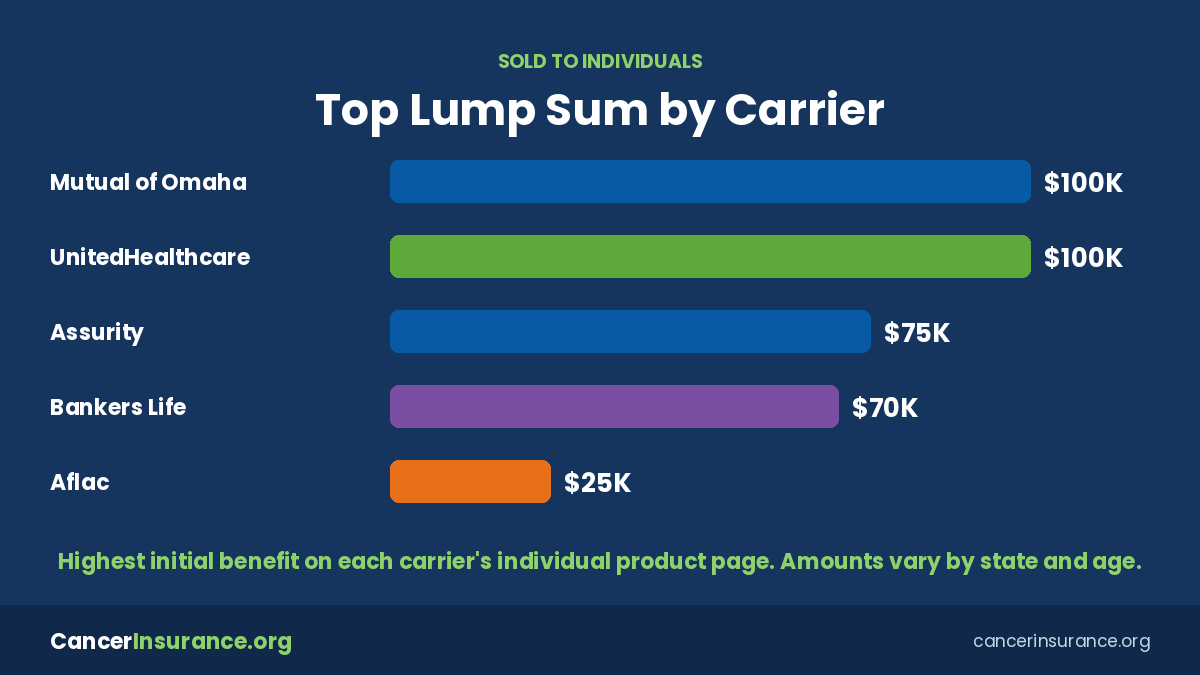
Critical illness insurance providers that sell to individuals ranked by largest lump sum offered

When no employer plan exists, the field narrows to insurers with an individual product. Each one draws its own lines on age and amount. Mutual of Omaha sells $10,000 to $100,000 to applicants 18 to 64. Assurity offers $5,000 to $75,000 under simplified underwriting for ages 18 to 70. Bankers Life sells Critical Benefit in $10,000 steps up to $70,000, with issue ages up to 85, or 75 with its PLUS Critical Conditions rider.

Aflac’s individual page lists an initial diagnosis payout of up to $25,000 and lets you start a quote online or with an agent. UnitedHealthcare’s individual plans, underwritten by Golden Rule, go up to $100,000, with amounts that vary by state and age. See Mutual of Omaha critical illness insurance and Bankers Life critical illness insurance for how those two policies are built.

Age matters: Assurity’s product highlights state that the benefit drops by 50% starting at the later of the third policy year or the policy year after the insured turns 70. Read each policy’s age-reduction clause before comparing prices.

Compare Critical Illness Providers

Speak with a licensed insurance agent

1-888-891-0229

CancerInsurance.org logo

How to Compare Two or Three Providers

Once you know which carriers you can reach, line them up on the points that differ the most from one company to the next.

1

Confirm eligibility first. Rule out carriers whose issue ages or sales channel exclude you before you look at a single premium.

2

Match the covered conditions. Lists range from six named conditions on Bankers Life’s base policy to more than 30 on Guardian’s group plan. Make sure heart attack, stroke and the conditions in your family history are on the list.

3

Compare the same benefit amount. Quote every carrier at one lump-sum figure so the premiums can be compared fairly.

4

Read the reduction and renewal terms. Look for age-based cuts, term lengths and whether the policy is guaranteed renewable.

5

Check the insurer’s strength. Use the AM Best grade of the company that issues the policy, not the parent brand.

Cancer is usually one of the core covered conditions, though many policies pay a reduced share for early-stage diagnoses, so read the cancer definition on any policy you shortlist.

Brand Name vs. the Company on Your Policy

The logo you see at enrollment is not always the legal insurer, and that difference matters for ratings and claims. Aflac’s group plans are issued by Continental American Insurance Company, while its individual policies come from American Family Life Assurance Company of Columbus; AM Best rates both A+ (Superior). UnitedHealthcare’s individual plans are issued by Golden Rule.

Allstate to The Standard. AM Best lowered American Heritage Life from A+ to A (Excellent) in May 2025 after StanCorp, The Standard’s parent, completed the deal.

Cigna to HCSC. Cigna’s sale of its Medicare and supplemental benefits businesses to Health Care Service Corporation closed on March 19, 2025.

UnitedHealthcare downgrade. AM Best cut UnitedHealthcare’s health insurers from A+ to A (Excellent) in August 2025 and set a stable outlook.

None of these changes cancels an existing policy by itself, but they can change the name on your bills and claim forms. When you request quotes, ask which company issues the contract and look up that company’s rating.

Bottom Line

Start with the channel: if your employer offers MetLife, Guardian, Cigna, Colonial Life or The Standard, that plan is your baseline, and if not, Mutual of Omaha, Assurity, Bankers Life, Aflac and UnitedHealthcare’s Golden Rule sell policies you can own yourself. Narrow the list by age limits and maximum amounts, then compare the issuing company’s AM Best grade. Whichever provider you pick, this is extra cash on top of health insurance, not a substitute for it.

Get Free Critical Illness Quotes

Speak with a licensed insurance agent

1-888-891-0229

CancerInsurance.org logo

Critical Illness Insurance Providers — Frequently Asked Questions

➤ Which critical illness insurance companies sell directly to individuals?

Mutual of Omaha, Assurity, Bankers Life, Aflac and UnitedHealthcare through Golden Rule all offer individual policies. Most are sold through licensed agents, and Aflac and UnitedHealthcare also let you start a quote online.

➤ Can I buy MetLife or Guardian critical illness coverage without an employer?

Their consumer pages direct shoppers to an employer benefits office, and neither describes an individual policy. Without a workplace plan, look at the carriers that sell individual coverage.

➤ Which provider accepts the oldest applicants?

Among the individual products reviewed here, Bankers Life Critical Benefit accepts applicants up to age 85, or up to 75 if you add its PLUS Critical Conditions rider. Assurity stops at 70 and Mutual of Omaha at 64.

➤ What does an AM Best rating tell me about a provider?

It is an independent grade of the insurer’s financial ability to pay claims. A++ and A+ are Superior, A and A- are Excellent, and the grade belongs to the specific company that issues your policy.

➤ Why does my Allstate critical illness certificate now say The Standard?

The Standard bought Allstate’s employer voluntary benefits business, largely American Heritage Life Insurance Company, on April 1, 2025. Existing certificates moved with that business.

➤ Who runs Cigna’s individual supplemental policies now?

Health Care Service Corporation bought Cigna’s supplemental benefits business in a sale that closed March 19, 2025. Cigna still markets group critical illness coverage to employers.

➤ Is it better to buy through work or on my own?

Work plans often skip health questions and use payroll deduction, while individual policies require underwriting but are not tied to your job. Many people compare both and keep the one with the better amount and terms.

➤ Do providers pay critical illness benefits instead of my health plan?

No. Every provider here sells limited-benefit coverage that pays cash to you after a covered diagnosis. Your health insurance or Medicare still pays the medical bills.

Cancer Insurance Quotes

Call a Licensed Agent Now

Compare cancer insurance plans and cash benefits from several insurance companies in one call.

☎ 1-888-891-0229

No obligation to buy

Ready to Compare? Get Free Cancer Insurance Quotes

Speak with a licensed insurance agent

1-888-891-0229

CancerInsurance.org logo

ZRN Health & Financial Services, LLC, a Texas limited liability company