




Speak with a licensed insurance agent

1-888-891-0229

Is HIFU for Prostate Cancer Covered by Insurance? Insurer Policies, Medicare Rules and Appeals

Updated November 2026

Key Takeaway

HIFU for prostate cancer is covered by many private insurers only when cancer comes back after radiation therapy; published Aetna and Cigna policies treat it as medically necessary for that use but not as a first treatment, and several Anthem and Blue Cross policies call it not medically necessary or investigational. Medicare has no national coverage decision for prostate HIFU, so payment depends on the regional Medicare contractor or the Medicare Advantage plan.

2027 by the Numbers

Jan. 1, 2021

date CPT code 55880 for transrectal HIFU took effect (AMA, reported by AUA News)

$8,558

average Medicare outpatient payment per HIFU prostate ablation under the 2023 CMS rule, up from $4,506 (Health Imaging)

180 days

to file an internal appeal after a private plan denial (HealthCare.gov)

High-intensity focused ultrasound, or HIFU, heats and destroys prostate tissue with sound waves aimed through a probe in the rectum, usually as an outpatient procedure. Whether a health plan pays for it is a separate question from whether a urologist thinks it fits.

This guide lines up what major insurers have published about HIFU, explains how Medicare handles it, walks through prior authorization and appeals, and shows where a supplemental policy can add cash. It builds on our overview of cancer insurance and experimental treatments. Treatment choice belongs with a urologist; this page covers the money side only.

Compare Cancer Insurance Plans

Speak with a licensed insurance agent

1-888-891-0229

CancerInsurance.org logo

Why HIFU Coverage Is Still Uneven

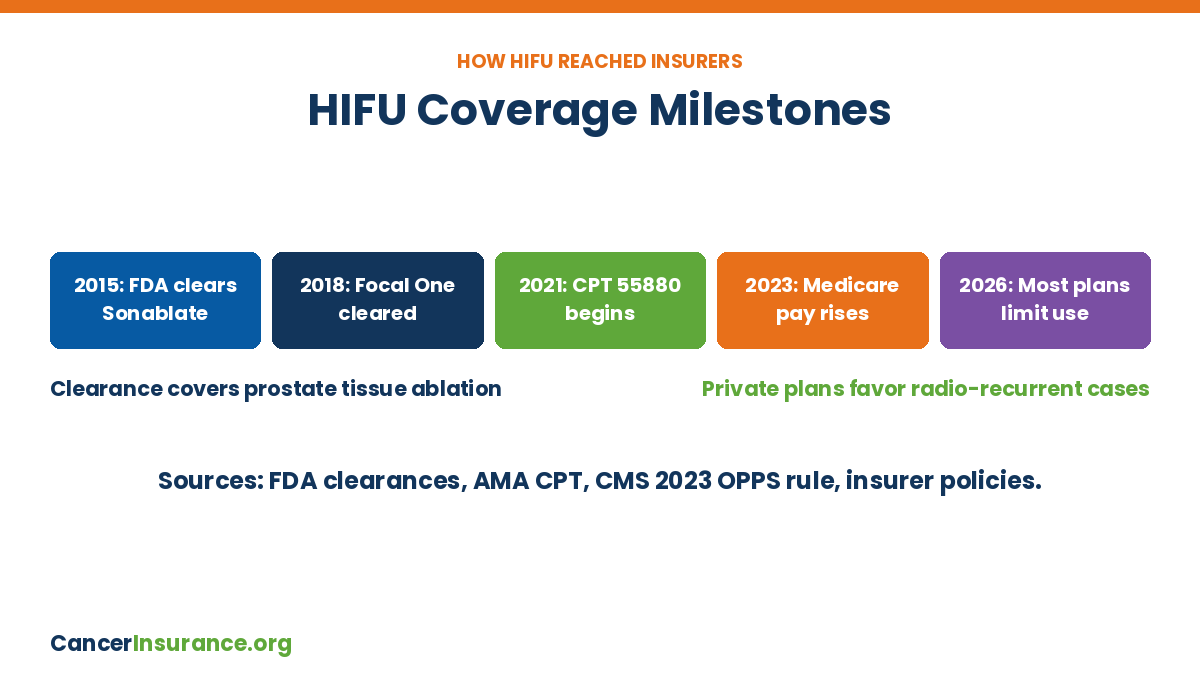
Timeline of FDA clearance, billing codes and payment changes behind whether HIFU for prostate cancer is covered by insurance

Insurers decide coverage based on evidence and on how a procedure is billed, and HIFU has moved slowly on both fronts. In October 2015 the FDA cleared SonaCare’s Sonablate device for ablation of prostate tissue, with EDAP’s Ablatherm cleared shortly after, and Focal One followed in 2018. These were 510(k) clearances for destroying prostate tissue, not a specific FDA finding that HIFU treats prostate cancer. When the first device was cleared, the FDA called the cancer outcomes from its study inconclusive.

Billing code arrived in 2021. Before then, doctors billed HIFU with unlisted code 55899, which rarely paid. CPT 55880, for transrectal HIFU ablation of malignant prostate tissue, took effect on January 1, 2021.

A facility code came first. Medicare had already created HCPCS code C9747 so hospital outpatient departments could bill the facility side of the procedure.

Evidence still drives denials. A code means a claim can be filed, not that a plan agrees the procedure is proven for a given patient.

Cancer Insurance Quotes

Call a Licensed Agent Now

Compare cancer insurance plans and cash benefits from several insurance companies in one call.

☎ 1-888-891-0229

No obligation to buy

HIFU Coverage Side by Side: What Insurer Policies Say

Each insurer publishes a medical policy that its reviewers follow on HIFU requests. No single public source lines these up, so the table below compares the wording in each policy as posted on the insurer’s site. The common pattern: recurrence after radiation may be approved, first-line treatment of localized cancer usually is not.

Insurer and policyPolicy date shownRadio-recurrent cancerFirst treatment of localized cancer
Aetna CPB 0766, High Intensity Focused UltrasoundLast reviewed Oct. 26, 2026Medically necessary if no metastatic diseaseListed as experimental and investigational
Cigna Coverage Policy 0274, HIFUEffective Dec. 15, 2025Medically necessary with a recent positive biopsy and no distant spreadNot medically necessary
Anthem (Elevance) CG-MED-81, Ultrasound Ablation for Oncologic IndicationsLast reviewed Nov. 14, 2024Not medically necessaryNot medically necessary
Blue Cross Blue Shield of Mississippi, Focal Treatments for Prostate CancerUpdated Aug. 18, 2026Not separately addressedFocal therapy, HIFU included, is investigational
BlueCross BlueShield of South Carolina CAM 80161Annual review June 18, 2025Not separately addressedFocal therapy, HIFU included, is investigational or unproven
Blue Cross NC Medicare Advantage HIFU policyNew in 2026May be medically necessary with preauthorizationNot covered as initial treatment

Summarized from each insurer’s published medical policy, reviewed November 2026. Policies change often and employer plans can differ, so check the current policy and the plan’s own benefit booklet.

Aetna and Cigna both tie approval to proof that cancer has returned in the prostate after radiation and has not spread. Several Blue plans fold HIFU into a broader focal therapy policy that also covers cryoablation and laser methods.

How Medicare and Medicare Advantage Handle HIFU

Original Medicare has no national coverage determination for prostate HIFU, and UnitedHealthcare’s Medicare Advantage prostate policy notes that no local coverage determinations exist either. Without a national rule, each regional Medicare Administrative Contractor has discretion over whether to pay. Some hospital programs, such as Mount Sinai in New York, state that Medicare covers HIFU at their facility, while other cancer centers tell patients it is not a covered option. Payment levels did rise: the 2023 hospital outpatient rule raised Medicare’s average facility payment from about $4,506 to $8,558 per procedure.

Medicare Advantage note: Private Medicare plans set their own review criteria when Medicare has none. UnitedHealthcare’s Medicare Advantage policy refers reviewers to InterQual criteria for HIFU. Blue Cross NC’s 2026 Medicare Advantage policy may approve HIFU for cancer that returns after radiation when the PSA is under 10 ng/mL, the recurrence is confirmed by biopsy and the plan grants preauthorization.

Anyone on Original Medicare should ask the treating hospital whether its regional contractor pays CPT 55880 before scheduling. If the hospital expects a denial, it may ask the patient to sign a notice accepting financial responsibility, so read anything signed at check-in carefully.

Where a Cancer Insurance Policy Can Help With HIFU

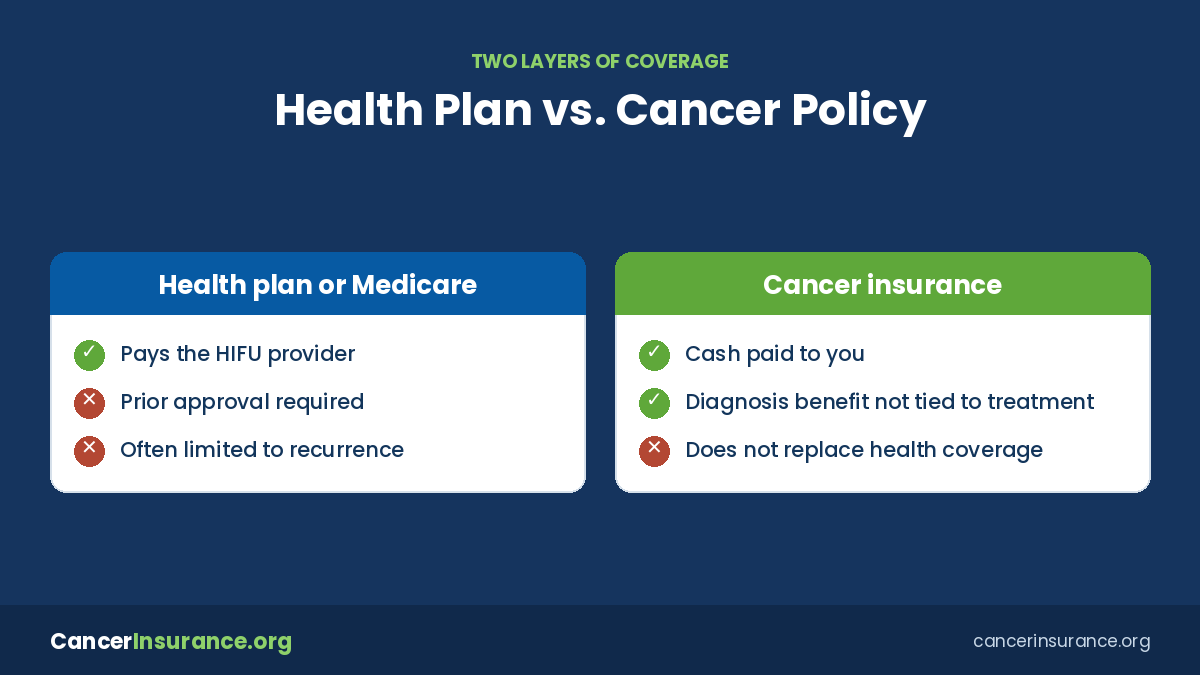
Is HIFU for prostate cancer covered by insurance: health plan coverage compared with a supplemental cancer policy

A supplemental cancer policy works differently from a health plan. It pays fixed cash benefits to the policyholder after a covered diagnosis, and the money can go to deductibles, travel to a HIFU center, lost wages or a self-pay bill. Cancer insurance is a supplemental, limited-benefit policy and does not replace health insurance. The question is which benefits in the policy the HIFU treatment actually triggers.

Benefit type in filed outlinesHow it may apply to HIFUFine print to check
Lump-sum or initial diagnosis benefitPays on a covered prostate cancer diagnosis, no matter which treatment is chosenWaiting period and cancers diagnosed before coverage began
Surgery benefitAflac’s B70200 outline pays from a schedule of operations, and an unlisted procedure is paid like the most similar oneWhether HIFU is treated as surgery, and the daily maximum
Treatment benefitsAflac’s outline says listed treatments must be NCI or FDA approvedHIFU devices are FDA cleared, not approved, so the insurer decides how this applies
Experimental treatment benefitColonial Life’s CanAssist outline pays for physician-prescribed care in an experimental cancer treatment programProgram and FDA drug rules in the certificate

From Aflac outline B70225IL and Colonial Life CanAssist outline 77302, reviewed November 2026. Benefits vary by state and plan level; the policy certificate controls.

A diagnosis benefit is the most predictable piece because it does not depend on how the treatment is classified. Our guide to what cancer insurance covers explains each benefit type.

Compare Cancer Insurance Plans

Speak with a licensed insurance agent

1-888-891-0229

CancerInsurance.org logo

Prior Authorization and Appeal Steps for a HIFU Denial

Almost every plan that might pay for HIFU requires approval before the procedure. A denial is not always the last word, especially when the file is missing records the policy asks for.

1

Pull the insurer’s HIFU policy. Search the insurer’s medical policy site for HIFU, focal therapy or CPT 55880 and print the criteria. Compare each one with the records the urologist will send.

2

Send the documents the policy names. Policies may ask for prior radiation records, a recent positive biopsy, the PSA level, imaging that shows no spread and notes showing other options were discussed.

3

Get the denial reason in writing. A denial for missing paperwork can be fixed and resubmitted. A denial calling HIFU investigational needs a medical argument from the doctor.

4

File the internal appeal on time. Private plans allow 180 days from the denial notice, and must decide a pre-service appeal within 30 days. Medicare Advantage members have 65 days to request reconsideration; Original Medicare allows 120 days to request a redetermination.

5

Ask for external review if needed. After a final internal denial, most private plans must offer review by an independent organization. In urgent cases, external review can be requested at the same time as the internal appeal.

Appeal tip: Some HIFU centers run appeal assistance for patients. Ask the treatment center whether it prepares letters of medical necessity and tracks prior authorization before any self-pay deposit is taken.

Paying for HIFU When Insurance Says No

Published self-pay prices for HIFU are scarce and dated. A 2016 KFF Health News report put the out-of-pocket price at roughly $15,000 to $25,000 when insurers, Medicare included, were not paying. Prices today depend on the center, whether whole-gland or focal treatment is done and what the quote includes, so ask for a written, itemized estimate.

Compare the quote with your plan’s costs. If another treatment is covered, its deductible and coinsurance give a baseline to weigh against a self-pay HIFU price.

Use pre-tax money. A health savings or flexible spending account can generally pay for a medical procedure a plan denies.

Stack supplemental benefits. Cash from a cancer, critical illness or hospital indemnity policy can be used for any bill, including a HIFU deposit or travel.

Families planning ahead can look at cancer insurance plans, the 5 best cancer insurance policies and our list of cancer insurance providers. A policy must be in force, and past any waiting period, before a diagnosis for benefits to pay.

Bottom Line

Most private insurers that publish a HIFU policy approve it only for prostate cancer that returns after radiation, and several Blue and Anthem policies still decline it as a first treatment. Medicare coverage depends on the regional contractor or the Medicare Advantage plan, so get prior authorization in writing, appeal on time, and treat a cancer policy’s cash benefits as a backup, not a substitute for health coverage.

Related: is proton therapy covered by insurance How Medicare, Aetna and UnitedHealthcare rules treat proton beam therapy, plus appeal steps.

Related: prostate cancer insurance How cancer and critical illness policies pay for low-grade tumors, hormone therapy and radiation.

Get Free Cancer Insurance Quotes

Speak with a licensed insurance agent

1-888-891-0229

CancerInsurance.org logo

HIFU for Prostate Cancer and Insurance — Frequently Asked Questions

➤ What CPT code is used to bill HIFU for prostate cancer?

CPT 55880 covers transrectal HIFU ablation of malignant prostate tissue, including ultrasound guidance. It took effect on January 1, 2021; before that, providers used unlisted code 55899.

➤ Is HIFU FDA approved for prostate cancer?

HIFU devices such as Sonablate, Ablatherm and Focal One were cleared by the FDA through the 510(k) process for ablation of prostate tissue. The clearance is for destroying tissue, not a specific approval as a prostate cancer treatment.

➤ Does Aetna cover HIFU for prostate cancer?

Aetna’s policy CPB 0766 treats HIFU as medically necessary for prostate cancer that recurs after radiation when there is no metastatic disease. It lists HIFU for primary prostate cancer as experimental and investigational.

➤ Will Cigna pay for HIFU as a first treatment?

Cigna’s policy 0274 says HIFU is not medically necessary as initial treatment for localized prostate cancer. It covers recurrence after radiation failure when a repeat biopsy is positive and there is no distant spread.

➤ Does Medicare Advantage cover HIFU?

It depends on the plan. With no national Medicare rule, each Medicare Advantage plan applies its own criteria, and policies published by UnitedHealthcare and Blue Cross NC rely on review criteria and preauthorization.

➤ What records help get HIFU approved?

Plans that cover HIFU often ask for prior radiation records, a recent positive biopsy, the current PSA level, imaging showing no spread and notes that other treatments were considered.

➤ Will a cancer insurance policy pay if my health plan denies HIFU?

A diagnosis benefit usually pays on a covered prostate cancer diagnosis regardless of treatment choice. Treatment benefits are less certain, since some outlines require treatments to be NCI or FDA approved and HIFU devices are FDA cleared.

➤ Should I choose HIFU based on what insurance covers?

Coverage is one factor, but the choice between HIFU, surgery, radiation or monitoring belongs with a urologist. Get coverage answers in writing first.

Cancer Insurance Quotes

Call a Licensed Agent Now

Compare cancer insurance plans and cash benefits from several insurance companies in one call.

☎ 1-888-891-0229

No obligation to buy

Ready to Compare? Get Free Cancer Insurance Quotes

Speak with a licensed insurance agent

1-888-891-0229

CancerInsurance.org logo

ZRN Health & Financial Services, LLC, a Texas limited liability company