




Speak with a licensed insurance agent

1-888-891-0229

Life Insurance With Critical Illness Rider: How It Pays and What It Costs You Later

Updated November 2026

Key Takeaway

Life insurance with a critical illness rider lets you pull part of your death benefit early, as a lump sum, if you are diagnosed with a listed condition such as a heart attack, stroke or life-threatening cancer. Whatever you take out is subtracted from what your beneficiaries get later, which is the main way it differs from a standalone critical illness or cancer policy.

2027 by the Numbers

80%

most of the face amount Term Life Express living benefit riders can advance (United of Omaha)

$2,000,000

lifetime cap across all Corebridge accelerated benefit riders (Corebridge disclosure)

$430/day

2026 federal per diem limit that applies to chronic illness benefits (IRS)

Many term, whole and universal life policies now come with a living benefit option. The most common version is a critical illness rider: if you suffer a serious diagnosis while the policy is in force, the insurer advances part of the death benefit to you instead of waiting until you die.

That sounds like free critical illness coverage, and sometimes the rider adds nothing to your premium. But the money comes out of the pot your family is counting on, and the insurer often shrinks the check for paying early. Below we compare four insurers’ rider papers, explain the tax rules, and show when a separate critical illness insurance policy is the better tool.

Compare Critical Illness and Cancer Coverage

Speak with a licensed insurance agent

1-888-891-0229

CancerInsurance.org logo

How a Critical Illness Rider on a Life Policy Works

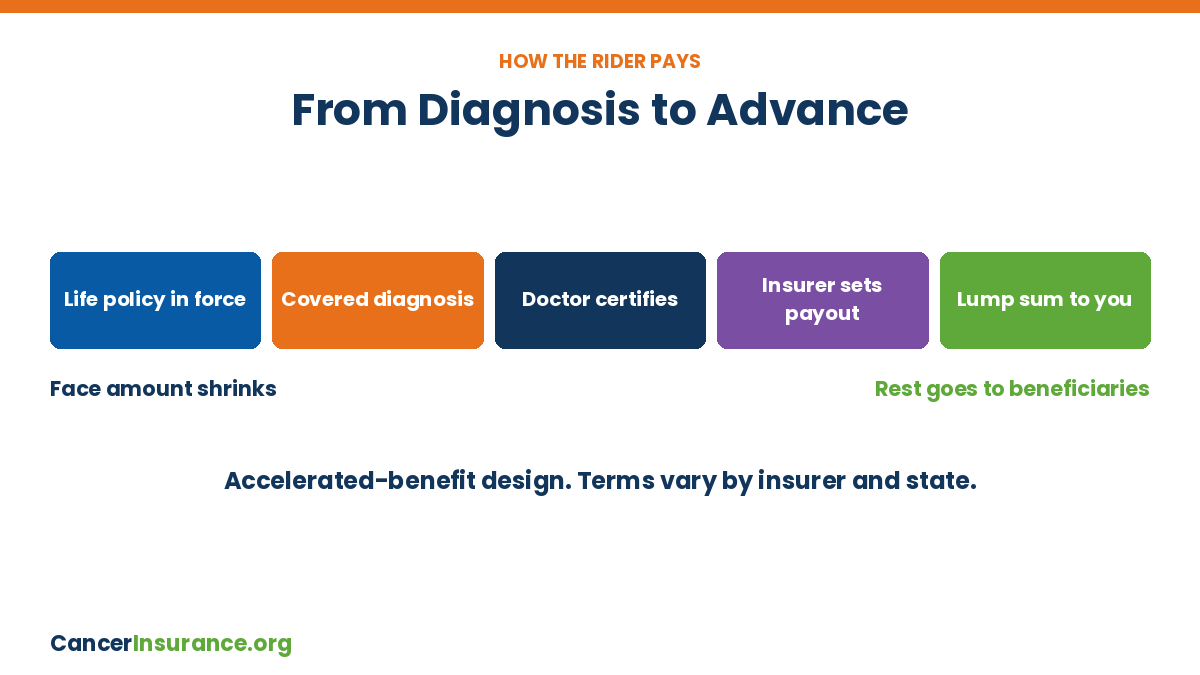
How life insurance with critical illness rider pays out, from diagnosis to reduced death benefit

Insurers file this rider under names like accelerated death benefit for critical illness or living benefits rider. If a doctor certifies a covered condition, you can ask the company to pay a slice of your face amount now. The policy stays in force on whatever is left. Two designs exist, and the difference matters more than the brochure label.

Accelerated benefit design. The payout is an advance on the death benefit. It reduces the face amount and, on permanent policies, the cash value too. Take the whole amount and the policy can end.

Separate benefit design. A few carriers sell a rider with its own benefit amount and its own premium, paid as a percentage of that amount by condition, similar to a small critical illness policy bolted onto the life contract.

Either way, you must be diagnosed first. The rider pays only after a covered condition is certified, not for checkups or ordinary medical bills.

Cancer Insurance Quotes

Call a Licensed Agent Now

Compare cancer insurance plans and cash benefits from several insurance companies in one call.

☎ 1-888-891-0229

No obligation to buy

What Four Insurers' Rider Documents Actually Say

Marketing pages for these riders sound alike. The filed rider forms, product guides and consumer disclosures do not. Here are the published terms for four products, side by side.

Carrier and productRider designHow you pay for itPayout limitConditions named
Mutual of Omaha (United of Omaha), Term Life ExpressAccelerates death benefit (Critical Illness Rider, form ICC18L189R)Brochure lists it as an optional rider with additional premium, subject to state approvalUp to 80% of the face amount at issueALS, kidney failure, life-threatening cancer, heart attack, stroke, dementia, major burns and more
Transamerica, Trendsetter LB termAccelerates death benefit (with chronic and terminal riders)Included where approved; payout reduced for early payment, plus an administrative fee per requestUp to $1.5 million in living benefitsExamples given: cancer, heart attack, stroke, paralysis; full list in the rider
Corebridge Financial (American General), Quality of Life ridersAccelerates death benefitPayout reduced by an actuarial discount based on mortality and interestLesser of the death benefit or $2,000,000 lifetime across all ridersDefined in each state’s rider form
Assurity, Term Life Critical Illness Benefit Rider (R I0762)Its own benefit amount, paid by condition categorySeparate rider premium, full underwriting$20,000 to $100,000, never more than the base face amountInvasive cancer, heart attack, stroke at 100%; carcinoma in situ and bypass at 25%; angioplasty at 10%

Sources: United of Omaha Term Life Express brochure; Transamerica Trendsetter LB guide; Corebridge rider disclosure; Assurity Term Life product guide. Terms vary by state and change over time.

Read the rider: Two riders with the same name can pay very different amounts for the same diagnosis. The covered list, the advance percentage and the discount method are set in the rider form, not the sales sheet.

Paying Up Front vs. Paying at Claim Time

The biggest hidden difference between these riders is when you pay for them. Some add a few dollars to every premium. Others cost nothing until you use them, and then the insurer keeps part of the money. Ask for a sample claim illustration at your age before counting on a specific amount.

Charged rider. You pay added premium while the rider is attached, so more of the advance tends to reach you at claim.

No-premium rider. There is no charge while you are healthy. At claim, the company reduces the payment for paying early. Corebridge describes this as an actuarial discount tied to life expectancy and interest; Transamerica adds a per-request fee.

Severity-based payout. Several discount-style riders size the payment by how much the diagnosis shortens your expected lifespan. A condition that barely changes your life expectancy can produce a small check, and Corebridge’s disclosure warns it may be zero.

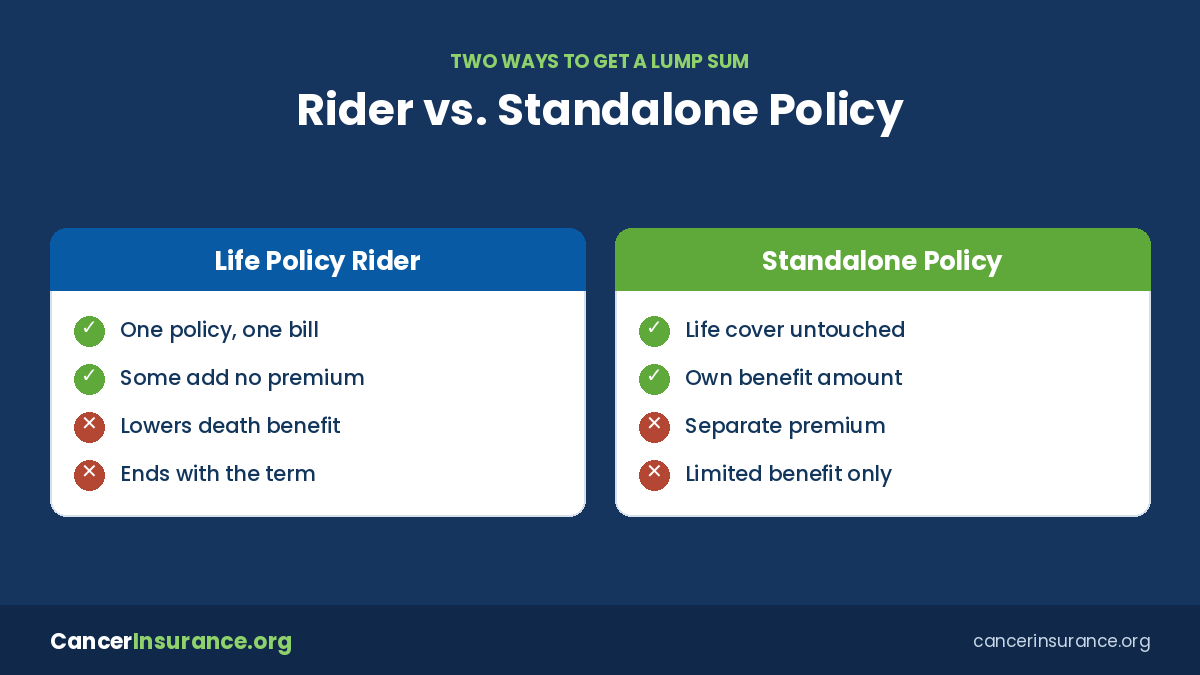
Rider or Standalone Critical Illness or Cancer Policy?

Life insurance with critical illness rider compared with a standalone critical illness policy

A standalone critical illness policy pays its own lump sum and leaves your life insurance untouched. A cancer policy does the same for cancer only. Both are supplemental, limited-benefit coverage that does not replace health insurance. Our comparison of health insurance vs critical illness covers that difference.

1

Start with the life need. If your family needs every dollar of the death benefit, advancing part of it creates a new gap. A separate policy protects both goals.

2

Check the term length. A rider on a 20-year term policy ends with that policy.

3

Compare what triggers a payment. Riders often pay only for severe or life-threatening forms of an illness. Standalone policies may pay a partial benefit for early-stage cancer or in situ findings.

4

Price both ways. Get a quote for the life policy with and without the rider, then a quote for a separate plan. Browse cancer insurance plans to see what cancer-only coverage looks like.

Compare Critical Illness and Cancer Coverage

Speak with a licensed insurance agent

1-888-891-0229

CancerInsurance.org logo

Taxes, Benefits Eligibility and Other Fine Print

Section 101(g) of the tax code treats some accelerated death benefits like a death benefit, which generally means no income tax. That section covers only terminal illness and chronic illness. A payment triggered purely by a critical illness diagnosis fits neither definition by itself, so carriers flag possible taxes.

Payout triggerHow 101(g) treats itWhat carriers note
Terminal illnessCertified life expectancy of 24 months or less; generally tax free, with no daily capReported on Form 1099-LTC (Corebridge)
Chronic illnessUnable to do 2 of 6 daily activities for 90 days, or severe cognitive impairment; tax free up to the per diem limit ($430 a day in 2026) or actual long-term care costsReported on Form 1099-LTC (Corebridge)
Critical illness onlyNot one of the two 101(g) categories on its ownCorebridge reports it on Form 1099-R; Mutual of Omaha warns it is not expected to get the same favorable treatment

General information, not tax advice. Talk with a tax professional before you file a claim.

Fine print: An advance can count as income or assets for Medicaid and other need-based programs. Corebridge also limits critical illness elections to a single window of 60 days after the claim form is received, so timing your request matters.

Questions to Ask Before You Add the Rider

A critical illness rider can be a useful layer on a policy you were buying anyway. These questions show what you are really getting. For add-ons sold on cancer policies instead, see our guide to cancer insurance policy riders.

Which conditions, and how severe? Words like life-threatening or major can exclude early or minor cases.

What percent can I take? Ask for the percentage cap, any dollar cap, and whether it is measured at issue or at claim.

What does it cost, and when? Premium now, a discount later, a claim fee, or all three.

What is left for my family? Ask how an advance changes the remaining death benefit, cash value and future premiums.

If you want a lump sum that never touches your life insurance, compare it with a dedicated policy. Our page on the critical illness insurance lump sum payment explains how those checks are paid.

Bottom Line

A critical illness rider turns part of your life insurance into an early cash advance after a serious diagnosis, but every dollar you take is a dollar your beneficiaries lose. If you need both a full death benefit and a separate cushion for a major illness, a standalone critical illness or cancer policy is usually the cleaner fit.

Get Free Critical Illness Insurance Quotes

Speak with a licensed insurance agent

1-888-891-0229

CancerInsurance.org logo

Life Insurance With Critical Illness Rider — Frequently Asked Questions

➤ Does a critical illness rider reduce my death benefit?

On most riders, yes. The payment is an advance on the face amount, so the death benefit drops by at least the amount you accelerate. Separate-benefit riders such as Assurity’s work differently, so read the form.

➤ Is there a cost for a critical illness rider on term life?

It depends on the design. Some riders add premium every month; others charge nothing up front and reduce the payment at claim time, sometimes plus a fee.

➤ How much of my policy can I take out early?

Each insurer sets its own limit. Mutual of Omaha’s Term Life Express caps requests at 80% of the face amount at issue; Corebridge sets a $2,000,000 lifetime maximum.

➤ Is a critical illness rider payout taxable?

It may be. The 101(g) exclusion covers terminal and chronic illness, not a critical illness diagnosis alone, so some carriers warn the payment may not be tax free. Ask a tax professional before you claim.

➤ Can I add a critical illness rider to a policy I already own?

Usually the rider is chosen when you apply, though some no-premium riders are built in automatically where approved. Your insurer can tell you what your contract allows.

➤ Does the rider cover early-stage cancer?

Many riders cover only life-threatening or invasive cancer. Assurity’s separate-benefit rider pays 25% for carcinoma in situ, but accelerated-benefit riders often pay little for early findings.

➤ Is a critical illness rider the same as health insurance?

No. Like standalone critical illness and cancer insurance, it pays cash after a covered diagnosis, not doctors or hospitals, and cannot replace your health plan.

➤ What happens to the rider if my term policy lapses or ends?

The rider ends with the policy. When a term policy runs out, the critical illness protection ends too, which is one reason some people keep a separate plan.

Cancer Insurance Quotes

Call a Licensed Agent Now

Compare cancer insurance plans and cash benefits from several insurance companies in one call.

☎ 1-888-891-0229

No obligation to buy

Ready to Compare? Get Free Cancer Insurance Quotes

Speak with a licensed insurance agent

1-888-891-0229

CancerInsurance.org logo

ZRN Health & Financial Services, LLC, a Texas limited liability company