




Speak with a licensed insurance agent

1-888-891-0229

Cigna Critical Illness Insurance: The Workplace Plan, Its Payouts and Who Owns What Now

Updated November 2026

Key Takeaway

Cigna critical illness insurance is a voluntary group plan sold through employers and issued by Cigna Health and Life Insurance Company that pays you a cash lump sum, often $10,000 to $30,000, after a covered diagnosis such as invasive cancer, heart attack or stroke. Cigna’s former individual supplemental policies are now run by Health Care Service Corporation under the HealthSpring name.

2027 by the Numbers

A (Excellent)

AM Best financial strength rating for Cigna Health and Life Insurance Company, affirmed March 2026 (AM Best)

Age 100

when ported coverage ends in the Cigna plan summaries reviewed (Cigna)

12 months

gap needed before the same condition can pay a recurrence benefit (Cigna plan summaries)

Most people who look up Cigna critical illness coverage have just seen it on an open enrollment screen. The premium comes out of each paycheck, and the benefit is paid in cash to you, not to a doctor. You can spend it on a deductible, rent, travel for treatment or lost wages.

This guide covers which Cigna company stands behind the plan, what each diagnosis pays and what happens if you get sick twice or leave your job, using plan summaries employers have posted. Critical illness coverage is supplemental, limited-benefit insurance. It does not replace a medical plan from work, the Marketplace or Medicare. For the basics, see our critical illness insurance overview.

Compare Critical Illness and Cancer Plans

Speak with a licensed insurance agent

1-888-891-0229

CancerInsurance.org logo

Which Cigna Company Issues the Coverage Today?

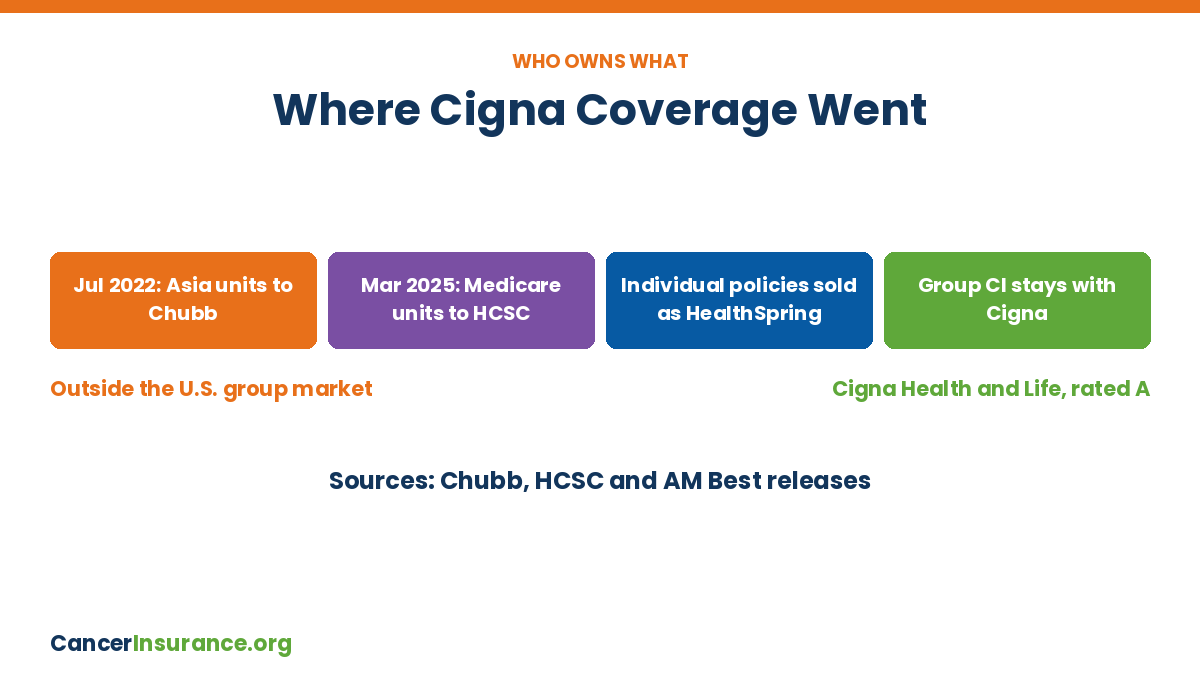
Timeline of ownership changes behind Cigna critical illness insurance and former Cigna supplemental policies

The answer depends on where you bought the coverage. For U.S. workplace plans, the insurer is Cigna Health and Life Insurance Company of Bloomfield, Connecticut. Cigna’s employer page lists group forms such as GCI-00-1000 and GCI-02-1000, administered by Cigna Health and Life.

Two sales changed the picture outside the group market. On July 1, 2022, Chubb closed its $5.36 billion purchase of Cigna’s personal accident, supplemental health and life business in Korea, Taiwan, New Zealand, Thailand, Hong Kong and Indonesia; no U.S. business was included. On March 19, 2025, Health Care Service Corporation (HCSC) closed its purchase of Cigna’s Medicare Advantage, Part D, Medicare supplemental benefits and CareAllies units, and said member coverage stayed the same.

Good to know: A rating applies to the company printed on your certificate. AM Best rates Cigna Health and Life Insurance Company A (Excellent) with a stable outlook, a rating it affirmed in March 2026.

Cancer Insurance Quotes

Call a Licensed Agent Now

Compare cancer insurance plans and cash benefits from several insurance companies in one call.

☎ 1-888-891-0229

No obligation to buy

Conditions a Cigna Group Certificate Can Pay For

Each covered condition pays a set share of the amount you elect. Employers pick from a menu, so your list may differ from the groups below, taken from 2025 and 2026 Cigna summaries.

Cancer. Invasive cancer pays 100%. Carcinoma in situ, an early cancer that has not spread, pays 25%. Basal or squamous cell skin cancer pays a flat $250 once per lifetime.

Heart and blood vessels. Heart attack and stroke pay 100%. Coronary artery disease that needs bypass surgery pays 25% in most designs; angioplasty and stents do not qualify.

Nervous system. Advanced-stage Alzheimer’s disease, ALS, Parkinson’s disease and multiple sclerosis usually pay 25%, and none of them pays a second time.

Organs and senses. End-stage kidney disease, major organ failure, paralysis, benign brain tumor and blindness pay 100%. Some plans add loss of hearing, loss of speech, lupus and serious infections such as sepsis.

Definitions matter as much as the list. Invasive cancer leaves out pre-malignant conditions, melanoma in situ and certain low-risk prostate tumors staged T1a to T1c. A stroke needs imaging and deficits lasting at least 96 hours, so a mini-stroke (TIA) does not count. If cancer is the main worry, a cancer-only policy covers it more broadly; our cancer insurance plans page explains how those pay.

Four Employers, Four Versions of the Same Cigna Plan

Cigna lets each employer set the benefit amounts, the screening benefit, the waiting time between claims and how premiums are rated. Cigna’s own site does not show these choices side by side, so we lined up four plan summaries employers have published for workers.

Plan detailXavier University (2025)Highland Park ISD, TX (2025)El Paso ISD, TX (2025)Dartmouth College (2026)
Employee amounts$5,000 to $30,000$10,000 or $20,000$10,000 to $30,000$10,000 to $30,000
No health questions up to$30,000$20,000$30,000$30,000
Spouse amountUp to $15,000100% of employee100% of employee100% of employee
Coronary artery disease25%25%100%25%
Yearly health screening$100$75$50$50
Gap between different conditions180 days90 days180 days90 days
How premiums are ratedAttained age (rises with age)Issue age (locked at enrollment)Issue age (locked at enrollment)Attained age (rises with age)
Extra cancer benefitNone listedNone listed$500 second opinionNone listed

Our comparison of Cigna Health and Life Insurance Company benefit summaries (group policies CI111134, CI112760, CI112803 and CI111205). Your own certificate and state rules control.

Cancer, heart attack and stroke paid 100% in all four. What moved were the extras and the pricing method. Attained-age premiums climb as you enter each new age band. Issue-age premiums on the amount you first elect stay tied to your age at enrollment, though a rate change for the whole group is still possible.

Getting Paid More Than Once: Separation and Recurrence

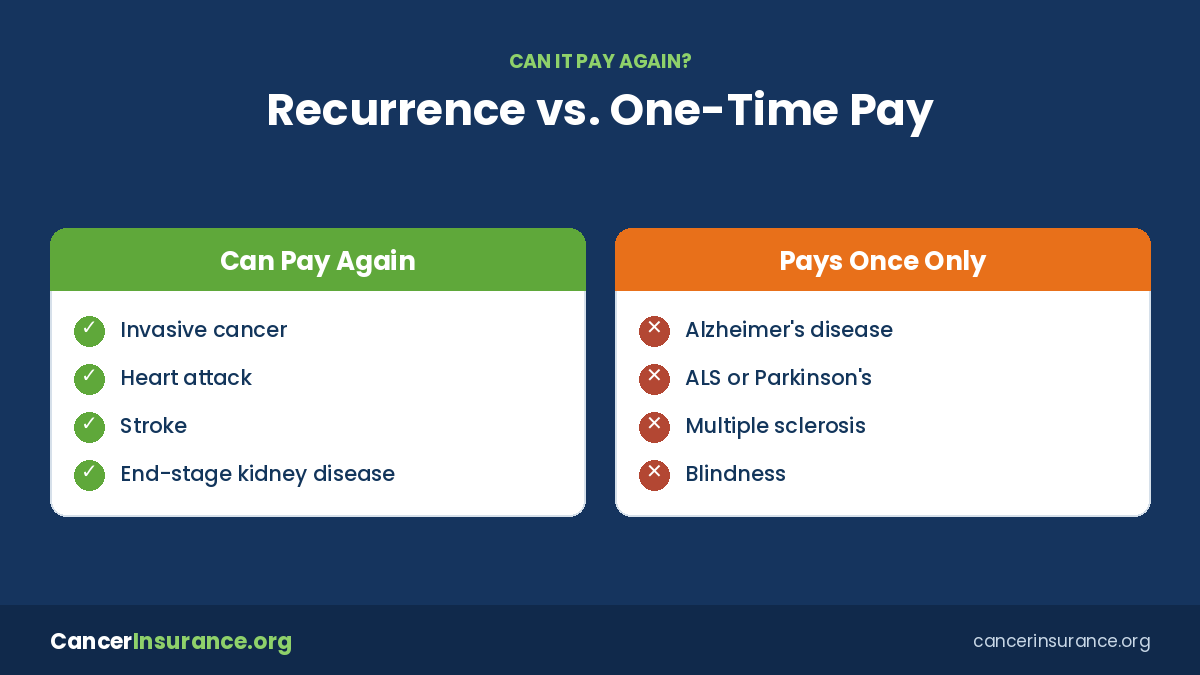
Cigna critical illness insurance conditions that can pay a recurrence benefit compared with those that pay only once

A Cigna certificate can pay several times, but two separate clocks control when. One applies to a new, different condition. The other applies when the same condition is diagnosed again.

1

First diagnosis. The initial benefit for that condition pays once per covered person, at the percentage on your summary.

2

A different condition. A second, unrelated condition can pay its own initial benefit if its diagnosis falls outside the separation period, which was 90 or 180 days in the plans we read.

3

The same condition again. A recurrence benefit can pay after 12 months have passed since the earlier diagnosis, if the condition is one that allows recurrence.

4

Conditions with no second payment. Alzheimer’s, ALS, Parkinson’s, MS and blindness pay only once, and major organ failure will not pay again for an organ already paid.

None of the summaries listed a lifetime maximum, so ask your benefits office whether one applies. The Xavier and Dartmouth summaries also exclude recurrence or spread of a cancer first diagnosed before coverage began.

Compare Critical Illness and Cancer Plans

Speak with a licensed insurance agent

1-888-891-0229

CancerInsurance.org logo

What It Costs, the Screening Benefit and Simple File Claims

Each employer group sets its own premiums. In Dartmouth’s 2026 summary, $10,000 of employee-only coverage ran from $1.88 a month under age 29 to $56.33 at 80 and older. In Highland Park ISD’s issue-age plan, the same amount cost $5.10 a month under 29 and $61.24 at 70 and older for non-tobacco users.

The yearly health screening benefit pays a flat $50 to $100 for a test such as a mammogram or certain blood work, whatever the test cost; virtual visits count. Cigna’s Simple File service can also help: with Cigna medical coverage, Cigna reviews your medical claims and reminds you to file an eligible claim, and with Cigna disability, life or AD&D coverage, eligible claims can be filed for you. It is based on a one-time review of the first claim, so later events are not flagged.

Enrollment check: Guaranteed issue limits usually apply to new hires who sign up during the first eligibility window. Electing more than the limit, or enrolling later, can require proof of good health that the insurer must approve.

Leaving Your Job, Older Cigna Policies and Other Choices

Taking it with you. The summaries let you continue 100% of coverage for everyone covered when your job coverage ends, as long as the person is under 100. Rates may change, and all coverage ends at 100. Texas and Vermont call this continuation.

Older individual Cigna policies. Cigna’s individual lump sum heart attack and stroke and cancer policies were issued by Loyal American Life, now part of HCSC and marketed as HealthSpring. Our Cigna cancer insurance page covers the cancer side.

Coverage bought in Asia. A Cigna policy bought in one of the six Asia-Pacific markets before July 2022 is now a Chubb policy, with its own local terms.

No Cigna plan at work. Cigna’s group plan is sold only through employers. Other carriers sell lump-sum coverage directly, as our cancer insurance providers list shows.

Before porting, compare the ported rate with a new individual policy, which may add a waiting period or health questions. To pay only for cancer, see our 5 best cancer insurance policies or compare quotes from our cancer insurance home page.

Bottom Line

Cigna critical illness insurance is a workplace benefit from Cigna Health and Life that pays 100% for invasive cancer, heart attack and stroke and less for early cancer and other listed conditions. Each employer sets the amounts, claim gaps and pricing, so your own summary decides what you get. Keep a health plan, and compare it with a cancer-only policy before you enroll.

Get Free Critical Illness Quotes

Speak with a licensed insurance agent

1-888-891-0229

CancerInsurance.org logo

Cigna Critical Illness Insurance — Frequently Asked Questions

➤ Can I buy Cigna critical illness insurance on my own?

Not as a standalone policy that we could find. Cigna sells critical illness coverage through employers, and its former individual heart attack, stroke and cancer policies are now marketed by HCSC as HealthSpring.

➤ Did Chubb take over Cigna critical illness policies in the U.S.?

No. Chubb’s 2022 purchase covered Cigna’s personal accident, supplemental health and life business in Korea, Taiwan, New Zealand, Thailand, Hong Kong and Indonesia, not U.S. group plans.

➤ What does Cigna pay for carcinoma in situ?

The four plan summaries we compared paid 25% of the elected amount for carcinoma in situ. Invasive cancer paid 100%, and basal or squamous cell skin cancer paid a flat $250 once per lifetime.

➤ How long must I wait between two Cigna critical illness claims?

A different condition must be diagnosed outside a separation period, 90 or 180 days in the plans reviewed. The same condition can pay a recurrence benefit after 12 months, where recurrence is allowed.

➤ Does a Cigna critical illness plan ask health questions?

Not up to the guaranteed issue amount, which was $20,000 or $30,000 for employees in the plans reviewed, if you enroll when first eligible. Higher amounts or late enrollment can require proof of good health.

➤ Will my Cigna critical illness premium go up as I age?

It depends on how your employer’s plan is rated. Attained-age plans raise the premium in older age bands, while issue-age plans tie it to your age at enrollment.

➤ Is the health screening benefit paid even if my test was free?

Yes. The summaries say it pays a flat amount once a year, $50 to $100 in the plans reviewed, regardless of the actual cost of the covered screening.

➤ Does Cigna critical illness insurance count as health insurance?

No. It is limited-benefit coverage that does not meet ACA minimum essential coverage rules and is not a Medicare or Medicaid supplement. It pays cash on top of a medical plan.

Cancer Insurance Quotes

Call a Licensed Agent Now

Compare cancer insurance plans and cash benefits from several insurance companies in one call.

☎ 1-888-891-0229

No obligation to buy

Ready to Compare? Get Free Cancer Insurance Quotes

Speak with a licensed insurance agent

1-888-891-0229

CancerInsurance.org logo

ZRN Health & Financial Services, LLC, a Texas limited liability company