




Speak with a licensed insurance agent

1-888-891-0229

Does Critical Illness Insurance Cover Cancer? Full, Partial and Zero Payouts by Diagnosis

Reviewed by Russell Noga, Licensed Insurance Agent — Last updated November 24, 2026

Key Takeaway

Yes, critical illness insurance covers cancer: most policies list invasive cancer as a covered condition and pay 100% of the lump sum when it is first diagnosed while coverage is in force. Carcinoma in situ paid 25% in all five employer plans reviewed here, non-melanoma skin cancer usually gets a small fixed amount, and some very early prostate and thyroid tumors pay a reduced benefit or nothing.

2027 by the Numbers

25%

carcinoma in situ payout in all 5 employer plan documents reviewed (Aflac, Aetna, Cigna, MetLife, ReliaStar)

$250 vs $1,000

one-time skin cancer benefit in the Cigna and Aetna employer documents reviewed

3 of 5

documents that move some early prostate tumors out of the full-benefit cancer tier

Cancer sits on the covered list of most critical illness policies sold in the US. The harder question is how much a policy pays for your specific diagnosis. A pathology report that says invasive ductal carcinoma triggers a very different check than one that says ductal carcinoma in situ, even though both are breast cancer.

This page walks through how a critical illness plan grades a cancer diagnosis, using five real employer plan documents filed by Aflac, Aetna, Cigna, MetLife and ReliaStar (a Voya company). Critical illness coverage is a supplemental, limited-benefit policy that pays cash on top of health insurance and does not replace it. For a broader look at the product, start with our critical illness insurance guide.

Compare Critical Illness Coverage

Speak with a licensed insurance agent

1-888-891-0229

CancerInsurance.org logo

How a Critical Illness Policy Grades a Cancer Diagnosis

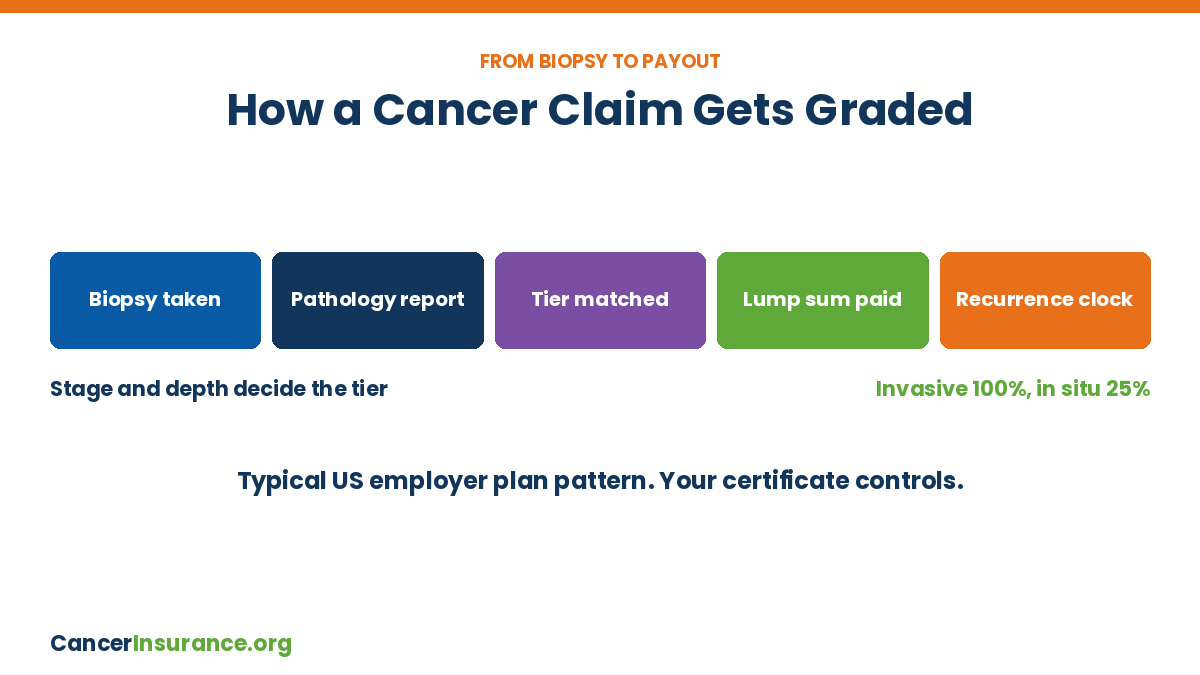
Does critical illness insurance cover cancer: path from biopsy to pathology tier to lump sum payout

A critical illness policy does not ask what your treatment will cost. It asks which box your diagnosis fits into, then pays the percentage tied to that box. Most US plans use the same basic tiers, although the wording and the exact figures change from insurer to insurer.

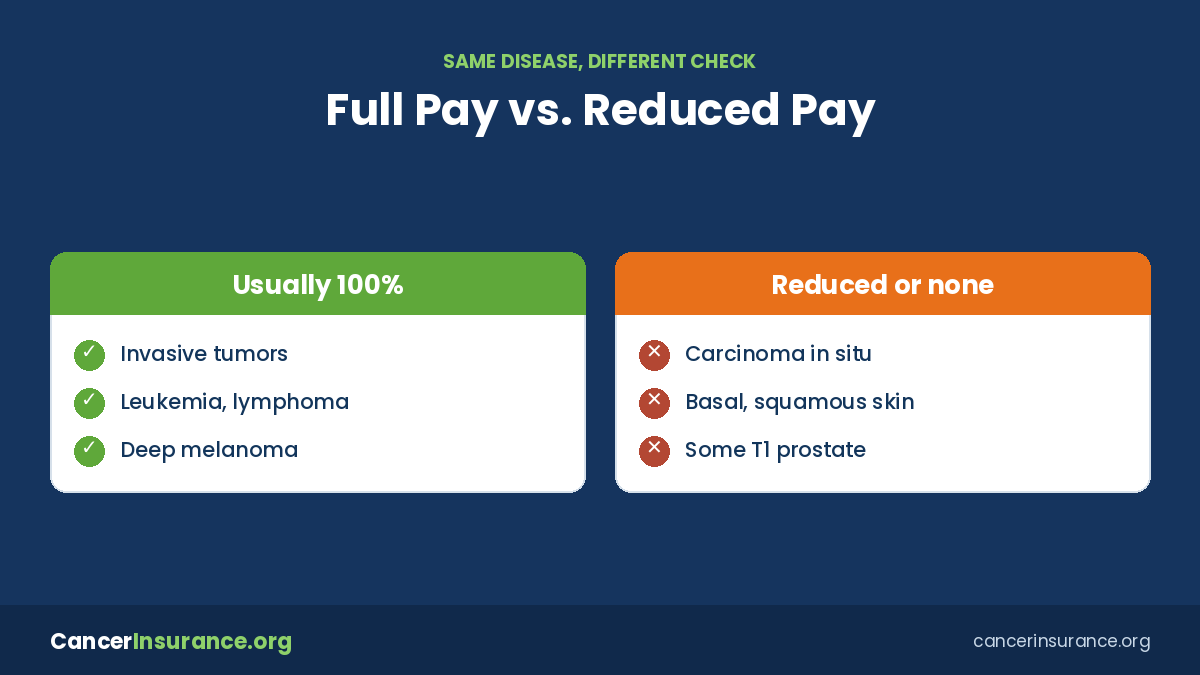
Invasive cancer. Malignant cells that have grown beyond where they started, plus most leukemias and lymphomas. This tier pays the full face amount you chose when you enrolled.

Carcinoma in situ. Cancer cells still confined to the site of origin. Plans call it non-invasive or partial-benefit cancer and pay a fraction of the face amount.

Skin cancer. Basal cell and squamous cell carcinoma, and very thin melanoma, are pulled out of the cancer tiers and paid a small fixed amount or percentage.

Carve-outs. Certain early tumors, pre-cancerous growths and benign tumors are named in the fine print and pay at a lower tier or not at all.

The tier is decided by the pathology report, not by how sick you feel or how much surgery you need. A small invasive tumor removed in one operation can earn the full benefit, while an in situ cancer that needs a mastectomy may still earn only the partial amount.

Cancer Insurance Quotes

Call a Licensed Agent Now

Compare cancer insurance plans and cash benefits from several insurance companies in one call.

☎ 1-888-891-0229

No obligation to buy

Five Employer Plans Side by Side: What Each Pays for Cancer

No single insurer publishes a comparison like this. The table pulls the cancer rules out of each company’s certificate or employer benefit summary so the differences sit in one place.

Plan documentInvasive cancerIn situSkin cancerEarly prostate tumorsCancer again later
Aflac group (Continental American), certificate C21101CA, University of CaliforniaFull benefit25%Amount in the certificate schedule, once per calendar yearTX, T0, T1a and T1b not covered as a critical illnessDiagnoses 6 months apart, plus 12 treatment-free months in complete remission
Aetna Life, CVS Health employee plan, form GR-96843100%25%$1,000, once per lifetimeNo prostate carve-out named100% if it recurs at least 180 days after the prior paid diagnosis
Cigna Health and Life, Dartmouth employee summary100%25%$250, once per lifetimeT1a, T1b and T1c (N0, M0) excluded from invasive cancer100% after a 12-month separation
MetLife, certificate GCERT19-CI, Sweeny ISD (Texas)100%25%5% of the benefit, at least $250, once per personT1a excluded; T1b and T1c paid at the 25% tier100% once, after 90 treatment-free days
ReliaStar (Voya), Stanislaus County certificate100%25%10% of the benefitIn situ and premalignant prostate lesions paid at the 25% tierRecurrence riders shown for the critical illness module; cancer recurrence not clearly stated

Our review of each document as published by the insurer or employer. Employer contracts and state versions differ, and the certificate you receive controls. Where a document did not state a rule, the cell says so.

Pattern worth noticing: The in situ figure was the one number all five documents agreed on. Skin cancer, early prostate tumors and second diagnoses were handled five different ways.

The Fine-Print Cancers That Pay Less or Nothing

Most articles on this topic stop at the in situ rule. The special exclusions lists in real certificates go further and name specific early tumors by their medical stage. These matter because early prostate and thin skin tumors are often found through routine checkups, before any symptoms appear.

Early prostate cancer. Tumors staged T1 are often found by a PSA test rather than felt on exam. Cigna’s summary removes T1a through T1c from its invasive cancer definition, and Aflac’s certificate does the same for TX, T0, T1a and T1b.

Small thyroid tumors. MetLife’s certificate excludes papillary, follicular or medullary thyroid tumors staged T1N0M0 or less and one centimeter or smaller, unless the cancer has spread.

Thin melanoma. Melanoma below a set Breslow depth is paid as skin cancer, not invasive cancer. The cutoff was 0.75 mm in the Aetna, Cigna and ReliaStar documents, 0.77 mm in Aflac’s and 0.80 mm in MetLife’s.

Bladder and blood conditions. MetLife’s list also excludes papillary bladder tumors staged Ta and myelodysplastic syndrome, along with any benign or pre-malignant growth.

None of these rules is hidden, but they sit pages away from the benefit schedule. If prostate, thyroid or skin cancer runs in your family, read the exclusions page of the certificate before you enroll, not after a diagnosis.

What Proof the Insurer Needs Before Cancer Pays

Does critical illness insurance cover cancer comparison of diagnoses that earn full pay versus reduced or no pay

Because the payout turns on the type of cancer, the claim turns on the paperwork that names it. Every document reviewed expects a tissue diagnosis first and allows exceptions only in narrow cases.

1

Pathology comes first. MetLife’s certificate asks for a pathological diagnosis based on microscopic examination of tissue, such as a biopsy, or of blood or bone marrow.

2

Clinical diagnosis is the backup. MetLife accepts a diagnosis without tissue only when a biopsy would be medically inappropriate or life-threatening. Aflac requires supporting medical evidence and a doctor actively treating the cancer.

3

The diagnosis date must fall inside coverage. Aetna’s summary states that the date of diagnosis must occur while coverage is in force. A cancer found before the effective date does not qualify.

4

Where you are diagnosed can matter. Aetna’s plan excludes cancer diagnosed or treated outside the United States and its territories.

Ask the treating doctor’s office for the final pathology report, including stage and any tumor depth or size figures. Those numbers decide which tier the claim lands in.

Compare Critical Illness Coverage

Speak with a licensed insurance agent

1-888-891-0229

CancerInsurance.org logo

When an Early Cancer Is Upgraded or Comes Back

A first pathology report is not always the last word. A biopsy that shows in situ cancer can be followed by surgery that finds invasion, and a treated cancer can return years later. Policies handle both events with separate rules.

Upgrade to a higher tier. MetLife treats an in situ cancer later found to be invasive as a related occurrence and pays the difference between the 25% already paid and the full amount.

Paid on top, not instead. Aflac’s certificate says its non-invasive benefit is payable in addition to all other applicable benefits.

Return after remission. Second cancer payments in the table needed anywhere from 90 treatment-free days (MetLife) to 12 treatment-free months (Aflac) before they apply.

Fact to confirm: Separation and treatment-free periods are counted from dates of diagnosis or the end of treatment, not the date a claim is filed. Our guide to early stage cancer insurance goes deeper on how partial benefits work.

Limits on Cancer Coverage Inside a Critical Illness Plan

Even a full cancer payout has edges. A critical illness plan pays a lump sum at diagnosis, then steps aside. It does not track chemotherapy sessions, radiation or hospital days the way a treatment-based cancer policy can.

Cancer waits longer. Individual policies often hold back cancer for a period after the start date. UnitedHealthcare’s critical illness page says a life-threatening cancer must be diagnosed more than 90 days after the effective date. See our critical illness insurance waiting period page.

Prior cancer is limited. ReliaStar’s certificate pays nothing in the first 12 months for a condition diagnosed or treated in the 12 months before coverage began.

One check per diagnosis. The lump sum does not grow with a long or costly course of treatment. A cancer-only policy can keep paying as treatment continues.

If cancer is the main worry, it is worth weighing a plan built only for cancer. Our comparison of cancer insurance vs critical illness lays out that choice, and you can browse cancer insurance plans to see treatment-based options.

Bottom Line

Critical illness insurance does cover cancer, but it pays by tier: the full amount for invasive cancer, 25% for in situ cancer in every plan reviewed here, and a small fixed sum for most skin cancers. Early prostate, small thyroid and thin melanoma tumors can fall into a lower tier or out of coverage entirely, so read the exclusions page along with the benefit schedule. Keep your health insurance in place, since this coverage only adds cash on top.

Get Free Critical Illness and Cancer Quotes

Speak with a licensed insurance agent

1-888-891-0229

CancerInsurance.org logo

Does Critical Illness Insurance Cover Cancer — Frequently Asked Questions

➤ Will a critical illness plan pay the full amount for DCIS breast cancer?

Usually not. Ductal carcinoma in situ is a non-invasive cancer, and all five employer documents reviewed pay 25% of the face amount for in situ cancer. If later surgery finds invasive cancer, some plans, such as MetLife’s, pay the difference.

➤ Are leukemia and lymphoma treated as cancer under critical illness insurance?

In the documents reviewed, yes. MetLife’s certificate names leukemia and lymphoma inside its invasive cancer definition, which pays 100%. The same certificate excludes myelodysplastic syndrome.

➤ Does critical illness insurance pay for melanoma?

It depends on depth. Melanoma that is deeper than the policy’s Breslow cutoff counts as invasive cancer and pays in full, while thinner melanoma is paid as skin cancer. The cutoff ranged from 0.75 mm to 0.80 mm in the plans reviewed.

➤ What happens if my in situ cancer is later found to be invasive?

Some plans pay the difference. MetLife’s certificate calls this a related occurrence and pays the gap between the 25% already paid and the full benefit. Check your own certificate, since not every plan states this.

➤ Can cancer be covered without a biopsy?

Only in limited cases. Plans expect a pathology report, but MetLife accepts a clinical diagnosis when a biopsy would be unsafe, and Aflac accepts one with supporting medical evidence and a treating doctor.

➤ Can a critical illness plan pay twice for cancer?

Many can, after a gap. Aetna’s CVS plan pays 100% again for a recurrence at least 180 days after the prior paid diagnosis, and Cigna’s summary pays 100% after a 12-month separation.

➤ Is early prostate cancer covered by critical illness insurance?

Often only partly. Cigna’s summary excludes T1a to T1c tumors from invasive cancer, Aflac’s certificate excludes TX, T0, T1a and T1b, and MetLife pays T1b and T1c at the 25% tier.

➤ Does critical illness insurance pay my chemotherapy bills?

Not directly. It pays one lump sum when a covered cancer is diagnosed, and you decide how to spend it. It is a supplemental, limited-benefit policy and does not replace health insurance.

Cancer Insurance Quotes

Call a Licensed Agent Now

Compare cancer insurance plans and cash benefits from several insurance companies in one call.

☎ 1-888-891-0229

No obligation to buy

Ready to Compare? Get Free Cancer Insurance Quotes

Speak with a licensed insurance agent

1-888-891-0229

CancerInsurance.org logo

ZRN Health & Financial Services, LLC, a Texas limited liability company