




Speak with a licensed insurance agent

1-888-891-0229

Term Critical Illness Insurance: How Long U.S. Coverage Lasts

Reviewed by Russell Noga, Licensed Insurance Agent — Last updated November 27, 2026

Key Takeaway

Term critical illness insurance is a lump-sum policy that covers you for a set number of years, such as the 10, 15, 20 or 30-year terms Mutual of Omaha sells, rather than for life. Most other U.S. critical illness coverage is either an individual policy that is guaranteed renewable for life or a workplace certificate that lasts only while you stay in the employer’s plan, unless you port it when you leave.

2027 by the Numbers

10 to 30 yrs

term lengths on Mutual of Omaha’s individual critical illness policy

Age 80

when ported coverage ends under The Hartford’s group critical illness portability policy

Age 100

when all coverage ends in Dartmouth’s 2026 Cigna group summary

Search for this phrase and most of what comes back describes Canadian, U.K. or Hong Kong products. American carriers rarely put the word term on a critical illness policy. The question underneath it is still a fair one: how long does the coverage last, can the price go up, and what makes it stop?

This guide answers that from the carriers’ own brochures, outlines and employer benefit summaries. If you are new to the product, start with our overview of critical illness insurance. Every policy below is supplemental, limited-benefit insurance. It pays a fixed amount of cash after a covered diagnosis and does not replace health insurance, Medicare or Medicaid.

Compare Critical Illness Coverage Options

Speak with a licensed insurance agent

1-888-891-0229

CancerInsurance.org logo

Fixed Term, Lifetime or Tied to a Job: The Three U.S. Shapes

Term critical illness insurance durations: fixed term, lifetime renewable, workplace certificate and ported coverage

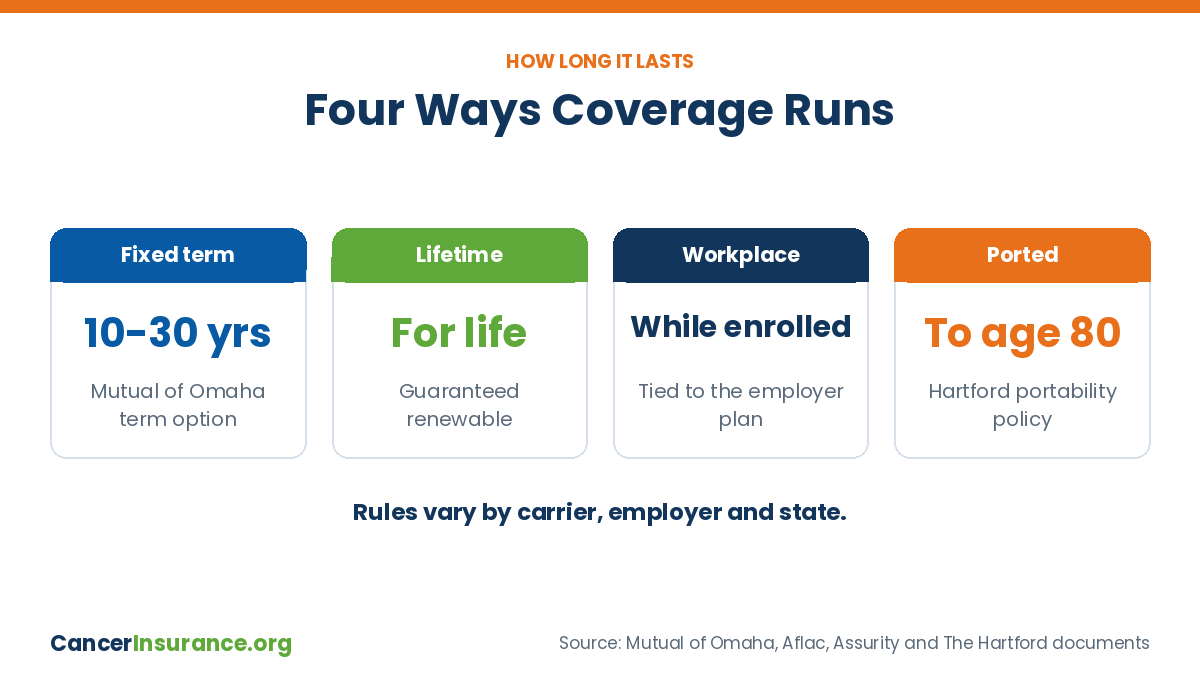
A U.S. critical illness plan usually lasts in one of three ways. A fixed-term individual policy runs for a set number of years. A lifetime individual policy keeps going as long as you pay, with the right to renew written into the contract. A workplace certificate lasts as long as you stay eligible and the employer keeps the group policy, which is why its real length depends on your job.

Mutual of Omaha is the clearest example of a true term product. Its critical illness policy comes as lifetime coverage or a term of 10, 15, 20 or 30 years. Its Critical Advantage overview lists issue ages of 18 to 54 for the term version and 18 to 64 for lifetime, and states there is no reduction of benefits at any age.

Read this line first: The policy’s renewability provision, often printed near the top of the outline of coverage, tells you how long the coverage can last. The brochure headline rarely does.

Cancer Insurance Quotes

Call a Licensed Agent Now

Compare cancer insurance plans and cash benefits from several insurance companies in one call.

☎ 1-888-891-0229

No obligation to buy

Guaranteed Renewable vs. Noncancelable: What Each Promise Covers

Two phrases decide whether an insurer can drop you or reprice you, and state insurance rules define them. Texas, for example, says a guaranteed renewable policy that is not also noncancelable must state that the insurer can change premium rates by class at renewal. Delaware’s rule says a noncancelable promise bars the insurer from changing any provision on its own during the guaranteed period.

Guaranteed renewable. The insurer must keep renewing while you pay on time and cannot single you out for a rate hike. Aflac’s Delaware outline for its lump sum critical illness policy says premiums can change only for every policy on the same form and rate class in that state.

Noncancelable. The insurer cannot cancel the policy or change its terms, including the premium, during the guaranteed period. The critical illness documents reviewed for this page used guaranteed renewable, not noncancelable.

Renewable for life. Assurity and Aflac both use this wording on their individual critical illness policies, and UnitedHealthcare says its Golden Rule CriticalGuard plans are guaranteed renewable for life in most states.

Minimum protection. For limited-benefit coverage, Texas requires a renewal guarantee to run to at least age 50, or at least five years for a policy issued after age 44. Policies can promise more.

Renewal, End Dates and Age Cuts in Nine Carrier Documents

No carrier publishes its duration rules next to a competitor’s. The table pulls them from one document per carrier. Group rows reflect a single employer’s plan, so the same carrier may write different terms for another employer.

Carrier (document)Renewal or rate basisWhen coverage endsAge-based benefit cutIf you leave a job
Mutual of Omaha individual (Critical Advantage overview)Term of 10, 15, 20 or 30 years, or lifetime; guaranteed renewable per the carrier’s siteTerm: end of the chosen term. Lifetime: no end age statedNone at any ageYou own it; a job change does not matter
Aflac individual (Delaware outline, B71000 series)Guaranteed renewable for your lifetime; class-wide rate changes onlyNo end age listedNone in the outlineYou own it
Assurity individual (product page)Guaranteed renewable for lifeNo end age listed50% at the anniversary after the later of age 70 or 3 policy yearsYou own it
MetLife group (Carnegie Mellon summary)Employer picks attained-age or issue-age ratesWhen premiums stop or the employer moves to similar coverage with another carrierNone listedPortable if you keep paying premiums
Cigna group (Dartmouth 2026 summary)Attained age in 10-year bandsAll coverage ends at 100None listedCan continue 100% of coverage if under 100; rates may change
The Hartford portability policy (Wellesley, Mass.)Attained-age step premiumsFirst day of the year after you reach 8050% at age 70, for you and a covered partnerMust be under 80; apply within 31 days
Unum group (Prince George’s County, Md.)Not statedNot stated50% at the first anniversary after age 70; premium does not dropTake it with you without health questions
Voya / ReliaStar group (Iowa public universities)Attained age; may rise at a new bandPer the certificateNone in the summaryDirect-billed at the same rates
Aflac group / Continental American (Clemson 2026)Not statedPlan ends, premium unpaid past 31 days, or you leave the eligible classNone mentionedMay be continued, with stipulations

From carrier product pages, outlines of coverage and employer-posted benefit summaries. Terms vary by state and employer; the policy or certificate controls.

Two patterns stand out. Individual policies are built to last and rarely list an end age, while group plans either run to a high age such as 100 or cut the benefit at 70. The Hartford’s ported coverage is the only document here that both halves the benefit and then ends it.

Issue-Age vs. Attained-Age Premiums Over Time

Issue-age vs attained-age premiums for term critical illness insurance and workplace plans

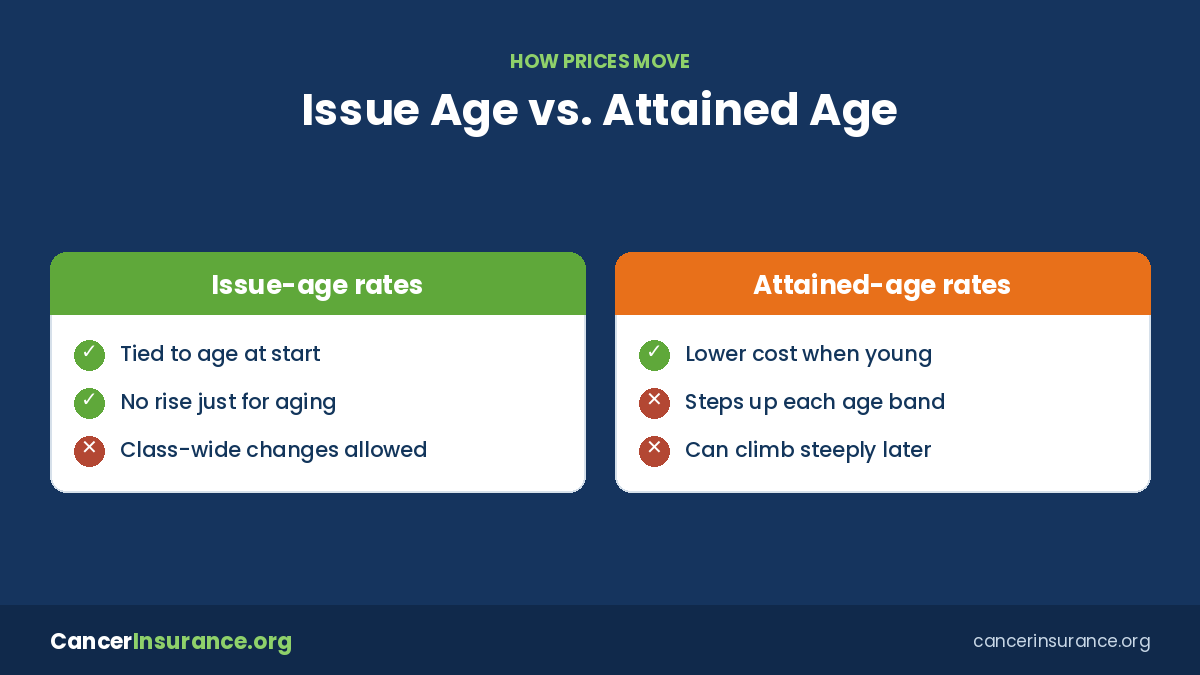
How long a policy lasts and how its price moves are linked. With attained-age rates, the premium is set by your current age band and climbs each time you cross into a new one. Dartmouth’s Cigna summary shows the effect: the employee-only cost for $10,000 of coverage rises from $1.88 a month under age 29 to $56.33 in the 80 to 89 band.

With issue-age rates, your premium stays tied to the age you were when coverage started. Carnegie Mellon’s MetLife summary says issue-age rates do not rise because you get older, but MetLife can still change rates for the whole class. A guaranteed renewable individual policy works the same way: no personal rate hike, but a possible filed increase for everyone on the form.

Price check at renewal: A low starting premium on an attained-age plan can look very different 20 years later. Ask for the full rate table, not just the rate for your current age.

Compare Critical Illness Coverage Options

Speak with a licensed insurance agent

1-888-891-0229

CancerInsurance.org logo

Porting a Workplace Plan Before It Lapses

A group certificate normally ends soon after you stop working. Unum’s Caltech summary ends employee coverage at the end of the month after your last day of active work. Portability lets you keep it by paying the insurer directly, but the rules are strict.

1

Find the deadline. The Hartford’s portability policy wants your request within 31 days of the group coverage ending and accepts none after 91 days.

2

Check the age limits. The same Hartford policy requires the primary insured to be under 80 and ends coverage after age 80. Cigna’s Dartmouth plan lets you continue only while under 100.

3

Confirm the amount. Hartford’s ported amount cannot exceed what you had and must be in $5,000 steps, with a $5,000 minimum. Cigna lets you carry 100% of coverage.

4

Compare the new bill. Voya’s Iowa summary bills you at the same rates. Hartford switches you to step premiums by age band, and Cigna says rates may change.

If porting is not offered or costs too much, an individual critical illness policy is the other route, though it usually requires health questions.

When the Benefit Is Used Up or the Policy Simply Stops

Coverage can also end for reasons that have nothing to do with a calendar. How a policy treats a full payout varies widely, so read the termination section before you buy.

After a full payout. Unum’s Prince George’s County summary says coverage can continue for the remaining covered conditions after a full benefit is paid. Other plans stop once a lifetime maximum is reached; see our guide to multiple critical illness insurance.

At the end of a term. Mutual of Omaha’s brochures list the term lengths but do not describe what happens at expiry. Ask for the policy’s termination and renewal wording before choosing term over lifetime.

When premiums stop. Missing payments past the grace period ends almost every policy reviewed. Aflac’s group summary allows 31 days.

On a term life rider. A critical illness rider usually lasts no longer than the term life policy it is attached to. Our page on critical illness riders covers how they pay.

For cancer-only coverage with its own duration rules, compare cancer insurance plans or browse cancer insurance providers.

Bottom Line

In the U.S., true term critical illness insurance is uncommon; Mutual of Omaha’s 10 to 30-year option is the main example. Most buyers choose between an individual policy that is guaranteed renewable for life and a workplace plan that lasts only as long as the job or a ported certificate. Check the renewal wording, the rate basis, any age-70 cut and the end age, and treat every option as supplemental cash, not health coverage.

Get Free Critical Illness Quotes

Speak with a licensed insurance agent

1-888-891-0229

CancerInsurance.org logo

Term Critical Illness Insurance — Frequently Asked Questions

➤ What does term mean on a critical illness policy?

It means the coverage runs for a fixed number of years instead of for life. Mutual of Omaha, for example, offers terms of 10, 15, 20 or 30 years alongside a lifetime option.

➤ What happens when a term critical illness policy expires?

The brochures reviewed do not say, so check the policy’s termination and renewal provisions. Do not assume you can renew or convert without new health questions unless the contract says so.

➤ Is guaranteed renewable the same as noncancelable?

No. Both stop the insurer from dropping you while you pay, but only a noncancelable policy also locks the premium. A guaranteed renewable policy can be repriced for everyone in your rate class.

➤ Can an insurer raise the price on my individual critical illness policy?

On a guaranteed renewable policy, yes, but only for a whole class. Aflac’s outline says changes apply to all policies on the same form and rate class in your state.

➤ Why did my workplace critical illness premium jump this year?

Your plan likely uses attained-age rates and you moved into a new age band. Issue-age plans avoid that, though the insurer can still change rates for the group.

➤ Will porting my work plan keep the same benefit amount?

Often, but not always. Cigna’s Dartmouth plan lets you continue 100% of coverage, while The Hartford caps the ported amount at your prior coverage and halves it at age 70.

➤ Does a critical illness policy end after it pays the full benefit?

Some do and some do not. Unum’s Prince George’s County plan says coverage can continue for the other covered conditions after a full payout.

➤ Does term critical illness insurance replace my health plan?

No. It is supplemental, limited-benefit insurance that pays cash after a listed diagnosis. You still need health insurance or Medicare for medical bills.

Cancer Insurance Quotes

Call a Licensed Agent Now

Compare cancer insurance plans and cash benefits from several insurance companies in one call.

☎ 1-888-891-0229

No obligation to buy

Ready to Compare? Get Free Cancer Insurance Quotes

Speak with a licensed insurance agent

1-888-891-0229

CancerInsurance.org logo

ZRN Health & Financial Services, LLC, a Texas limited liability company