




Speak with a licensed insurance agent

1-888-891-0229

MetLife Critical Illness Insurance: How It Pays for Cancer and Other Conditions

Updated October 2026

Key Takeaway

MetLife critical illness insurance is a group, limited-benefit policy sold mainly through employers that pays you a lump sum when you are diagnosed with a covered condition such as cancer, heart attack or stroke. It adds cash on top of your health plan but does not replace health insurance.

Many people first see MetLife critical illness insurance on their open enrollment screen at work. It is one of the most common voluntary benefits offered by employers, and cancer is one of the biggest reasons people file a claim on it. The policy is underwritten by Metropolitan Life Insurance Company, which AM Best rates A+ (Superior).

This guide explains what the coverage pays for cancer, how full and partial cancer benefits differ, when a recurrence is covered, what happens if you change jobs and how to file a claim. It also shows how a broad critical illness insurance plan compares with the standalone policies in our cancer insurance plans guide. Every employer plan is a little different, so always check your own certificate.

Compare Cancer and Critical Illness Plans

Speak with a licensed insurance agent

1-888-891-0229

CancerInsurance.org logo

What Is MetLife Critical Illness Insurance?

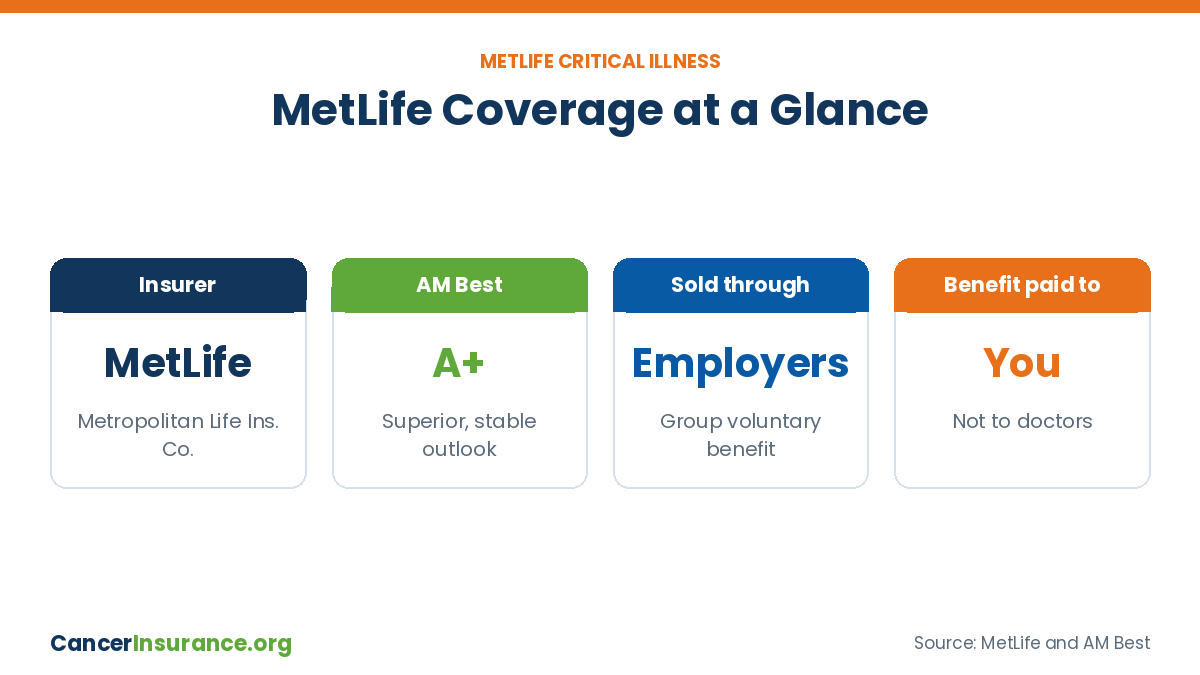
MetLife critical illness insurance at a glance: insurer, AM Best rating, how it is sold and who gets paid

MetLife critical illness insurance is a group policy that pays a one-time cash benefit when a covered person is diagnosed with a covered condition. The money is paid to you, not to your doctor or hospital, and you can spend it however you like. People often use it for deductibles, copays, travel to treatment, rent or lost pay while they recover.

Your employer picks the plan design. That includes the benefit amounts you can choose, which conditions are covered and whether rates are based on your age when you enroll or your current age. MetLife’s own materials show plan options such as $10,000, $20,000 or $30,000 at one employer, but your choices may be different.

Important: MetLife states that this coverage is not a substitute for medical coverage. It is supplemental, limited-benefit insurance that pays cash on top of your health plan. It does not pay your medical bills directly and does not replace employer, ACA Marketplace or Medicare coverage.

Cancer Insurance Quotes

Call a Licensed Agent Now

Compare cancer insurance plans and cash benefits from several insurance companies in one call.

☎ 1-888-891-0229

No obligation to buy

Conditions MetLife Critical Illness Insurance Covers

Each covered condition pays a set share of your initial benefit amount. The table below shows a typical layout from MetLife plan summaries. Your employer’s plan may use different percentages or a different list.

Covered conditionTypical share of initial benefitRecurrence benefit?
Full Benefit Cancer100%Yes, in many plans
Partial Benefit Cancer25%Yes, in many plans
Heart attack100%Yes, in many plans
Stroke (severe stroke in some states)100%Yes, in many plans
Coronary artery bypass graft or coronary artery diseaseVaries by planVaries by plan
Kidney failure, major organ transplant, Alzheimer’s disease100%Usually no
A list of other named conditions, such as multiple sclerosisOften 25%No

Based on MetLife plan summaries and certificates published by several employers. Percentages, the condition list and state rules vary, so your certificate controls.

Plans also set a total benefit cap, which is a multiple of your initial benefit, such as three or five times. Once total payments reach that cap, the coverage pays nothing more. Some plans also cut benefits by 25% at age 65 and 50% at age 70.

How MetLife Critical Illness Insurance Pays for Cancer

Cancer is split into tiers. The tier depends on how far the cancer has spread and how it is treated, based on the pathology report and staging from your doctor.

Full Benefit Cancer. Invasive cancer that spreads into normal tissue and needs surgery, radiation or chemotherapy, has spread to other parts of the body, or is terminal. Typically pays 100% of your benefit.

Partial Benefit Cancer. Early cancers such as carcinoma in situ that needs treatment, some tumors removed by endoscopy alone, very thin melanomas and certain early prostate cancers. Typically pays 25%.

Skin cancer. Most non-melanoma skin cancers are left out of the full and partial tiers. Some plans pay a small separate skin cancer benefit.

Cancer before coverage. A cancer diagnosed before your coverage start date is not covered.

A recurrence benefit can pay again if the same cancer comes back, but only if an initial benefit was paid first. Plans use a benefit suspension period, which is 365 days in at least one MetLife certificate, and you generally must have had no symptoms of or treatment for that cancer during that time. Some plans pay the full benefit again for a recurrence and others pay half, so check your plan summary.

MetLife Critical Illness vs. a Standalone Cancer Policy

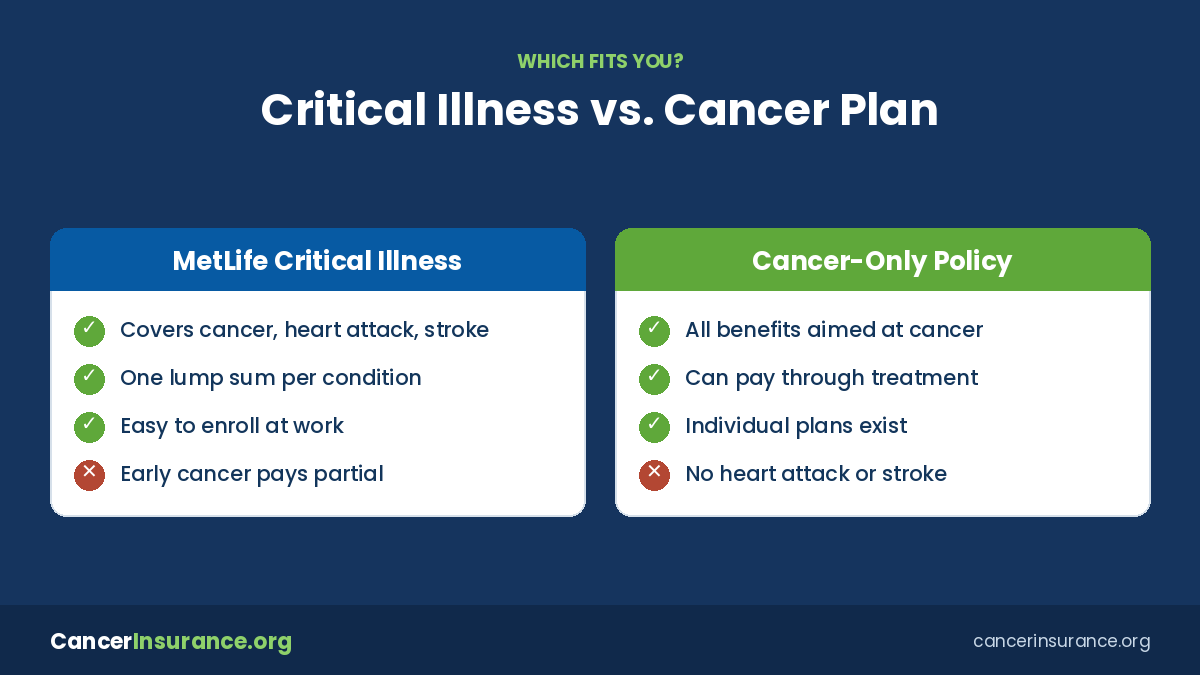
MetLife critical illness insurance compared with a standalone cancer insurance policy

Critical illness insurance spreads one benefit pool across many conditions. A standalone cancer insurance policy focuses only on cancer and may pay more ways, such as per day in the hospital or per round of treatment. MetLife also offers a separate workplace cancer insurance product that includes only the cancer conditions from its critical illness policy.

If your biggest worry is cancer, a cancer-only plan may give you more cancer coverage for the same premium. If you want one check for heart attack, stroke and cancer, a critical illness plan is broader. For a deeper look at the trade-offs, read cancer insurance vs. critical illness.

Broker tip: Some people carry both: workplace critical illness for broad protection and an individual cancer policy that stays with them no matter where they work. Make sure the combined premium still fits your budget.

Compare Cancer and Critical Illness Plans

Speak with a licensed insurance agent

1-888-891-0229

CancerInsurance.org logo

Who Can Get It and What Happens When You Leave Your Job

MetLife describes this coverage as a group benefit offered through employers, and some membership groups offer it too. We could not confirm an individual MetLife critical illness policy you can buy on your own, so if your job does not offer it, look at individual plans instead. Our 5 best cancer insurance policies list is a good place to start.

1

Enroll at work. Sign up during open enrollment or when you are first eligible. Many plans need no medical exam or health questions if you are actively at work.

2

Add family. Spouses, domestic partners and children can often be covered, frequently at a share of your benefit, such as 50%. Rules vary by state.

3

Watch for exclusions. Some plans have a pre-existing condition exclusion, and some states require you to have medical coverage to enroll.

4

Keep it if you leave. MetLife lets many members continue coverage after a job change or retirement by paying premiums directly. You usually must ask in writing within a set time.

Portability has limits. For example, one MetLife certificate says continued coverage is not available if your group coverage ended because you stopped paying premiums. Ask your benefits office for the deadline before your last day.

How to File a MetLife Critical Illness Claim

Filing is fairly simple, but missing paperwork is the most common reason for delays. Here is how the process usually works.

1

Get your diagnosis in writing. Ask your doctor for the pathology report and the date of diagnosis.

2

Start the claim. File through MetLife’s MyBenefits website, the MetLife mobile app or a paper claim form, depending on your employer’s setup.

3

Add the physician statement. Your doctor completes a section that confirms the condition and diagnosis date.

4

Submit and track it. MetLife says claims are generally processed within 10 business days once it has everything it needs.

5

Receive your payment. Benefits are paid to you by direct deposit or check.

Don’t forget: Many MetLife plans include a yearly health screening benefit, often $50 in plan summaries we reviewed, for tests such as a mammogram or colonoscopy. It is not offered in every state, but it can partly offset your premium. For more on paperwork, see our cancer insurance claim steps.

Bottom Line

MetLife critical illness insurance is a solid, A+ rated workplace benefit that pays cash for cancer, heart attack, stroke and other covered conditions. Know that early cancers often pay only part of the benefit, recurrence rules have waiting periods and the details depend on your employer’s plan. Because it is limited-benefit coverage, pair it with real health insurance and compare it with a cancer-only policy before you decide.

Related: Prudential critical illness insurance How Prudential’s workplace plan pays for cancer, travel extras and portability.

Related: Voya critical illness insurance How ReliaStar’s workplace plans pay for early, invasive and repeat cancer.

Get Free Cancer Insurance Quotes

Speak with a licensed insurance agent

1-888-891-0229

CancerInsurance.org logo

MetLife Critical Illness Insurance — Frequently Asked Questions

➤ Does MetLife critical illness insurance cover cancer?

Yes. Most MetLife plans cover cancer in two tiers: Full Benefit Cancer, which typically pays 100% of your benefit, and Partial Benefit Cancer, which typically pays 25%. Not every type of cancer is covered, and most non-melanoma skin cancers are excluded from those tiers.

➤ Does it pay for carcinoma in situ?

Carcinoma in situ that needs treatment usually falls under Partial Benefit Cancer. That means it pays a smaller share of your benefit, often 25%, rather than the full amount.

➤ Will MetLife pay if my cancer comes back?

Many plans include a recurrence benefit, but only after an initial benefit was paid and a benefit suspension period has passed. You generally must have had no symptoms or treatment for that cancer during that period.

➤ Can I keep MetLife critical illness insurance if I leave my job?

Often, yes. MetLife offers continuation of coverage when you change jobs or retire, as long as you request it in time and keep paying premiums. Eligibility rules and limits apply.

➤ Can I buy MetLife critical illness insurance on my own?

MetLife sells this coverage mainly through employers and some groups. If you cannot get it through work, an individual cancer or critical illness policy from another carrier is usually the option.

➤ How long does a MetLife critical illness claim take?

MetLife says claims are generally processed within 10 business days after it receives all the required information. Payment goes straight to you by direct deposit or check.

➤ Does MetLife critical illness insurance replace health insurance?

No. MetLife says it is not a substitute for medical coverage. It is a limited-benefit supplemental policy that pays cash on top of your employer plan, ACA plan or Medicare.

➤ What is MetLife’s AM Best rating?

AM Best rates Metropolitan Life Insurance Company, the insurer behind MetLife critical illness insurance, A+ (Superior) with a stable outlook.

Cancer Insurance Quotes

Call a Licensed Agent Now

Compare cancer insurance plans and cash benefits from several insurance companies in one call.

☎ 1-888-891-0229

No obligation to buy

Ready to Compare? Get Free Cancer Insurance Quotes

Speak with a licensed insurance agent

1-888-891-0229

CancerInsurance.org logo

ZRN Health & Financial Services, LLC, a Texas limited liability company